Three-Bean Salad with Fresh Herbs

After salad greens go to seed, my salads become heartier, with varieties of snap and dried beans and fresh herbs standing in for greens. Learn more at TwiceasTasty.com.
By the time the garden’s snap beans are ready, many of its salad greens have gone to seed. But that doesn’t mean I stop making salads. Instead, my salads become heartier, with varieties of snap and dried beans and fresh herbs standing in for greens. I share one of my favorite renditions, a three-bean salad with homemade Creamy Balsamic Salad Dressing, this week in my Twice as Tasty column for the Flathead Beacon.

Like all salads, you can adapt this one to the seasons and the ingredients you have on hand. My favorite cheeses for this salad include Cold-Smoked Mozzarella and Homemade Farmer’s Cheese. When I’ve put the garden to bed for the season, I still make this salad with the Classic Dilly Beans or the Szechuan-Peppered Snap Beans in my pickling cookbook. When even my herbs have died back for the year, my stockpile of homegrown and dried herbs provides plenty of flavor.
Learn to make Three-Bean Salad with Fresh Herbs

Green Goddess Salad Dressing

This creamy avocado-based dressing appeals to many dietary needs: vegan, gluten free, keto friendly, and more. Learn more at TwiceasTasty.com.
I’m such a lover of all things pickled and fermented that most of my salad dressings start with vinegar and oil. So when I was asked to create some condiments for a large dinner a few years back, I knew I needed to branch out not just with a creamy choice but also one that would appeal to as many dietary needs as possible: vegan, gluten free, keto friendly, and more. That’s why the salad dressing I share this week in my Twice as Tasty column for the Flathead Beacon eschews the original mayonnaise and other dairy-heavy renditions in favor of a dairy-free, avocado-based blend.

Avocados have grown in popularity as a nondairy fat replacement in baked goods—the same way I often replace oil and butter in quick breads with applesauce. I occasionally use avocados in this way, especially when making desserts for vegan friends. But I typically eat avocados sliced fresh, such as on corn tortillas with Crispy Sprouted Lentils, or turn them into Grilled Onion Guacamole. I even have a recipe for pickling them in my pickling cookbook. If you like tangy salads, try the pickled avocado slices in the green goddess dressing.
Learn to make Green Goddess Salad Dressing

Grilled Tomato Bloody Mary Mix

Over the years, I have fine-tuned a balance between chunky salsa in a glass and thin, overly drained juice to create intensely flavored bloody Mary mix. Learn more at TwiceasTasty.com.
If you’ve been following the Twice as Tasty blog from the beginning, you might remember how the entire idea of writing a food blog started with my grilled tomato recipes, especially the bloody Mary mix recipe that I share this week column for the Flathead Beacon. The recipe has improved with every season as I fine-tuned a balance between chunky salsa in a glass and thin, overly drained juice. For a long time, I blended some tomato solids back into the juice, but this left slightly chewy bits and too many seeds. I’ve finally settled on using a large-holed colander to separate juice and solids and then pressing the result through a fine-mesh strainer to leave just the seeds behind.

This recipe has also evolved from one I jarred and sealed in a boiling water bath to one I prefer to make in batches from the freezer. The frozen juice tastes fresher, and it keeps the smoky tomato juice on hand for easy winter lunches like Tomato Juice Soup.
Learn to make Grilled Tomato Bloody Mary Mix

Stuffed Squash Blossoms

Handle squash blossoms with care as you harvest them, and you can fill their cavity and fry them. Learn more at TwiceasTasty.com.
If you’re the type of person who picks honeysuckle blossoms on the trailside to taste drops of their sweet nectar, start looking around your garden for other edible flowers. The most obvious will likely be squash blossoms to stuff and fry, as I share this week in my Twice as Tasty column for the Flathead Beacon.

Squash blooms have delicate petals atop a stiff base, so handle them with care as you harvest them and fill their cavity. Cut them off where the green stem base meets the main plant, but wait to cut off the stems and remove the stamen, which can taste bitter, as you prep them for shallow pan frying.

Most edible garden blooms wilt quickly, so it’s best to use them as soon as you harvest them. But since I recommend a midmorning harvest, you can keep squash blossoms in a cool, dry place, or in a pinch in the refrigerator, if you won’t serve them until the evening. You might be able to get away with holding them over for a day to use as garnish, but they will be challenging to stuff and rip easily. If you do tear one down its side, fill it carefully and then try using a drop of batter almost like glue to hold it together until it hits the sauté pan.
Learn to make Stuffed Squash Blossoms

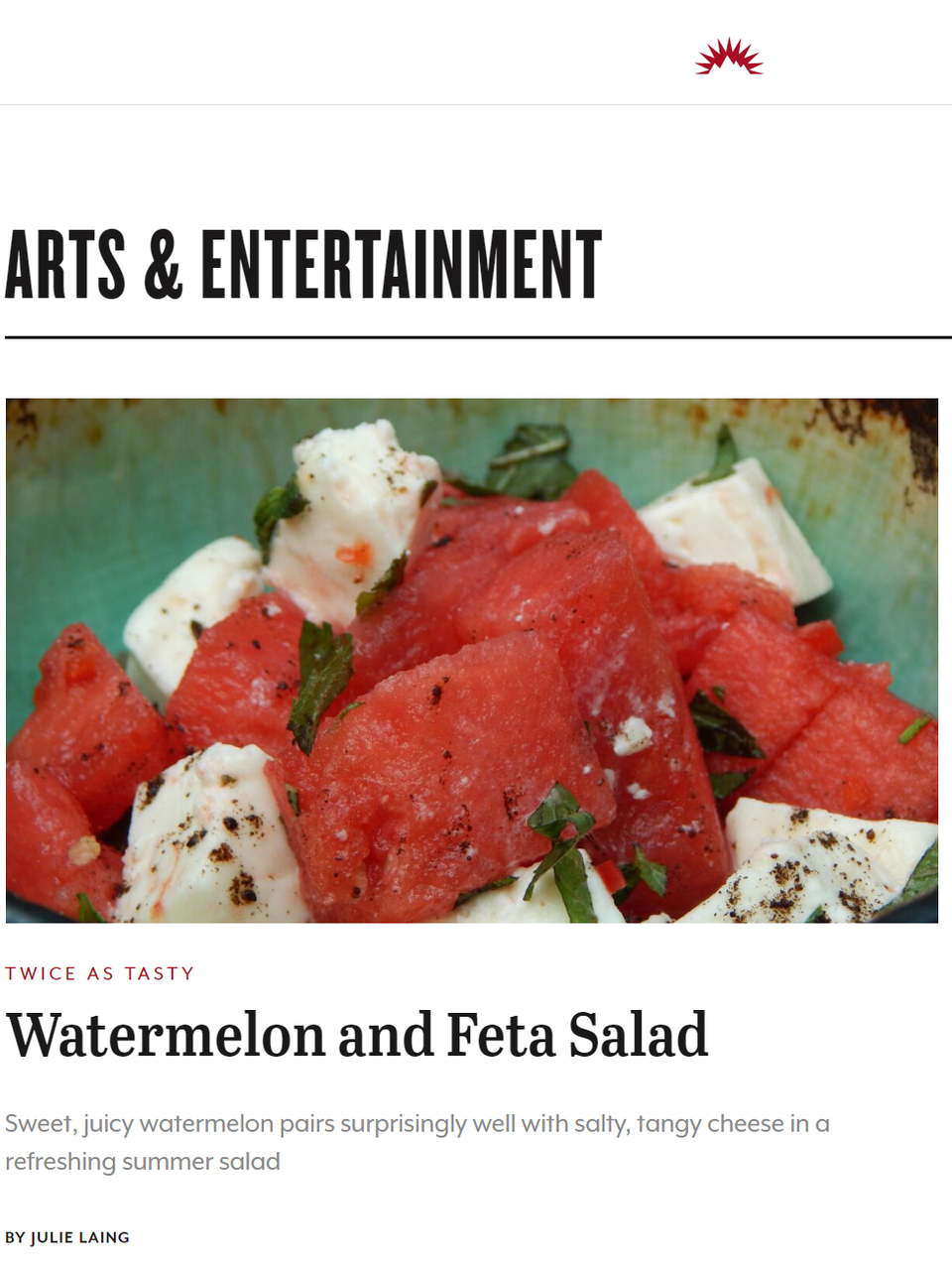
Watermelon and Feta Salad

Get right to the heart of summer by pairing sweet, juicy watermelon with tangy, salty feta cheese—especially homemade dry-salted feta. Learn more at TwiceasTasty.com.
The recipe I share this week in my Twice as Tasty column for the Flathead Beacon gets right to the heart of summer, pairing sweet, juicy watermelon with tangy, salty feta cheese. Like many of my favorite recipes that use feta, you can buy a high-quality block in brine for this salad. I like a creamy Bulgarian sheep’s milk feta, which holds its shape well, or the sharp taste of Greek sheep’s milk feta alongside the sweet melon.

My favorite pairing is homemade Dry-Salted Feta. Even when I use whole cow’s milk instead of milk from goats or sheep, it has far superior flavor and texture to the crumbly, dry store-bought American feta made from skimmed cow’s milk. The hardest part about making feta is holding the milk at a steady temperature for a couple of hours—a challenge that is far easier amid summer’s heat than during freezing winter months.
Learn to make Watermelon and Feta Salad

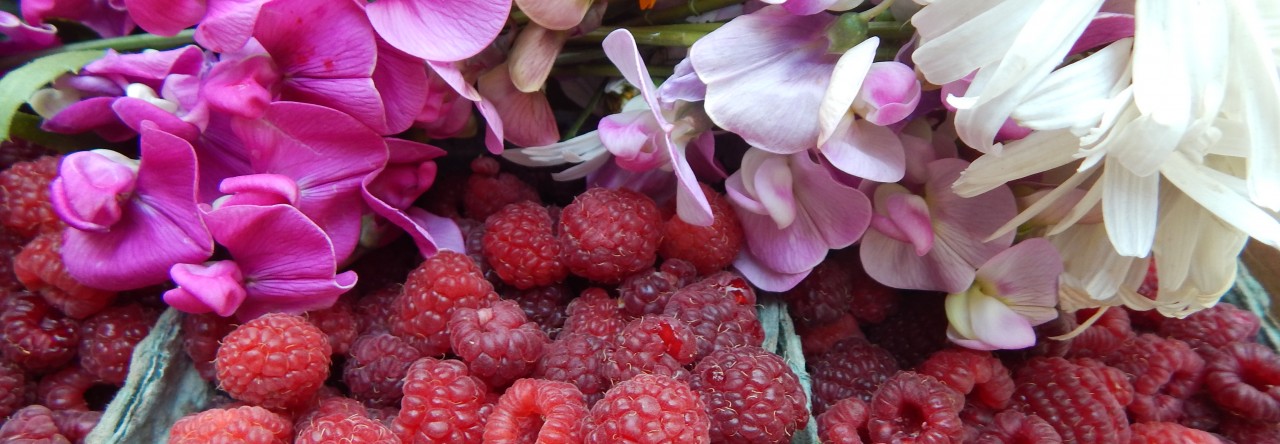
Raspberry Vinaigrette

You can blend fresh raspberries into this vinaigrette, but it’s also ideal for using up roasted raspberry pulp. Learn more at TwiceasTasty.com.
My favorite salads might start with a bed of greens, but then I pile on the vegetables and other toppings. Because the layers give the salad so much flavor and texture, I rarely bother with more than a simple dressing of vinegar or citrus juice, oil, and an emulsifier like mustard or garlic.

But a three- or four-ingredient salad can handle an intensely flavored dressing, like the one I share this week in my Twice as Tasty column for the Flathead Beacon. This berry dressing can turn the bed of greens, early onions, and the last of my storage carrots into a delicious lunch or side salad.

You can blend fresh raspberries into this vinaigrette, but it’s also ideal for using up the pulp left after making Roasted Raspberry Syrup or the Roasted Raspberry-Thyme Shrub in my cookbook, The Complete Guide to Pickling.
Learn to make Raspberry Vinaigrette

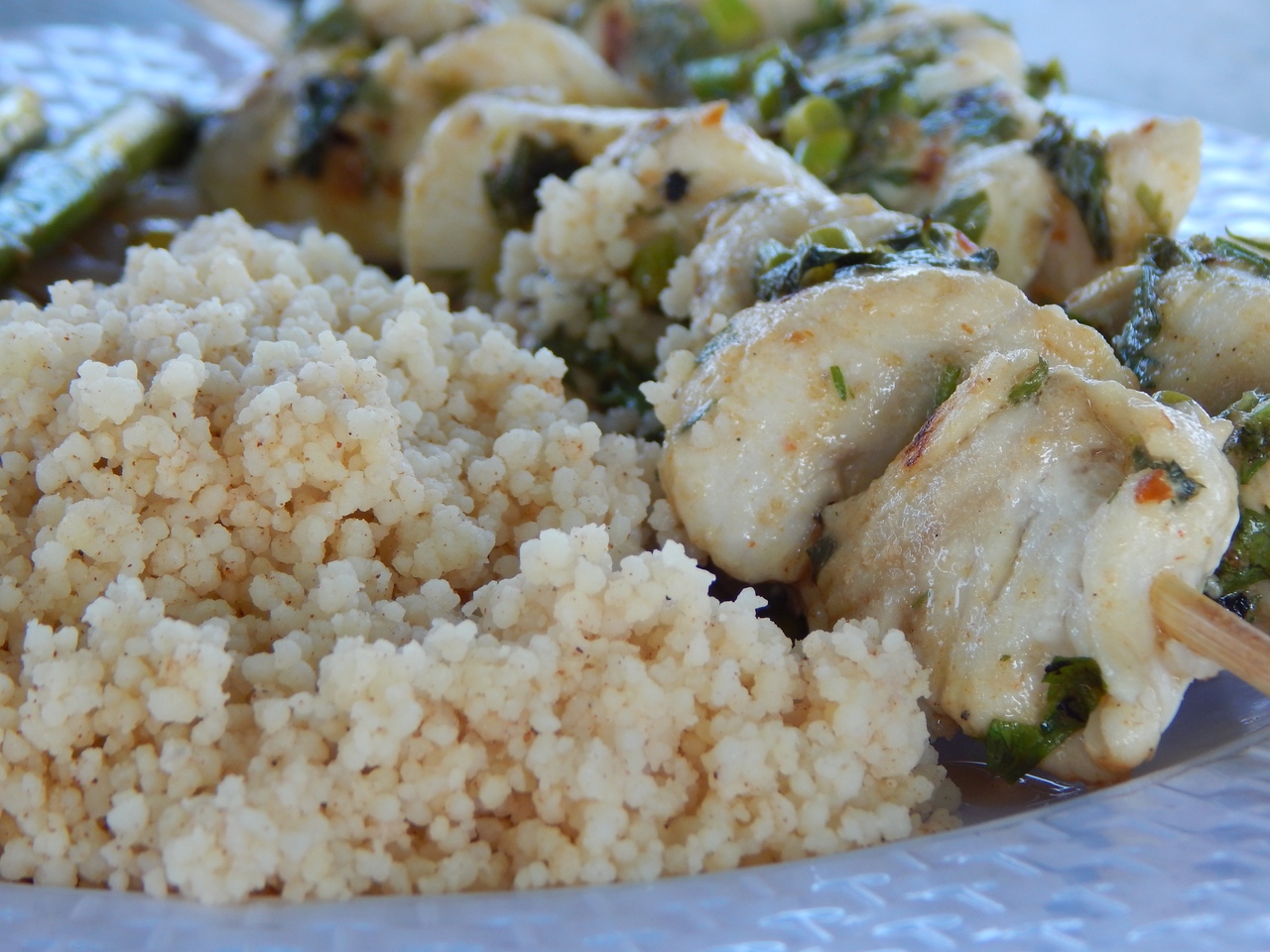
Chickpea and Vegetable Couscous Salad

Instant couscous has become one of my staple grains not just at home but for lakeside picnics and onboard dinners. Learn more at TwiceasTasty.com.
Once I accepted that I was never going to justify housing a giant couscoussière in my tiny Montana kitchen and using its vastness, sized for the average Moroccan family, to feed my household of two, instant couscous became a staple grain not just at home but for lakeside picnics and onboard dinners. We recently wrapped up a two-week sailing adventure aboard The Blue Mule in the San Juan and Gulf Islands, and the couscous recipes I’ve been sharing in my Twice as Tasty column for the Flathead Beacon were part of our cruising menu.

The little grains cook so well in just-boiled water that I keep a collapsible silicone container with a tightly sealing lid in my galley box. I pour the couscous into it, add a pat of butter and sprinkling of cinnamon and salt, and then pour JetBoil-heated water on top and seal the container. For dinner before an evening sail on Flathead Lake, I use the same technique but boil the water on my kitchen stove and take it to the lake in a thermos.
Learn to make Chickpea and Vegetable Couscous Salad with Pour-Over Cinnamon Couscous

Herbed Bean Salad

 After several evolutions, this salad has become a spring favorite, tossing warm beans with the first lettuces and herbs to appear in my garden. Learn more at TwiceasTasty.com.
The other day, I was asked how I come up with my recipes. The inspiration varies, but they’re like jazz tunes: once published, I continue to play and let them evolve. The recipe in my latest Twice as Tasty column for the Flathead Beacon is among those that I’ve been riffing on for years.

The salad began as a way to use some of my favorite homemade condiments, which I later included in my cookbook, The Complete Guide to Pickling: the bright pink vinegar and softened flowers of Pickled Chive Blossoms, the complementary flavor of German-Inspired Spicy Mustard, and Pickled Nasturtium Seeds as the homegrown stand-in for capers. To feature Quick Homemade Mozzarella, I plated the salad in layers with slices of fresh cheese and encouraged my cheese-making workshop students to do the same. Then I revised the recipe to share with buyers of vertically farmed fresh greens, using it to showcase the brand’s baby spinach, arugula, and chard. When the company shut down, I altered the recipe again, tossing the warm beans with the first lettuces and herbs to appear in my garden each spring: spinach, arugula, butter lettuce, chives, and sorrel.
Learn to make Herbed Bean Salad

Warm Quinoa and Feta Salad

There’s something special about salads made with spring's first herbs and greens from plants that bravely withstand 50°-plus temperature swings. Learn more at TwiceasTasty.com.
We’ve had our usual cyclic spring weather in Montana, with a high of 76°F on Sunday followed by nights in the 20s. It makes me appreciate even more the first spring greens and herbs that eagerly pop through the sun-warmed soil and then tough out the crisp nights and frosty mornings. As I share this week in my Twice as Tasty column for the Flathead Beacon, my first spring salads mainly consist of store-bought ingredients and sneak in handfuls of whatever garden treats appear first for fresh pops of green.

I make variations on these spring salads throughout the growing season, transitioning to homegrown summer vegetables and herbs as the weeks pass. But there’s something special about the ones made with those first perennial and self-seeded herbs and greens, the plants that bravely leaf out through 50°-plus temperature swings.
Learn to make Warm Quinoa and Feta Salad

Weeknight Pasta with Roasted Pumpkin and Parmesan

I can’t think of a better way to celebrate the arrival of spring than with last season’s harvest. Learn more at TwiceasTasty.com.
When spring arrives, I start watching bulbs grow by the hour—and inspecting my storage vegetables for their waning freshness. Over time, I’ve become better at choosing varieties that keep well, curing them properly, and storing them so that they stay fresh and usable for many months. By the first day of spring, I still have dry-stored vegetables tucked away. As I dig through the stash, I usually find one surprising keeper that has held on longer than in any other year.

This year, it was winter squash, as I share this week in my Twice as Tasty column for the Flathead Beacon. I just made the column’s recipe with the last of my delicata squash, swapping it for the pumpkin. I’ve been growing long-keeping onions, which I used instead of shallots, and am still enjoying a small basket of garlic just making its first attempts to sprout. My supply of homegrown and dehydrated herbs has begun to wane but will see me through until the next crop. I can’t think of a better way to celebrate the arrival of spring than with last season’s harvest.
Learn to make Weeknight Pasta with Roasted Pumpkin and Parmesan