
Roasted Golden Beet and Garlic Salad

I often wait until fall to make beet salad, but it really can be made with the season’s first beets. Learn more at TwiceasTasty.com.
I plucked my first beets in August, but somehow I always think of them as a fall crop. Earlier in the summer, I toss them into all sorts of mixed-vegetable recipes and no-recipe-required meals. They then become pickles when a large batch is ready; they keep so well in vinegar that I included four beet recipes, from quick to canned, in The Complete Guide to Pickling. Yet I often wait until fall to make the salad I share this week in my Twice as Tasty column for the Flathead Beacon.

The wait is primarily for our apples to fully ripen. Even though I like slightly tart ones in this salad, the ones on our trees typically have a starchy, chalky texture when picked too early. If you’re buying apples or grow ones that ripen early, this salad really can be made with the season’s first beets.
Learn to make Roasted Golden Beet and Garlic Salad

Panzanella (Tomato and Bread Salad)

Late summer salads burst with color yet greens have likely bolted. That’s my excuse for tossing in chunks of homemade sourdough bread. Learn more at TwiceasTasty.com.
If you grow your own vegetables, spring salads feature shades of green: various lettuces, herbs, asparagus, scallions, and peas. Late-summer salads burst with color, but most of my lettuces have bolted by the time tomatoes, cucumbers, peppers, and red onions are ready. At least that’s my excuse for replacing greens with chunks of homemade sourdough bread that can soak up the tomatoes’ juices and oil-and-vinegar dressing.

I share my favorite variation of panzanella, a tomato and bread salad, this week in my Twice as Tasty column for the Flathead Beacon. It’s heavy on late-summer and early-fall vegetables and herbs, but I also throw in cheese and Kalamata olives. If your garden or farmer’s market features other produce, you can swap in plenty of other ingredients, drop the cheese for a vegan option, and replace the olives with capers or skip them altogether for less tang.

For a solo lunch, I use this recipe as a guideline when piling all of the ingredients straight into the bowl I’ll be eating from, only stopping when I reach the end of the list and the bowl is overflowing. The key is to start with a base of bread and tomatoes and build from there.
Learn to make Panzanella (Tomato and Bread Salad)

Arugula Salad with Asparagus and Shaved Parmesan

Homegrown greens have flavor that is muted or missing from store-bought ones. Learn more at TwiceasTasty.com.
One of my favorite things about the start of garden season is clipping the first homegrown spring greens. If you grow lettuce, spinach, arugula, or other greens, you know what I’m talking about. If you don’t, I highly recommend getting a few seeds and giving it a try. Homegrown greens have flavor that is often muted or missing from store-bought ones, and you can buy seeds in varieties that grocery stores won’t carry. These seeds grow easily in the ground or in pots. My sister seeds two “lettuce bowls”—wide, low plastic pots—for my parents each year that sit in the shade on their porch all summer. When the supply gets low, they simply pull the straggly plants and tuck in a few new seeds.

My homegrown lettuces and other greens mainly land in salads, as I share this week in my Twice as Tasty column for the Flathead Beacon. I also tuck them into tacos and sandwiches, fold them into hot pasta or curry, and pair them with eggs.
Learn to make Arugula Salad with Asparagus and Shaved Parmesan

Best DIY Salad Dressing

Using a basic ratio, you can make so many dressings in under 60 seconds. Learn more at TwiceasTasty.com.
After the heat of summer sent lettuces bolting, recent cool fall temperatures and rain mean salads are back. If you don’t grow your own salad fixings, you may not have noticed the shift from sweet, tender greens to bitter, coarse leaves. But home gardeners will be well aware of the change and have transitioned from lettuce-based salads to ones featuring heat-tolerant or late-season vegetables.

In a piece for Clean Pates earlier this summer, I shared my technique and ratio for making a collection of salad dressings. Even if you don’t grow salad greens, I’m a firm believer that you should make your own dressings. Among disappearing food traditions, one of the most lamentable is scratch-made salad dressing. As Mark Kurlansky writes in The Food of a Younger Land, “What could better spell the beginning of the end than bottled salad dressing, the manufacture of a product that was so easy to make at home?”

Easy is right: Using a basic ratio, you can make so many dressings. A pinch of this and dab of that completely change a dressing’s flavor. My technique clocks in under 60 seconds, and I can now eyeball the proportions without even dirtying measuring spoons.
Learn to make the Best DIY Salad Dressing

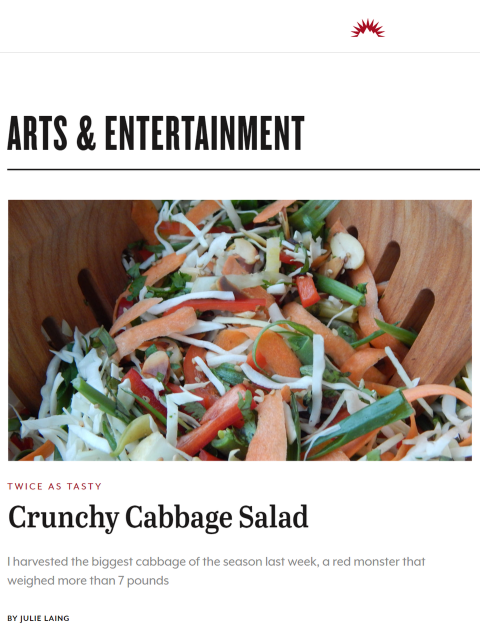
Crunchy Cabbage Salad

 I grow several cabbage varieties, some to ferment as sauerkraut, kimchi, and slaw and others to shred raw for my favorite salad. Learn more at TwiceasTasty.com.
Growing cabbage always presents challenges. In my short growing season, each plant produces one head but doesn’t really have enough time to form a second flush. It has a big garden footprint, and I have to protect it under a cover all season if I want to keep cabbageworms and loopers from calling it home. Some varieties need to be harvested midsummer, when everything else is begging for attention in the garden, so I need to check carefully for number of growing days to ensure a long, extended harvest.

Is it worth it? Clearly I’ve answered yes, because as I share in my Twice as Tasty column for the Flathead Beacon, I now grow several cabbage varieties. Some I enjoy fresh, especially as young, raw leafy greens. Others I ferment to have on hand all winter. But my favorites remain the raw crunchy heads that I shred for salads.
Learn to make Crunchy Cabbage Salad

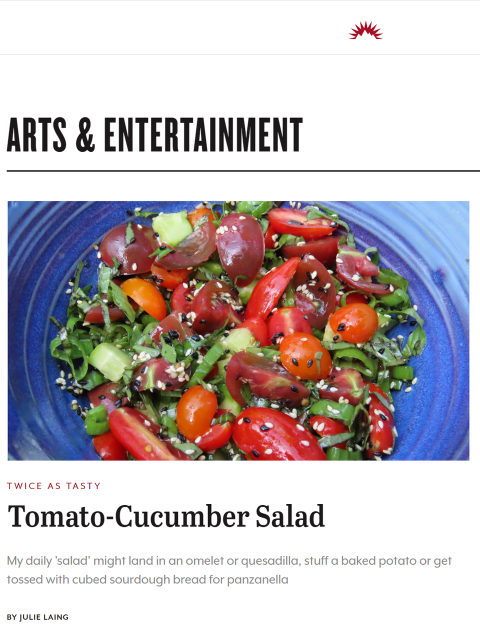
Tomato-Cucumber Salad with Asian-Inspired Dressing

Fresh cherry tomatoes and small cucumbers make a delicious salad, especially when flavored with an Asian-inspired dressing. Learn more at TwiceasTasty.com.
Tomato season is on. I harvested 45 pounds of heirloom paste and slicing tomatoes in one go earlier this week, and these larger tomatoes already need to be picked again. The cherry tomatoes have been prolific too; bowls of them are currently scattered around my house, waiting to be eaten, frozen, or canned.

As I share this week in my Twice as Tasty column for the Flathead Beacon, fresh cherry tomatoes and small cucumbers make a delicious salad. Nothing beats the taste of homegrown ones, of course, but local farmers can do the work for you and even a larger tomato and cucumber can be sliced up for a similarly quick, bright dish when they’re in season. Although most people think of a balsamic-based vinaigrette for tomatoes, I love to flavor this pairing with an Asian-inspired dressing—especially if I’m eating it with the recipe I shared in last week’s Flathead Beacon column: Zucchini-Basil Pancakes, one of my favorite was to use zucchini.
Learn to make Tomato-Cucumber Salad with Asian-Inspired Dressing

Creamy Balsamic Salad Dressing

 Look like a pro in the kitchen with minimal effort and expense by making your own salad dressings. Learn more at TwiceasTasty.com.
If you want to look pro in the kitchen with minimal effort and little expense, a smart move is to make your own salad dressings. As I explain this week in my Twice as Tasty column for the Flathead Beacon, store-bought dressings are expensive and loaded with additives easily avoided in homemade blends. I eat salads almost daily in summer, but I never buy dressings and am convinced you don’t need to either.

Among the first recipes I ever published on this blog are my base blends for vinaigrette and creamy salad dressing. For one of my more popular workshops, I bring more than 30 ingredients to blend into personalized dressings. This week, I share one of my go-to combinations that builds on those basic ratios.
Learn to make Creamy Balsamic Salad Dressing and other vinaigrettes