
Roasted Winter Squash Puree

This month, I’m breaking down my favorite pumpkin pie recipe by its homemade components. Learn more at TwiceasTasty.com.
When I planned my Twice as Tasty column for the Flathead Beacon this month, I knew I wanted to share my favorite recipe for pumpkin pie. But I quickly realized I didn’t have enough space to print the full scratch-made version. Instead, I’m breaking down the pie recipe by its homemade components: spice mix, pumpkin puree, pie crust, and the final filling and baking.

There are several advantages to this—beyond staying within my word-count limit. Each component is presented as a standalone recipe, showing you how it can be made in advance and put to other uses. You can also choose how homemade you really want your finished pie to be. You could make your own spice mix but buy canned puree. Or you could mix and roll your own crust but use a store-bought spice blend that’s already in your cupboard.

If you do decide to go entirely homemade, spreading out these recipes over a few weeks will hopefully make the project seem less daunting. You’ll also get to enjoy bonus goodies, like roasted pumpkin seeds, pumpkin cookies, and pie crust snacks, along the way.
Learn to make Roasted Winter Squash Puree
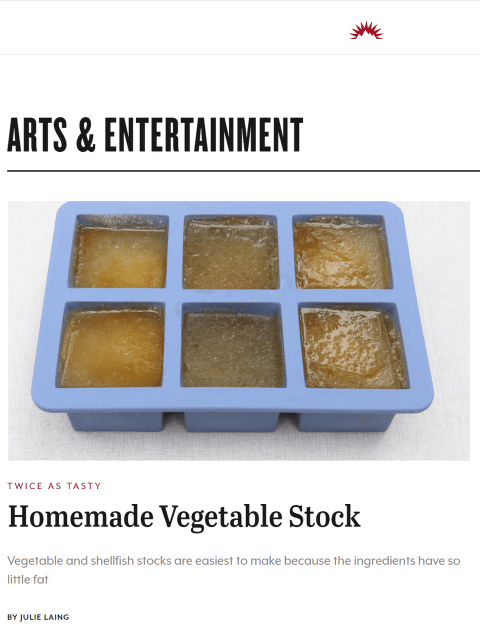
Homemade Vegetable Stock

When I make stock, it feels cost-free and effortless: I use whatever’s at hand, and it happens in the background of my day. Learn more at TwiceasTasty.com.
Any chef will point to stock as an easy way to add flavor. I use stocks the most from fall to spring, as the base for soups, to flavor rice or beans, and to round out sauces. Although you can simply use water in many of these dishes for the same effect, swapping in a stock gives a jump-start to a tasty meal.

Although many recipes include a stock in the ingredient list, they don’t mention how easy it is to make, either on the spot or in a large batch to freeze so that you always have a bit on hand. Store-bought stocks and broths may seem easier, but they add to your grocery bill, tend to be loaded with salt and preservatives, and can be thick enough that instead of giving light undertones of flavor they overpower a dish. When I make stock, it feels cost-free and effortless: I use whatever’s at hand, rather than buying ingredients specifically for it, and it happens in the background of my day, simmering on the stove while I prepare a meal or check other tasks off my to-do list.

This week, in my Twice as Tasty column for the Flathead Beacon, I share a stock recipe that uses whole vegetables so that you can learn the technique for making stock. Once you get a sense of the balance, you can swap in other vegetables and scraps so that you don’t spend time or money buying ingredients.
Learn to make Homemade Vegetable Stock

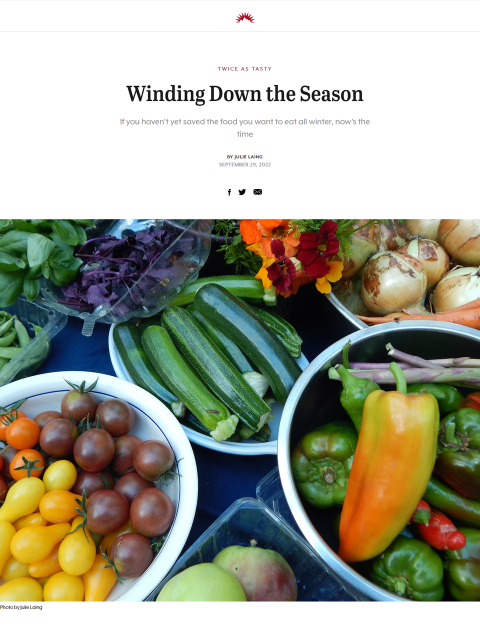
Winding Down the Season

Techniques that rely on freezing, dry storing, and dehydrating let you quickly save the garden’s last fruit and vegetables. Learn more at TwiceasTasty.com.
This September, we’ve been lucky to have fairly warm days and nights in Montana, with just a couple of hints at a killing frost that we were able to protect against temporarily. But the garden is still winding down. In the main garden, I’m finding fewer cucumbers and snap beans, with vines starting to dry and lose leaves. In the greenhouse, tomatoes and tomatillos are putting all of their energy into ripening existing fruit. It’s time to grab the last of the garden’s treats and stash it all away for winter.

This week, in my Twice as Tasty column for the Flathead Beacon, I share some of my favorite storage techniques for a range of vegetables. The article focuses on easy ways to save individual vegetables without needing to can or ferment them or changing their base flavor into a pickle or sauce. The techniques rely on freezing, dry storing, and dehydrating and can be done quickly with minimal prep.
Learn about winding down the season

Rhubarb–Rosemary Sorbet

Beat the heat with sorbet using affordable ingredients and tools already in your kitchen. Learn more at TwiceasTasty.com.
For my money, the best way to beat the heat is sorbet. And I do mean money: homemade sorbet can be made with affordable ingredients like in-season fruit, herbs, honey or sugar, and water. You can also make it with tools you likely already have in your kitchen, as I explain this week in my Twice as Tasty column for the Flathead Beacon.

A few tricks help you smooth out sorbet and counteract the ice crystals that can form so quickly when you try to make frozen, nondairy desserts. Ice cream makers and gelato machines may speed up the process, so you can use one if you already own one, but there’s no need to buy a new appliance if you want to enjoy dairy-free sorbets.
Learn to make Rhubarb–Rosemary Sorbet and other flavors