Corncob Stock

I make versatile, no-waste stock from a large batch of Husk-Grilled Corn after I’ve stripped the kernels off of the cobs to freeze for year-round use. Learn more at TwiceasTasty.com.
I love recipes like Corncob Stock because they turn food scraps into something delicious that you can’t easily buy. As I explain this week in my Twice as Tasty column for the Flathead Beacon, stock made from corncobs not only uses scraps but helps the cobs to break down faster in the compost.

I make this versatile stock from a large batch of Husk-Grilled Corn after I’ve stripped the kernels off of the cobs to freeze for year-round use in recipes like Corn Kernel Muffins with Sage. With the kernels set aside to eat and the cobs simmered into a flavorful stock, you’ve minimized waste and captured maximum flavor with little effort.
Learn to make Corncob Stock

Homemade Shrimp Stock

Homemade stocks are flavor-boost shortcuts in all sorts of dishes and cost nothing if you save trimmings and scraps. Learn to make Homemade Shrimp Stock. Learn more at TwiceasTasty.com.
Homemade stocks are one of my favorite shortcuts for an immediate flavor boost in all sorts of dishes. They cost nothing if you save vegetable trimmings, shrimp shells, and other scraps. They’re easy, adaptable, and take minimal effort. Save the scraps in a zip-close bag until it’s full, and you can make potful of stock to freeze in usable portions so that when you need it, it’s ready to go.

This week, I share my shrimp stock recipe in my Twice as Tasty column for the Flathead Beacon. It’s the bonus of buying raw shrimp in the shell and cleaning it yourself—beyond the improvements in flavor, texture, cost, and more that come from choosing raw over precooked, peeled shrimp. The recipe lists ingredients in whole counts, but you can save scraps to approximate equivalents. Bag and freeze enough tops and bottoms of onions and celery from nightly meals until you have the equivalent of two whole each. Zest the lemons before you add them to the stock pot, freezing the zest if you don’t have an immediate use for it. Fresh herbs that have gone soft and wilted, but not mushy, are ideal for use in stocks like this one.
Learn to make Homemade Shrimp Stock

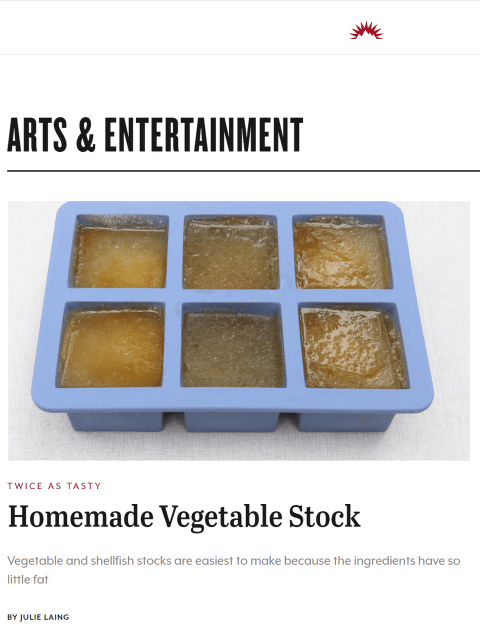
Homemade Vegetable Stock

When I make stock, it feels cost-free and effortless: I use whatever’s at hand, and it happens in the background of my day. Learn more at TwiceasTasty.com.
Any chef will point to stock as an easy way to add flavor. I use stocks the most from fall to spring, as the base for soups, to flavor rice or beans, and to round out sauces. Although you can simply use water in many of these dishes for the same effect, swapping in a stock gives a jump-start to a tasty meal.

Although many recipes include a stock in the ingredient list, they don’t mention how easy it is to make, either on the spot or in a large batch to freeze so that you always have a bit on hand. Store-bought stocks and broths may seem easier, but they add to your grocery bill, tend to be loaded with salt and preservatives, and can be thick enough that instead of giving light undertones of flavor they overpower a dish. When I make stock, it feels cost-free and effortless: I use whatever’s at hand, rather than buying ingredients specifically for it, and it happens in the background of my day, simmering on the stove while I prepare a meal or check other tasks off my to-do list.

This week, in my Twice as Tasty column for the Flathead Beacon, I share a stock recipe that uses whole vegetables so that you can learn the technique for making stock. Once you get a sense of the balance, you can swap in other vegetables and scraps so that you don’t spend time or money buying ingredients.
Learn to make Homemade Vegetable Stock