Chickpea Vegetable Skillet with Couscous and Feta

Veggie couscous works as garden-to-table meal or one that fits neatly in a cooler and kitchen box on the water or in a campground. Learn more at TwiceasTasty.com.
My garden is bountiful so far this year, and many of my home-cooked meals begin with me spreading out my harvest on the counter and chopping up a little of everything for an impromptu, no-recipe vegetable sauté, salad, or pasta meal. But when I’m not making dinner at home these days, I’m usually making it aboard our sailboat, the Blue Mule, where my range of options becomes more limited. One of the beauties of the recipe I share this week in my Twice as Tasty column for the Flathead Beacon is that you can approach it as garden-to-table meal or as a pantry-focused one that fits neatly in a cooler and kitchen box on the water or in a campground.

As I teach in my Fine Dining: Front Country workshop, the key to making such a veggie-heavy meal in the galley or at the campsite is to choose vegetables that travel well. Whole carrots, onions, and garlic can tumble around as the boat surfs waves or the car bounces down gravel roads, and they’ll still look and taste great at dinnertime. I pack small zucchini, so I don’t have a partial one left with an exposed cut edge that’s more susceptible to damage. I also tuck zukes and other tender vegetables into a plastic storage box that fits inside my ice chest and minimizes their bumping and bruising—and their direct exposure to melting ice.
Learn to make Chickpea Vegetable Skillet with Couscous and Feta

Brined and Seasoned Pot Beans

The more I cook dried beans, the more I savor the improved texture and expanded variety compared with commercially canned beans. Learn more at TwiceasTasty.com.
When people tell me they never cook dried beans, their most common excuse is that it takes too much time. I get it. When I need a quick dinner, I often pop open a store-bought can of beans. But the more I cook dried beans, the more I savor the improved texture and expanded variety compared with commercially canned beans. The techniques for preparing dried beans that I share this week in my Twice as Tasty column for the Flathead Beacon play a big part in my preference for home-cooked beans.

I make the best beans when I soak them for at least 6 hours in a cold-water brine and then simmer them on the stovetop. They keep their plump shape and have a consistent, creamy interior once cooked. I sometimes quick-soak them in warm brine or cook them in a pressure cooker, but only when I don’t mind that the skins will split.
Learn to make Brined and Seasoned Pot Beans

Zesty Baked Chickpea Snacks

I’ll be using this week’s baked chickpea recipe to demonstrate seeds as spices in my free workshop at Free the Seeds this Saturday. Learn more at TwiceasTasty.com.
Shell beans and other legumes form such a versatile and nutritious food group that we should all be eating more of them. They go in everything, whether blended into smooth, creamy hummus; softened in hearty soups; or left whole and slightly chewy in salads. It was only a few years ago that I discovered they also can become crunchy homemade garnishes and snacks ready for all sorts of seasonings, as I share this week in my Twice as Tasty column for the Flathead Beacon.

I’ll be using a variation on this week’s recipe to demonstrate the magic that happens when you toast, grind, and bloom spices in my free Seeds of Flavor workshop at Free the Seeds this weekend. Join me Saturday, March 1, in Kalispell in Flathead Valley Community College’s Arts and Technology Building. The free daylong event will be packed with workshops, a giant seed giveaway, booths hosted by local farmers and organizations, and a special keynote speaker to celebrate a decade of this fabulous educational and family-friendly gathering. Find all the info you need (like the full workshop schedule) on the website of the event’s organizer, Land to Hand Montana.
Learn to make Zesty Baked Chickpea Snacks

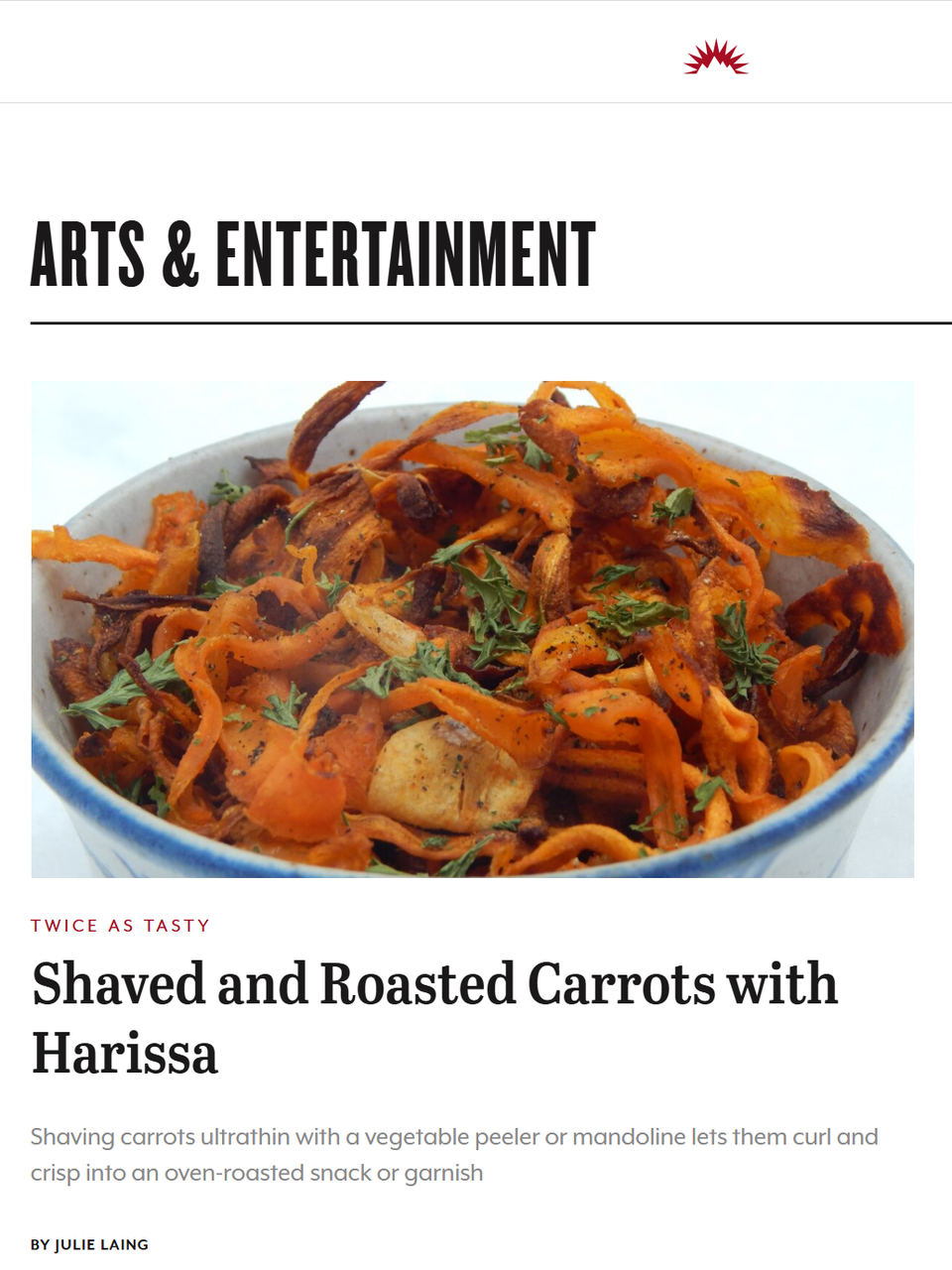
Shaved and Roasted Carrots with Harissa

Thinly shaved carrots won’t fall apart even when you toss them with olive oil, maple syrup, and North African chile paste. Learn more at TwiceasTasty.com.
Most of the snack recipes I’ve been sharing recently in my Twice as Tasty column for the Flathead Beacon benefit hugely from seasonings, but only with a light hand. Sheets of roasted seaweed and kale baked until crisp easily turn soggy, enough to make them chewy or fall apart, if you introduce too much oil or liquid.

This week’s recipe turns carrots shaved thin with a peeler or mandoline into slightly crisp strips that handle moist seasonings better than fragile leaves. The sturdy root vegetable won’t fall apart even when you toss it with olive oil, maple syrup, and harissa, a North African chile paste.

I included a recipe for my version of this traditional chile paste in my cookbook, The Complete Guide to Pickling. It takes just 10 minutes of hands-on time to make and lasts several months in the refrigerator. It’s worth keeping on hand because its so versatile, giving a little heat to everything from brined olives to grilled shrimp. It’s also a classic flavor in Harira (Moroccan Tomato Lentil Soup).
Learn to make Shaved and Roasted Carrots with Harissa

Homemade Roasted Seaweed Snacks

Pare down sheets of seaweed into bite-sized squares—just like store-bought roasted seaweed snacks but without the single-use plastic packaging. Learn more at TwiceasTasty.com.
I’m planning to share some crispy snack food recipes this month in my Twice as Tasty column for the Flathead Beacon. They’re great for those days when you can’t seem to get rid of the munchies but aren’t really hungry. I often make them before road trips, when it’s easy to plow through a whole bag of potato chips as dull miles of endless farm fields roll by.

My crispy homemade snacks are healthier than that bag of chips, seasoned for flavor, and made from ingredients available year-round. The ones I share this week pare down sheets of seaweed into bite-sized squares—just like the roasted seaweed snacks that have become popular on grocery store shelves but without all of that single-use plastic packaging. Making your own lets you control the flavor too. I often make mine from the scraps left after trimming the sheets down for homemade sushi rolls.
Learn to make Homemade Roasted Seaweed Snacks

Crispy Pan-Fried Tofu

The process of making tofu crispy is simple. It requires just two ingredients and can be broken into four key steps. Learn more at TwiceasTasty.com.
When I see recipes that aim to make tofu crispy, I’m often surprised by the various ingredients and effort applied—and even more surprised when I find they don’t achieve the desired effect. As I explain this week in my Twice as Tasty column for the Flathead Beacon, the process of making tofu crispy is simple. It requires just two ingredients, tofu and oil. It can be broken into just four key steps: remove excess moisture, use a hot pan and splatter shield, leave space around each piece, and wait to flip the tofu until it releases easily.

When I make tofu in this way, it comes out perfectly crisp every time, whether I’ve cut the tofu into cubes for a stir-fry, thick rectangles for a satay, or flat slabs for a sandwich. I typically reach for my largest cast-iron skillet, but any well-seasoned or nonstick pan that can be safely set over medium-high heat does the job. I prefer a mesh splatter shield to a silicone one; the latter tends to collect condensation that then drips back into the hot oil.
Learn to make Crispy Pan-Fried Tofu

Hot and Sour Shrimp and Noodle Soup

Let me take the recipe for Hot and Sour Broth Base and walk you through one of my favorite ways to turn it into a full-fledged soup. Learn more at TwiceasTasty.com.
This week’s Twice as Tasty column for the Flathead Beacon takes the recipe from the prior week, Hot and Sour Broth Base, and walks you through one of my favorite ways to turn it into a full-fledged soup. Just looking at the photo makes me want to fix a bowl for lunch today.

That’s easily done: At lunchtime, I’ll rehydrate a couple of dried shitake mushrooms in hot water and thaw a few shrimp in cold running water while I gather the other ingredients. Cubes of broth base and Homemade Shrimp Stock pulled from my freezer go straight into the pot, as do the noodles. A handful of shrimp take seconds to peel, and I’ll add their shells to the bag in my freezer awaiting my next stock-making day. Shallots, garlic, and cilantro also take seconds to prep in such a small amount. By the time my prep is done, the mushrooms will be soft and I can fill the soup pot, with lunch ready in about 15 minutes.
Learn to make Hot and Sour Shrimp and Noodle Soup

Hot and Sour Broth Base

For homemade soup that can be as effortless to serve as popping open a can, keep a soup base in the freezer. Learn more at TwiceasTasty.com.
The recipe I share this week in my Twice as Tasty column for the Flathead Beacon is all about the balance between effort and result. When you make real meals from scratch, the result can be phenomenal. But those meals usually take more effort than an off-the-shelf substitute.

I’ll always remember one of the comments I saw about my first recipe in the Flathead Beacon, 30-Minute Tomato Soup. Someone was appalled that it would take so long to make tomato soup when she could just pop open a can and heat it in the microwave. She completely missed the point of the recipe—and to this day is likely missing out on its rich flavor.

That reader will likely be just as snarky about this week’s recipe, even though its point is to achieve the equivalent of popping open a soup can by doing the bulk of the work ahead of time and keeping a hot and sour soup base in the freezer. But if you make that advanced effort, the result tastes amazing, even if all you do is heat up a couple of frozen cubes in a mug of stock.
Learn to make Hot and Sour Broth Base

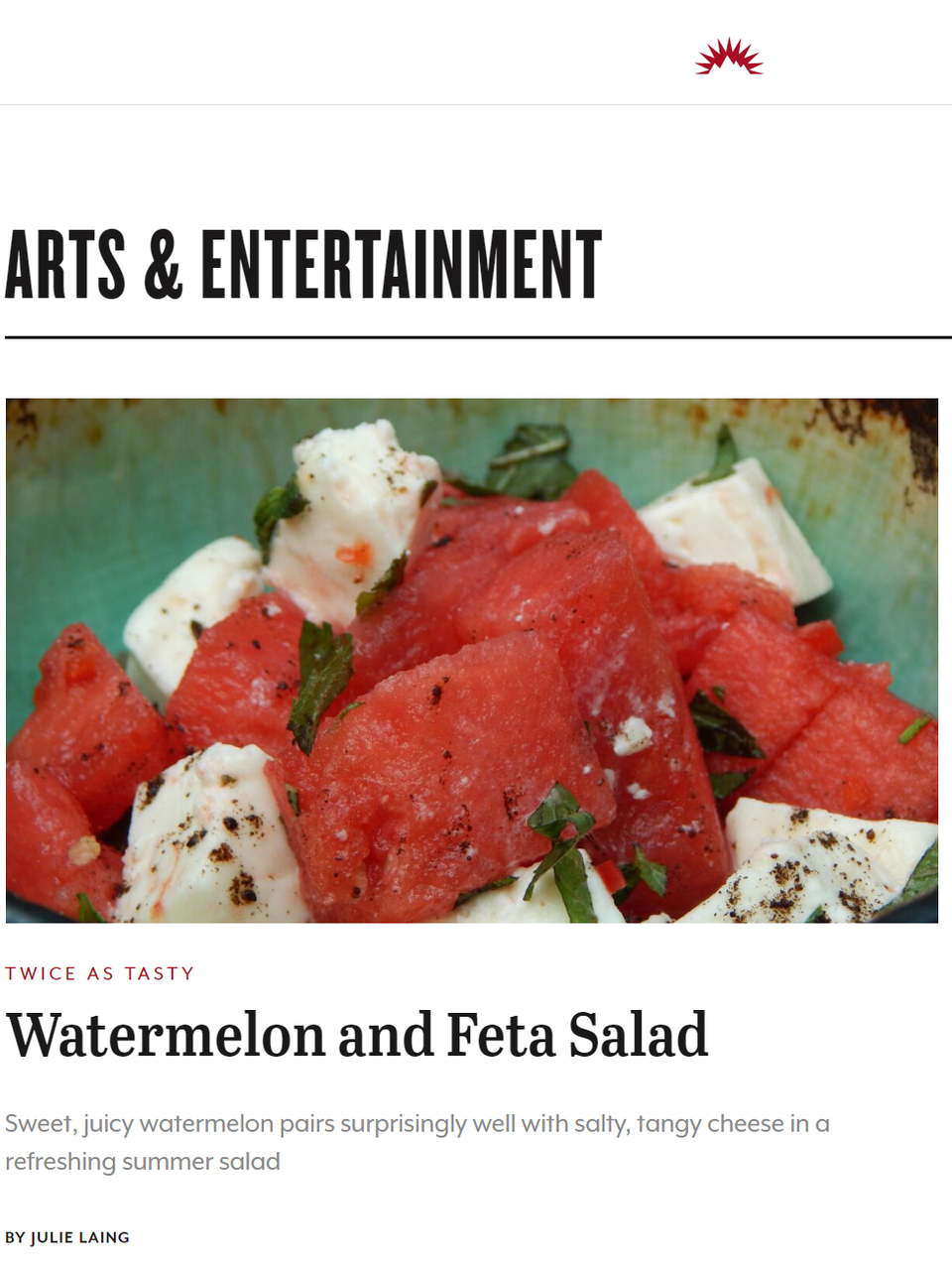
Watermelon and Feta Salad

Get right to the heart of summer by pairing sweet, juicy watermelon with tangy, salty feta cheese—especially homemade dry-salted feta. Learn more at TwiceasTasty.com.
The recipe I share this week in my Twice as Tasty column for the Flathead Beacon gets right to the heart of summer, pairing sweet, juicy watermelon with tangy, salty feta cheese. Like many of my favorite recipes that use feta, you can buy a high-quality block in brine for this salad. I like a creamy Bulgarian sheep’s milk feta, which holds its shape well, or the sharp taste of Greek sheep’s milk feta alongside the sweet melon.

My favorite pairing is homemade Dry-Salted Feta. Even when I use whole cow’s milk instead of milk from goats or sheep, it has far superior flavor and texture to the crumbly, dry store-bought American feta made from skimmed cow’s milk. The hardest part about making feta is holding the milk at a steady temperature for a couple of hours—a challenge that is far easier amid summer’s heat than during freezing winter months.
Learn to make Watermelon and Feta Salad

Raspberry Vinaigrette

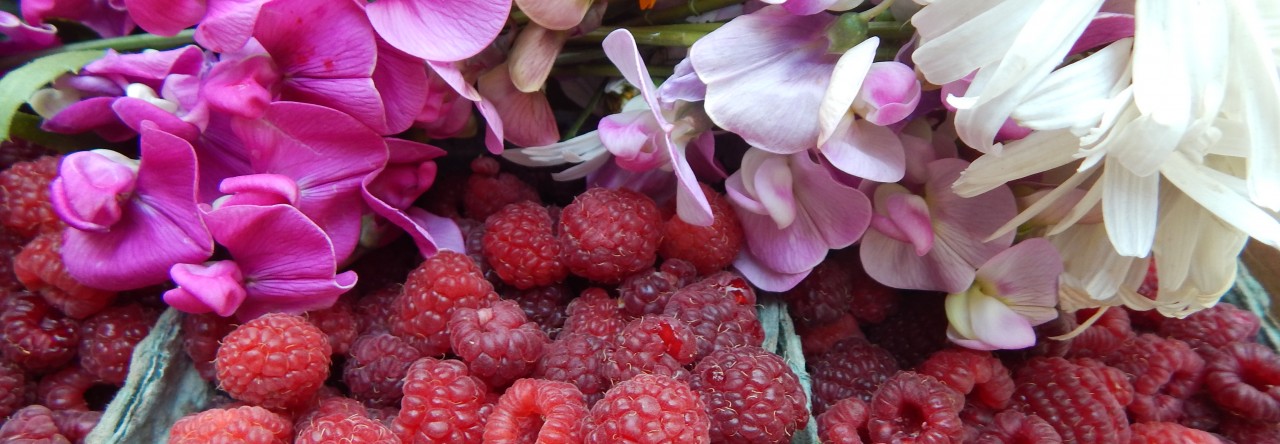
You can blend fresh raspberries into this vinaigrette, but it’s also ideal for using up roasted raspberry pulp. Learn more at TwiceasTasty.com.
My favorite salads might start with a bed of greens, but then I pile on the vegetables and other toppings. Because the layers give the salad so much flavor and texture, I rarely bother with more than a simple dressing of vinegar or citrus juice, oil, and an emulsifier like mustard or garlic.

But a three- or four-ingredient salad can handle an intensely flavored dressing, like the one I share this week in my Twice as Tasty column for the Flathead Beacon. This berry dressing can turn the bed of greens, early onions, and the last of my storage carrots into a delicious lunch or side salad.

You can blend fresh raspberries into this vinaigrette, but it’s also ideal for using up the pulp left after making Roasted Raspberry Syrup or the Roasted Raspberry-Thyme Shrub in my cookbook, The Complete Guide to Pickling.
Learn to make Raspberry Vinaigrette