Homemade Vanilla Extract

If you store vanilla beans in alcohol, they not only create vanilla extract for you but also stay mold free. Learn more at TwiceasTasty.com.
I’ve been working on pieces lately with recipes that are so simple but that have become more common as store-bought items for most people, including salad dressings, herb salt, and the latest recipe in my Twice as Tasty column for the Flathead Beacon: homemade vanilla extract. Beyond all of the reasons I give in my column for turning vanilla beans into extract, I’ve found that the process essentially acts as my vanilla bean storage system, keeping the expensive pods from spoiling.

Most grocery stores sell vanilla beans a pod at a time, the long, thin, dark shape tucked into a vial. Depending on how well it’s been sealed, the bean might be oily and pliable or dry and brittle. Sellers recommend keeping the bean as packaged until you need to use it but airing it out if you still have it 3 to 6 months later. I hadn’t realized how crucial this was until a friend who had bought oily, pliable vanilla beans in a vacuum-sealed pack opened the bag one day to find they had molded. But if you store the beans in alcohol, they not only create vanilla extract for you but also stay mold free. Just make sure they’re completely submerged.
Learn to make Homemade Vanilla Extract
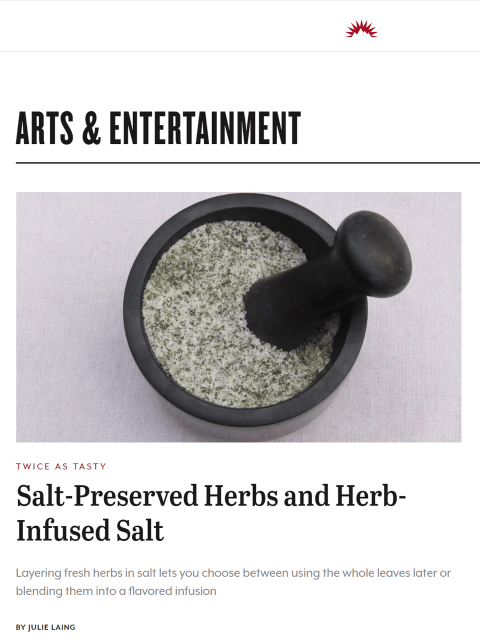
Salt-Preserved Herbs and Herb-Infused Salt

If you’re a fan of flavored salts, the recipe in my latest Flathead Beacon column is for you. Learn to make Salt-Preserved Herbs and Herb-Infused Salt. Learn more at TwiceasTasty.com.
If you’re a fan of flavored salts, for your own kitchen or to give to others, the recipe in my latest Twice as Tasty column for the Flathead Beacon is for you. Herb-infused salts are so simple to make, can be flavored with almost any homegrown herb, and keep a year or more. You can use them like plain salt when cooking or at the table, or you can intentionally showcase them as a finishing salt on any dish, sprinkling them on just before serving.

You can also swing the salt-and-herb pairing the other way, with more emphasis on using the herbs than the salt. Whole herb leaves preserved in salt stay soft and pliable, letting you use them like fresh leaves long after their parent plants have died back and gone dormant under a blanket of snow. The salt keeps bacteria and mold at bay and picks up hints of the herb’s flavor, remaining usable after you’ve pull the last leaf from the jar.
Learn to make Salt-Preserved Herbs and Herb-Infused Salt

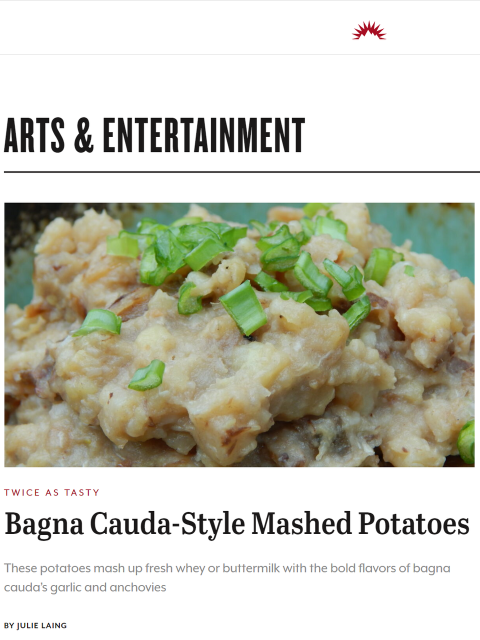
Bagna Cauda-Style Mashed Potatoes

As the first perennial edibles show off their bright green tops, I snip handfuls onto whatever I’m using up from last season’s harvest. Learn more at TwiceasTasty.com.
This time of year, I’m always pairing what remains of last season’s harvest with the first of spring’s perennial edibles. As they push through the ground and show off their bright green tops, I can’t help but snip a handful at a time onto whatever I’m trying to use up from dry storage or the freezer.

That approach to homegrown produce applies to this week’s Twice as Tasty column for the Flathead Beacon. In my unheated mudroom, the last of the potatoes that we dug and cured in October have begun to sprout in their storage box, an old, lidless cooler with a few shims in the bottom to allow air circulation and a towel thrown over the top to keep the light out and the potatoes from turning green. They’re still firm and ideal for mashed potatoes. The final garlic heads and onion bulbs are also trying to sprout but haven’t softened. All it takes is a sprinkling of the emerging onion tops cut from perennial walking onions to make the storage vegetables worthy of a spring meal.
Learn to make Bagna Cauda-Style Mashed Potatoes

Weeknight Pasta with Roasted Pumpkin and Parmesan

I can’t think of a better way to celebrate the arrival of spring than with last season’s harvest. Learn more at TwiceasTasty.com.
When spring arrives, I start watching bulbs grow by the hour—and inspecting my storage vegetables for their waning freshness. Over time, I’ve become better at choosing varieties that keep well, curing them properly, and storing them so that they stay fresh and usable for many months. By the first day of spring, I still have dry-stored vegetables tucked away. As I dig through the stash, I usually find one surprising keeper that has held on longer than in any other year.

This year, it was winter squash, as I share this week in my Twice as Tasty column for the Flathead Beacon. I just made the column’s recipe with the last of my delicata squash, swapping it for the pumpkin. I’ve been growing long-keeping onions, which I used instead of shallots, and am still enjoying a small basket of garlic just making its first attempts to sprout. My supply of homegrown and dehydrated herbs has begun to wane but will see me through until the next crop. I can’t think of a better way to celebrate the arrival of spring than with last season’s harvest.
Learn to make Weeknight Pasta with Roasted Pumpkin and Parmesan

Russian Kasha (Multigrain Hot Cereal Mix)

Mixed cereal flakes add more flavor and texture to hot cereal—and many other recipes—than a single grain. Learn more at TwiceasTasty.com.

Some recipes act less as precise instructions that need to be followed to successfully complete a dish and more as reminders for the possibilities that can be created. I share one of the latter recipes this week in my Twice as Tasty column for the Flathead Beacon.

When I adopted hot cereal into my regular meal schedule, the mix of grains I used opened up options for a range of recipes. I rarely bother to measure out portions these days, just combining the various grains by sight to come up with a blend that I not only cook into Russian kasha but also dehydrate for granola and use as a rolled oat replacement in other recipes. The various flakes add more flavor and texture than a single grain and can be easily and affordably combined at home.

Learn to make Russian Kasha (Multigrain Hot Cereal Mix)

Maple-Glazed Carrots

 If Thanksgiving feast numbers swell and you have a bag of carrots at hand, glazing them quickly using kitchen staples creates a stress-free, last-minute side dish. Learn more at TwiceasTasty.com.
My Twice as Tasty column for the Flathead Beacon went live early this week so that you have ample time to add its recipe to your Thanksgiving meal. Maple-Glazed Carrots slide in easily among traditional dishes, offering a hint of sweetness and touch of spice without overfilling a plate or adding excessive time to your prep. Their simplicity belies their flavor, which is rich enough to nestle against more complex holiday dishes or gussy up a weeknight meal.

Because they’re made in one pan on the stovetop, they don’t need space in an oven already claimed by a Thanksgiving turkey, dressings, or pies. Best of all, if your feast numbers swell and you have a bag of carrots in your refrigerator, you can glaze them quickly using kitchen staples and add this stress-free side dish to the holiday spread at the last minute. If you just bought carrots with their tops intact, take a nibble of their greens: Those that were recently harvested and remain sweet can be blended into a delicious herb salsa garnish.
Learn to make Maple-Glazed Carrots

Golden Onion and Potato Frittata

Visualize frittata as a crustless quiche or open-face omelet that relies on a few core ingredients but can be filled with an array of flavors. Learn more at TwiceasTasty.com.
I was served my first frittata, an Italian dish, by a Spanish woman while I was visiting a Greek island. I loved the meal so much—and it’s affordable price on a backpacker’s budget—that I ate frittata daily during my stay.

Visualize this baked egg dish as a crustless quiche or open-face omelet. When I make it today, the core ingredients remain the same each time I enjoy it. I share that basic recipe this week in my Twice as Tasty column for the Flathead Beacon, but it’s just the start to what you can put into a frittata. During my initial weeklong frittata fest, the chef layered tomatoes and basil, peppers and greens, or eggplant and summer squash over this base, always with feta mixed in. At home, I might use mushrooms, arugula, asparagus, spinach, carrots, and chard, swapping in whatever cheese seems to fit best.
Learn to make Golden Onion and Potato Frittata

Potato Salad with Pickles and Creamy Dressing

Pickled vegetables and a mild, creamy dressing present a dichotomy of flavors as a complementary pairing. Learn more at TwiceasTasty.com.
In the early 2000s, I lived in St. Petersburg, Russia, for close to a year. I’d been traveling through Europe and northern Africa for much of the year before that and was drawn to the local flavors in each country and region I visited. Russia presented an interesting dichotomy: a love of all things pickled yet little tolerance for anything spicy or powerfully flavored.

The salad and dressing recipe I share this week in my Twice as Tasty column for the Flathead Beacon shows how this dichotomy can be a complementary pairing, which is perhaps one reason both tangy and mild flavors were so popular in Russia. In contrast, the blend that many Westerners know as Russian dressing, which often contains chili sauce, horseradish, and other hot or sharp flavors, would have been too much for my Russian friends. They even found my homemade mac and cheese, with its dash of mustard powder, too spicy. But the tangy combination of pickled vegetables and sour cream in this potato salad was just fine.
Learn to make Potato Salad with Pickles and Creamy Dressing

Roasted Winter Vegetable “Grain” Bowls

I make roasted-veg bowls to use up long-held homegrown vegetables, but the ingredients are easily attainable and affordable in grocery stores. Learn more at TwiceasTasty.com.
In my area, snow and ice continue to cling to shady places and most growing spaces have yet to transition past mud to diggable soil. Spring cleanup outdoors will happen slowly for now, but indoors is a different story, as I explain this week in my Twice as Tasty column for the Flathead Beacon. I’m focused on emptying my food storage spaces before the next round of growing and harvesting kicks in.

In my house, I’m making room in my freezer and on my canning shelves, both of which I filled to overflowing last year. But the main effort is to eat up dry-stored produce that has been keeping well in boxes but won’t continue to do so for long. The recipe in this week’s column uses some of these long-held homegrown vegetables, but they’re also ones that are easily attainable and affordable in grocery stores this time of year.
Learn to make Roasted Winter Vegetable “Grain” Bowls

Winter Squash and Mushroom Risotto

You can use all sorts of winter squash and mushrooms in risotto, making it a showcase for homegrown or locally farmed or foraged varieties. Learn more at TwiceasTasty.com.
I feel lucky that my homegrown winter squash has held up so well in storage this year. First deer that found their way into the garden attempted to gnaw through their thick skins. Then we had several huge temperature swings throughout winter, including an extended power outage during subzero temperatures. Yet the squash kept in storage until now, ready for the delicious risotto I share this week in my Twice as Tasty column for the Flathead Beacon.

You can use all sorts of winter squash in risotto, from the pictured kabocha to delicata, butternut, or pumpkin. The same goes for mushrooms; cremini are readily available, but as local mushroom farming becomes more popular, it’s becoming easier to mix in oyster mushrooms, chestnut boletes, or other varieties. I recommend making your own vegetable stock too; it likely won’t be as thick or salty as store-bought broths. If you make a large batch and then freeze it in 1-cup portions, it will be ready to defrost for a range of risottos.
Learn to make Winter Squash and Mushroom Risotto