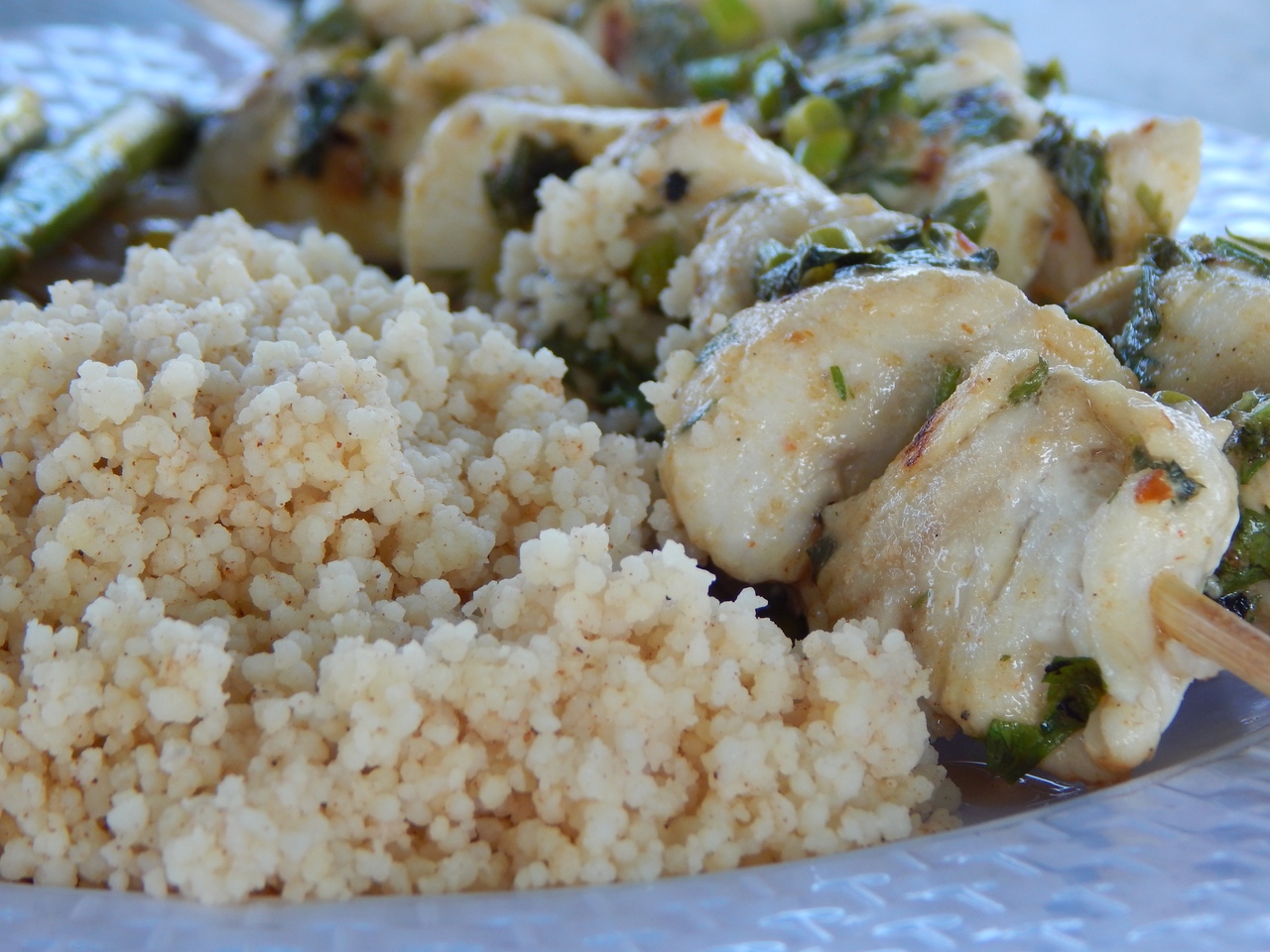

Chickpea and Vegetable Couscous Salad

Instant couscous has become one of my staple grains not just at home but for lakeside picnics and onboard dinners. Learn more at TwiceasTasty.com.
Once I accepted that I was never going to justify housing a giant couscoussière in my tiny Montana kitchen and using its vastness, sized for the average Moroccan family, to feed my household of two, instant couscous became a staple grain not just at home but for lakeside picnics and onboard dinners. We recently wrapped up a two-week sailing adventure aboard The Blue Mule in the San Juan and Gulf Islands, and the couscous recipes I’ve been sharing in my Twice as Tasty column for the Flathead Beacon were part of our cruising menu.

The little grains cook so well in just-boiled water that I keep a collapsible silicone container with a tightly sealing lid in my galley box. I pour the couscous into it, add a pat of butter and sprinkling of cinnamon and salt, and then pour JetBoil-heated water on top and seal the container. For dinner before an evening sail on Flathead Lake, I use the same technique but boil the water on my kitchen stove and take it to the lake in a thermos.
Learn to make Chickpea and Vegetable Couscous Salad with Pour-Over Cinnamon Couscous

Herbed Bean Salad

 After several evolutions, this salad has become a spring favorite, tossing warm beans with the first lettuces and herbs to appear in my garden. Learn more at TwiceasTasty.com.
The other day, I was asked how I come up with my recipes. The inspiration varies, but they’re like jazz tunes: once published, I continue to play and let them evolve. The recipe in my latest Twice as Tasty column for the Flathead Beacon is among those that I’ve been riffing on for years.

The salad began as a way to use some of my favorite homemade condiments, which I later included in my cookbook, The Complete Guide to Pickling: the bright pink vinegar and softened flowers of Pickled Chive Blossoms, the complementary flavor of German-Inspired Spicy Mustard, and Pickled Nasturtium Seeds as the homegrown stand-in for capers. To feature Quick Homemade Mozzarella, I plated the salad in layers with slices of fresh cheese and encouraged my cheese-making workshop students to do the same. Then I revised the recipe to share with buyers of vertically farmed fresh greens, using it to showcase the brand’s baby spinach, arugula, and chard. When the company shut down, I altered the recipe again, tossing the warm beans with the first lettuces and herbs to appear in my garden each spring: spinach, arugula, butter lettuce, chives, and sorrel.
Learn to make Herbed Bean Salad

Warm Quinoa and Feta Salad

There’s something special about salads made with spring's first herbs and greens from plants that bravely withstand 50°-plus temperature swings. Learn more at TwiceasTasty.com.
We’ve had our usual cyclic spring weather in Montana, with a high of 76°F on Sunday followed by nights in the 20s. It makes me appreciate even more the first spring greens and herbs that eagerly pop through the sun-warmed soil and then tough out the crisp nights and frosty mornings. As I share this week in my Twice as Tasty column for the Flathead Beacon, my first spring salads mainly consist of store-bought ingredients and sneak in handfuls of whatever garden treats appear first for fresh pops of green.

I make variations on these spring salads throughout the growing season, transitioning to homegrown summer vegetables and herbs as the weeks pass. But there’s something special about the ones made with those first perennial and self-seeded herbs and greens, the plants that bravely leaf out through 50°-plus temperature swings.
Learn to make Warm Quinoa and Feta Salad

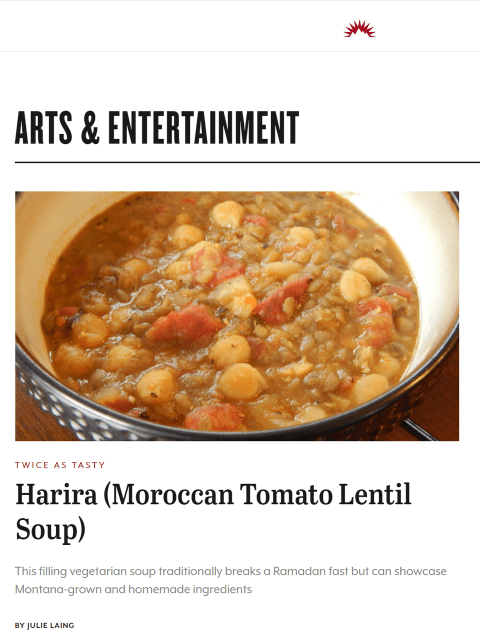
Harira (Moroccan Tomato Lentil Soup)

I’ve been playing with five varieties of lentils this month, including reds for dosas, Puy lentils for a crispy snack, and green ones in soup. Learn more at TwiceasTasty.com.
I’ve been having such fun with lentils since I taught a workshop on these little seeds at the beginning of the month for Free the Seeds. I took five varieties of lentils to the class, which means I now have five varieties at home to play with. I’ve been doing just that. In the workshop, we looked at of fermented Red Lentil and Basmati Dosa batter, so I spent a few days enjoying dosas wrapped, taco-style, around Indian-Inspired Sweet-and-Sour Potatoes or served under basted eggs.

We also looked at sprouted Puy or French lentils in the workshop, which I then baked into Crispy Sprouted Lentils. I’ve piled these on corn tortillas with avocado and Lime-Pickled Onions and even took them to a sushi workshop as a garnish. I share yet another recipe that uses green or brown lentils this week in my Twice as Tasty column for the Flathead Beacon.
Learn to make Harira (Moroccan Tomato Lentil Soup)

Mushroom-Filled Blini

Blini are delicious stuffed with cremini mushrooms, those brown-toned baby Portobellos, or with wild mushrooms. Learn more at TwiceasTasty.com.
When my Twice as Tasty column for the Flathead Beacon went live with the latest recipe, Mushroom-Filled Blini, one of the first reactions that I received focused on the mushrooms, rather than the thin pancakes I wrap around them. Although I wrote the recipe for cremini mushrooms, the brown-toned baby Portobellos that are easily found in most grocery stores, I ate delicious blini stuffed with wild mushrooms while traveling across Russia.

In my corner of Northwest Montana, spring mushroom foraging season is just around the corner. I recommend bookmarking this week’s recipe if you’ll soon be out hunting for morels, our most popular edible spring fungi. You can find more ideas for cooking your bounty in this blog post. It also links to a Flathead Beacon column I wrote in 2022 after interviewing local forager Dale Johnson, who offered tips for identifying and using your wild mushroom collection.
Learn to make Mushroom-Filled Blini

Spiced Red Lentil Dip

My free public workshop this Saturday digs into lentil varieties and ways to cook, spout, and ferment them for everything from spiced dips to full meals. Learn more at TwiceasTasty.com.
My free March 2 workshop on lentils will be my 10th presentation for Free the Seeds. If you’re in Northwest Montana, join us for not just my workshop but the whole daylong event to pick out free seeds, talk with local food experts, and attend the full slate of workshops on everything from successful gardening to saving seeds. If you’re not local, you can still participate in four workshops via Zoom.

I explain more about the event and my workshop in my latest Twice as Tasty column for the Flathead Beacon. I also share one of my favorite easy lentil recipes: Spiced Red Lentil Dip. In the workshop, we’ll look at the range of lentil varieties that are easy to find locally and ways to enjoy them, from cooked to spouted to fermented and from crunchy snacks to full meals.
Learn to make Spiced Red Lentil Dip

Grilled Onion Guacamole

Ripe avocados have the best flavor, and mixing them with onion and garlic that have mellowed and sweetened on the grill enhances their taste. Learn more at TwiceasTasty.com.

I don’t follow sports yet always know when the Super Bowl is approaching. It seems that in the week before the game, every grocery store puts avocados and tortilla chips on sale. I just bought large, not-yet-ripe ones yesterday, so it seems an apt time to share my guacamole recipe in my Twice as Tasty column for the Flathead Beacon.
For shoppers, avocados no longer have a season, as various countries cycle through their growing seasons and ship their harvest to the United States. Because they’re picked while hard and underripe for long transport, I look for unbruised avocados that have dark skin (for the variety) and an intact stem. Once you can easily push the stem free with a fingertip and see bright green flesh underneath, the avocado has hit its peak ripeness. Check for this after you’ve taken the avocado home and let it ripen on the counter for a few days, until it gives slightly under gentle pressure; popping off the stem too early affects the ripening process.

Ripe avocados have the best flavor, especially in a mild dip like guacamole. As I explain in this week’s column, mixing them with onion and garlic that have mellowed and sweetened on the grill enhances their taste.

Learn to make Grilled Onion Guacamole

Tomato, Potato, and Garlic Soup

Whether you grow your own food or seek out in-season produce, it’s worth freezing it for out-of-season use. Learn more at TwiceasTasty.com.

When I’m harvesting tomatoes and other sun-ripened vegetables in summer, I look forward to enjoying them not just fresh that same day but also from the freezer midwinter in soups and other recipes. As I explain this week in my Twice as Tasty column for the Flathead Beacon, having year-round access to the flavor of produce picked at the peak of its growth is the main reason I preserve food by freezing, canning, and more. Out-of-season produce shipped thousands of miles just can’t compete.

Even if you don’t grow your own food, it’s worth seeking out in-season produce and freezing it for out-of-season use. You still capture some of that fresh flavor, and you then have a freezer full of options for soups that can be made at a moment’s notice without a trip to the store. The tomatoes in this soup are among the easiest vegetables to freeze; potatoes, onions, and garlic can be stored even more simply in a dry, dark, cool place.

Learn to make Tomato, Potato, and Garlic Soup

Cooking with Bulgur Wheat

A chewy, nutty form of wheat, bulgur cooks relatively quickly and contains loads of nutrients and fiber. Learn more at TwiceasTasty.com.
Although I use many grains when cooking at home, I tend to overlook bulgur. When it sits at the front of my shelves, I reach for it as a base under everything from shrimp to shish kebabs, but I forget about it as soon as the jar gets shoved to the back. So I was excited to dig out my jar and create a primer about cooking with bulgur in my latest piece for Taste of Home.

This chewy, nutty form of wheat cooks relatively quickly and contains loads of nutrients and fiber. It comes in grinds ranging from fine to extra coarse—info that isn’t always listed on bulk bins or packaging. In the Taste of Home article, I explain how to identify the size, and thus the cooking time, as well as offering tips on preparing and using it.
Learn about cooking with bulgur wheat

Homemade Shaken Eggnog

Homemade eggnog has a soft, rich flavor that bears little resemblance to the drink that comes in a carton—and can be enjoyed all winter. Learn more at TwiceasTasty.com.
Many cocktails have a season, with cooling beverages like mojitos in summer and rich or hot ones in winter. Eggnog has one of the shortest seasons—late October or November through the end of the year, if you’re buying it premade or seeking a house-made version at your favorite distillery or bar. Historically, it was seen as a holiday beverage because of its richness and warming spices and was sometimes even served warm. Today, manufacturers say it just doesn’t sell outside the holidays, even in regions with months of cold, snowy weather.

If you’re an eggnog fan, the best way to extend the beverage’s season is to make it yourself. But even if you only want to enjoy it on Christmas or New Year’s Eve, the main reason to whip up your own eggnog is all in the glass—a soft, rich flavor in every sip that bears little resemblance to the cloyingly sweet milkshake-style drink that comes in a carton.
Learn to make Homemade Shaken Eggnog