Shrimp and Green Vegetable Risotto

Risotto often appears daunting but is actually just a 30-minute, one-pot meal. Learn more at TwiceasTasty.com.
Cool weather always puts me in the mood for risotto. The dish can be as warming as soup but is also hearty and filling. It’s a fabulous way to use up the last vegetables pulled from the garden before frost hits, but risotto can be made year-round: in winter with frozen and dry-stored ingredients, in spring with the first vegetables and herbs of the season, and throughout summer with the freshest treats from the garden.

As I explain this week in my Twice as Tasty column for the Flathead Beacon, risotto often appears daunting but is actually just a 30-minute, one-pot meal. Starting with the right rice and adjusting your cooking technique are key: Instead of covering a pot of short-grain rice and water with a lid, buy medium-grain Arborio rice and cook it in an open pot. Add a little hot liquid at a time, stirring often and letting the rice absorb it before pouring in more. I also create the best risotto when I use homemade stock.
Learn to make Shrimp and Green Vegetable Risotto

Fresh Broccoli and Cheddar Soup

Broccoli and cheese soup has long been a staple in my kitchen, but my recipe has evolved. Learn more at TwiceasTasty.com.
Broccoli and cheese soup has long been a staple on my fall and winter menu, but my recipe has evolved over the years. The first version I learned from my mom; besides fresh broccoli and sharp Cheddar cheese, it was simply seasoned with a bit of oregano. Once I began making it in my own kitchen, I jazzed it up (as Mom would say) with extra-sharp Cheddar and a little mustard and lemon juice, and when I began to successfully grow broccoli in my own garden, I created a freezer-based version of the jazzed-up recipe. Once I fell for grilled broccoli, I began grilling instead of steam-blanching it for even more flavor in the soup pot.

My latest rendition of a broccoli and cheese soup, which I share this week in my Twice as Tasty column for the Flathead Beacon, returns to fresh, lightly sautéed vegetables for just a touch of the roasted flavor. This is the way I make the soup with the last of the season’s broccoli, and it’s my preferred recipe for fresh store-bought broccoli. I’ve made one more ingredient addition, potato, for a thicker, chowder-like texture.
Learn to make Fresh Broccoli and Cheddar Soup

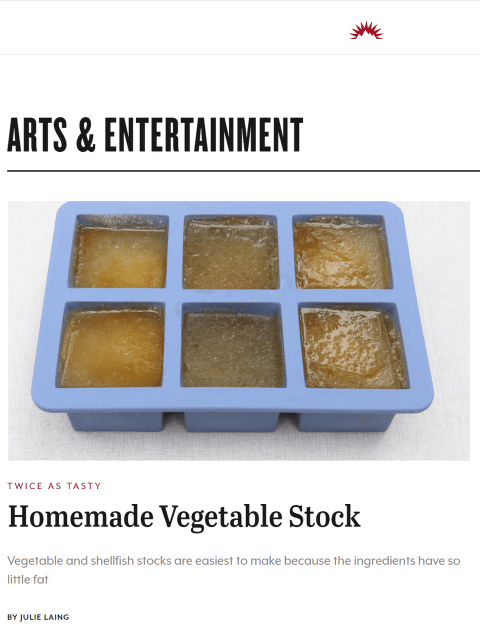
Homemade Vegetable Stock

When I make stock, it feels cost-free and effortless: I use whatever’s at hand, and it happens in the background of my day. Learn more at TwiceasTasty.com.
Any chef will point to stock as an easy way to add flavor. I use stocks the most from fall to spring, as the base for soups, to flavor rice or beans, and to round out sauces. Although you can simply use water in many of these dishes for the same effect, swapping in a stock gives a jump-start to a tasty meal.

Although many recipes include a stock in the ingredient list, they don’t mention how easy it is to make, either on the spot or in a large batch to freeze so that you always have a bit on hand. Store-bought stocks and broths may seem easier, but they add to your grocery bill, tend to be loaded with salt and preservatives, and can be thick enough that instead of giving light undertones of flavor they overpower a dish. When I make stock, it feels cost-free and effortless: I use whatever’s at hand, rather than buying ingredients specifically for it, and it happens in the background of my day, simmering on the stove while I prepare a meal or check other tasks off my to-do list.

This week, in my Twice as Tasty column for the Flathead Beacon, I share a stock recipe that uses whole vegetables so that you can learn the technique for making stock. Once you get a sense of the balance, you can swap in other vegetables and scraps so that you don’t spend time or money buying ingredients.
Learn to make Homemade Vegetable Stock

Fried Green Tomatoes

To successfully make fried green tomatoes, choose the right tomatoes and prepare them properly for the pan. Learn more at TwiceasTasty.com.
If you grow a garden, especially in a climate with a short growing season, you know that one of your last harvest decisions is what to do with green tomatoes. If you harvest them before they are damaged by frost, many green tomatoes will ripened indoors. You can also preserve tomatoes while they are still green. Some can be eaten fresh too.

I share one of my favorite ways to eat fresh tomatoes this week in my Twice as Tasty column for the Flathead Beacon: dredged in cornmeal and fried in a pan. Successfully making fried green tomatoes, with a just-soft, sweet interior and crisp outer shell that stays attached to each tomato slice, depends on the tomatoes you choose and the way you prepare them before you add them to the pan.
Learn to make Fried Green Tomatoes

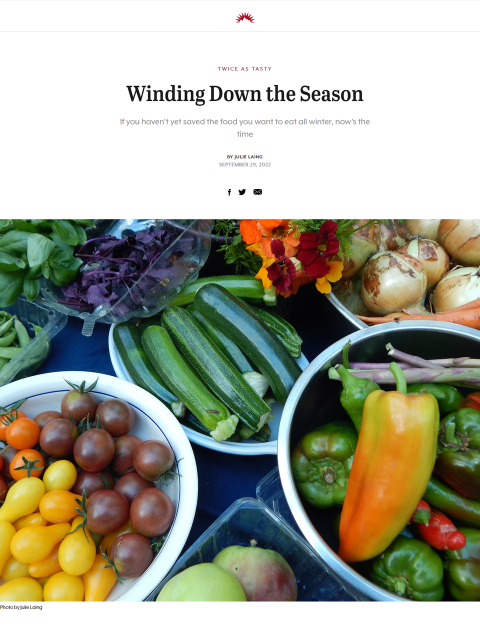
Winding Down the Season

Techniques that rely on freezing, dry storing, and dehydrating let you quickly save the garden’s last fruit and vegetables. Learn more at TwiceasTasty.com.
This September, we’ve been lucky to have fairly warm days and nights in Montana, with just a couple of hints at a killing frost that we were able to protect against temporarily. But the garden is still winding down. In the main garden, I’m finding fewer cucumbers and snap beans, with vines starting to dry and lose leaves. In the greenhouse, tomatoes and tomatillos are putting all of their energy into ripening existing fruit. It’s time to grab the last of the garden’s treats and stash it all away for winter.

This week, in my Twice as Tasty column for the Flathead Beacon, I share some of my favorite storage techniques for a range of vegetables. The article focuses on easy ways to save individual vegetables without needing to can or ferment them or changing their base flavor into a pickle or sauce. The techniques rely on freezing, dry storing, and dehydrating and can be done quickly with minimal prep.
Learn about winding down the season

Crunchy Cabbage Salad

 I grow several cabbage varieties, some to ferment as sauerkraut, kimchi, and slaw and others to shred raw for my favorite salad. Learn more at TwiceasTasty.com.
Growing cabbage always presents challenges. In my short growing season, each plant produces one head but doesn’t really have enough time to form a second flush. It has a big garden footprint, and I have to protect it under a cover all season if I want to keep cabbageworms and loopers from calling it home. Some varieties need to be harvested midsummer, when everything else is begging for attention in the garden, so I need to check carefully for number of growing days to ensure a long, extended harvest.

Is it worth it? Clearly I’ve answered yes, because as I share in my Twice as Tasty column for the Flathead Beacon, I now grow several cabbage varieties. Some I enjoy fresh, especially as young, raw leafy greens. Others I ferment to have on hand all winter. But my favorites remain the raw crunchy heads that I shred for salads.
Learn to make Crunchy Cabbage Salad

Shrimp and Summer Squash Enchiladas with Homemade Enchilada Sauce

A homemade sauce and soft yet intact tortillas makes these enchiladas household favorites. Learn more at TwiceasTasty.com.
The enchiladas I share this week in my Twice as Tasty column for the Flathead Beacon have become household favorites. And that all started with the sauce. Before I began making my own enchilada sauce, I occasionally attempted this rich, cheesy dish when we wanted comfort food, but I never quite nailed the technique of getting the tortillas in that just-right place, ending up with ones that were mushy or crunchy. Then I found a sauce recipe I love and started putting up jars of it, which led me to track down the technique that keeps the tortillas soft and intact, making them the perfect vehicle for the homemade sauce.

The recipe I share here lets you make this delicious sauce in a smaller batch without the effort of canning it. If you fall for this sauce like I did, you can make a larger amount to process in a boiling water bath using the instructions in Tips & Tricks. The enchiladas themselves can have all sorts of fillings: as we transition from summer to fall, my favorite pairs homegrown summer squash with sautéed shrimp.
Learn to make Shrimp and Summer Squash Enchiladas with Homemade Enchilada Sauce

Onion Lover’s Dip

Caramelizing onions on the grill makes a great primer for grilling vegetables and a flavor-packed dip. Learn more at TwiceasTasty.com.
I’m not sure there’s a vegetable that changes as much in texture and flavor when you apply heat as an onion. Caramelized onions taste completely different from raw ones, whether you cook them low and slow on the stovetop or let them pick up char and a slightly smoky flavor on the grill.

As with the three forms of ginger I use in Triple Gingersnaps, combining caramelized onions with other fresh and cooked alliums builds layers of flavor. I share one of my favorite combinations—grilled onions and garlic with fresh onion greens, whether the tops of bulb onions, chives, scallions, or walking onions—this week in my Twice as Tasty column for the Flathead Beacon. While you can oven-roast or sauté the onions and garlic for a similar effect, I fire up the grill while it’s still so hot into the evening. The recipe in my column outlines my grilling process, making this dip a great primer for grilling vegetables.
Learn to grill onions and make Onion Lover’s Dip

Tomato-Cucumber Salad with Asian-Inspired Dressing

Fresh cherry tomatoes and small cucumbers make a delicious salad, especially when flavored with an Asian-inspired dressing. Learn more at TwiceasTasty.com.
Tomato season is on. I harvested 45 pounds of heirloom paste and slicing tomatoes in one go earlier this week, and these larger tomatoes already need to be picked again. The cherry tomatoes have been prolific too; bowls of them are currently scattered around my house, waiting to be eaten, frozen, or canned.

As I share this week in my Twice as Tasty column for the Flathead Beacon, fresh cherry tomatoes and small cucumbers make a delicious salad. Nothing beats the taste of homegrown ones, of course, but local farmers can do the work for you and even a larger tomato and cucumber can be sliced up for a similarly quick, bright dish when they’re in season. Although most people think of a balsamic-based vinaigrette for tomatoes, I love to flavor this pairing with an Asian-inspired dressing—especially if I’m eating it with the recipe I shared in last week’s Flathead Beacon column: Zucchini-Basil Pancakes, one of my favorite was to use zucchini.
Learn to make Tomato-Cucumber Salad with Asian-Inspired Dressing

Zucchini–Basil Pancakes

Zucchini is delicious in many dishes, whether it’s obvious or disguised by other, more flavorful ingredients. Learn more at TwiceasTasty.com.
Zucchini. If you grow it, you likely have more of it than you know what to do with. Even if you don’t grow your own, store-bought zukes tend to be large enough it’s easy to buy more than you need. Fortunately, zucchini and other summer squash are delicious in many dishes, whether obvious or disguised by other, more flavorful ingredients.

I share one of my favorite recipes showcasing zucchini this week in my Twice as Tasty column for the Flathead Beacon: Zucchini-Basil Pancakes. They use two prolific producers from the garden and are tasty on their own or as the base for other flavors, like Grilled Tomatillo Salsa, Spiked Guacamole, and Chipotle-Marinated Grilled Shrimp with Garlic Scape Aioli.
Learn to make Zucchini–Basil Pancakes