
Cinnamon-and-Sugar Pie Crust

To master the technique of making any type of pie or quiche, start with a simple homemade pie crust recipe. Learn more at TwiceasTasty.com.
My family has a long history of homemade pie fillings and crusts, as I’ve shared in the past and this week in my Twice as Tasty column for the Flathead Beacon. I can’t remember when I ate or even exactly when I helped to make my first pie, but in my mother’s and grandmother’s kitchen, the crust was always mixed from scratch and the extra dough was always rerolled, sprinkled with cinnamon and sugar, and baked as a treasured snack.

These homemade pie crusts tended to consist of the same simple ingredients—the ideal setup for mastering the technique of making them. Once you find a pie dough recipe you like, whether it’s the one I share in my column this week or from another source, I recommend sticking with it and using it for everything from fruit and cream pies to quiche. When it becomes your go-to recipe, you’ll never worry about making a mistake, and you’ll never need to buy a premade shell.
Learn to make Cinnamon-and-Sugar Pie Crust

Roasted Winter Squash Puree

This month, I’m breaking down my favorite pumpkin pie recipe by its homemade components. Learn more at TwiceasTasty.com.
When I planned my Twice as Tasty column for the Flathead Beacon this month, I knew I wanted to share my favorite recipe for pumpkin pie. But I quickly realized I didn’t have enough space to print the full scratch-made version. Instead, I’m breaking down the pie recipe by its homemade components: spice mix, pumpkin puree, pie crust, and the final filling and baking.

There are several advantages to this—beyond staying within my word-count limit. Each component is presented as a standalone recipe, showing you how it can be made in advance and put to other uses. You can also choose how homemade you really want your finished pie to be. You could make your own spice mix but buy canned puree. Or you could mix and roll your own crust but use a store-bought spice blend that’s already in your cupboard.

If you do decide to go entirely homemade, spreading out these recipes over a few weeks will hopefully make the project seem less daunting. You’ll also get to enjoy bonus goodies, like roasted pumpkin seeds, pumpkin cookies, and pie crust snacks, along the way.
Learn to make Roasted Winter Squash Puree

Spiced and Roasted Pumpkin Seeds

You can spice pumpkin seeds with so many seasonings and can even roast the seeds of other winter squash in the same way. Learn more at TwiceasTasty.com.
Roasted pumpkin seeds feature among my favorite homegrown, homemade snacks, not just because they’re delicious but also because they’re easy. You can spice them with so many seasonings and can even roast the seeds of other winter squash in the same way, as I explain this week in my Twice as Tasty column for the Flathead Beacon.

The hardest part of roasting pumpkin and other winter squash seeds is getting the stringy mess out of the squash—which you need to do anyway when you want to use the flesh. As you scrape out the seeds and soft center of the squash, pull off any large pieces of membrane, dump everything else in a bowl of warm water, and let it sit for a couple of minutes. I’ve found it easiest to clean the seeds by plunging my hands into the bowl, rubbing the seeds free of the warmed stringy bits, and then plopping the seeds into a large-holed colander to drain.
Learn to make Spiced and Roasted Pumpkin Seeds

Shrimp and Green Vegetable Risotto

Risotto often appears daunting but is actually just a 30-minute, one-pot meal. Learn more at TwiceasTasty.com.
Cool weather always puts me in the mood for risotto. The dish can be as warming as soup but is also hearty and filling. It’s a fabulous way to use up the last vegetables pulled from the garden before frost hits, but risotto can be made year-round: in winter with frozen and dry-stored ingredients, in spring with the first vegetables and herbs of the season, and throughout summer with the freshest treats from the garden.

As I explain this week in my Twice as Tasty column for the Flathead Beacon, risotto often appears daunting but is actually just a 30-minute, one-pot meal. Starting with the right rice and adjusting your cooking technique are key: Instead of covering a pot of short-grain rice and water with a lid, buy medium-grain Arborio rice and cook it in an open pot. Add a little hot liquid at a time, stirring often and letting the rice absorb it before pouring in more. I also create the best risotto when I use homemade stock.
Learn to make Shrimp and Green Vegetable Risotto

Fresh Broccoli and Cheddar Soup

Broccoli and cheese soup has long been a staple in my kitchen, but my recipe has evolved. Learn more at TwiceasTasty.com.
Broccoli and cheese soup has long been a staple on my fall and winter menu, but my recipe has evolved over the years. The first version I learned from my mom; besides fresh broccoli and sharp Cheddar cheese, it was simply seasoned with a bit of oregano. Once I began making it in my own kitchen, I jazzed it up (as Mom would say) with extra-sharp Cheddar and a little mustard and lemon juice, and when I began to successfully grow broccoli in my own garden, I created a freezer-based version of the jazzed-up recipe. Once I fell for grilled broccoli, I began grilling instead of steam-blanching it for even more flavor in the soup pot.

My latest rendition of a broccoli and cheese soup, which I share this week in my Twice as Tasty column for the Flathead Beacon, returns to fresh, lightly sautéed vegetables for just a touch of the roasted flavor. This is the way I make the soup with the last of the season’s broccoli, and it’s my preferred recipe for fresh store-bought broccoli. I’ve made one more ingredient addition, potato, for a thicker, chowder-like texture.
Learn to make Fresh Broccoli and Cheddar Soup

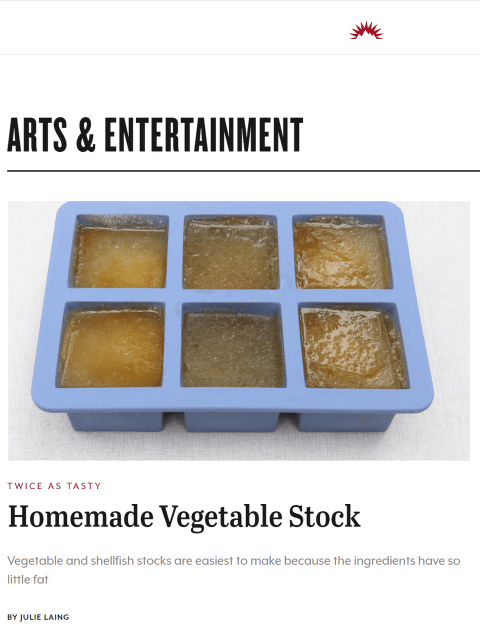
Homemade Vegetable Stock

When I make stock, it feels cost-free and effortless: I use whatever’s at hand, and it happens in the background of my day. Learn more at TwiceasTasty.com.
Any chef will point to stock as an easy way to add flavor. I use stocks the most from fall to spring, as the base for soups, to flavor rice or beans, and to round out sauces. Although you can simply use water in many of these dishes for the same effect, swapping in a stock gives a jump-start to a tasty meal.

Although many recipes include a stock in the ingredient list, they don’t mention how easy it is to make, either on the spot or in a large batch to freeze so that you always have a bit on hand. Store-bought stocks and broths may seem easier, but they add to your grocery bill, tend to be loaded with salt and preservatives, and can be thick enough that instead of giving light undertones of flavor they overpower a dish. When I make stock, it feels cost-free and effortless: I use whatever’s at hand, rather than buying ingredients specifically for it, and it happens in the background of my day, simmering on the stove while I prepare a meal or check other tasks off my to-do list.

This week, in my Twice as Tasty column for the Flathead Beacon, I share a stock recipe that uses whole vegetables so that you can learn the technique for making stock. Once you get a sense of the balance, you can swap in other vegetables and scraps so that you don’t spend time or money buying ingredients.
Learn to make Homemade Vegetable Stock

Fried Green Tomatoes

To successfully make fried green tomatoes, choose the right tomatoes and prepare them properly for the pan. Learn more at TwiceasTasty.com.
If you grow a garden, especially in a climate with a short growing season, you know that one of your last harvest decisions is what to do with green tomatoes. If you harvest them before they are damaged by frost, many green tomatoes will ripened indoors. You can also preserve tomatoes while they are still green. Some can be eaten fresh too.

I share one of my favorite ways to eat fresh tomatoes this week in my Twice as Tasty column for the Flathead Beacon: dredged in cornmeal and fried in a pan. Successfully making fried green tomatoes, with a just-soft, sweet interior and crisp outer shell that stays attached to each tomato slice, depends on the tomatoes you choose and the way you prepare them before you add them to the pan.
Learn to make Fried Green Tomatoes

Best DIY Salad Dressing

Using a basic ratio, you can make so many dressings in under 60 seconds. Learn more at TwiceasTasty.com.
After the heat of summer sent lettuces bolting, recent cool fall temperatures and rain mean salads are back. If you don’t grow your own salad fixings, you may not have noticed the shift from sweet, tender greens to bitter, coarse leaves. But home gardeners will be well aware of the change and have transitioned from lettuce-based salads to ones featuring heat-tolerant or late-season vegetables.

In a piece for Clean Pates earlier this summer, I shared my technique and ratio for making a collection of salad dressings. Even if you don’t grow salad greens, I’m a firm believer that you should make your own dressings. Among disappearing food traditions, one of the most lamentable is scratch-made salad dressing. As Mark Kurlansky writes in The Food of a Younger Land, “What could better spell the beginning of the end than bottled salad dressing, the manufacture of a product that was so easy to make at home?”

Easy is right: Using a basic ratio, you can make so many dressings. A pinch of this and dab of that completely change a dressing’s flavor. My technique clocks in under 60 seconds, and I can now eyeball the proportions without even dirtying measuring spoons.
Learn to make the Best DIY Salad Dressing

Crunchy Cabbage Salad

 I grow several cabbage varieties, some to ferment as sauerkraut, kimchi, and slaw and others to shred raw for my favorite salad. Learn more at TwiceasTasty.com.
Growing cabbage always presents challenges. In my short growing season, each plant produces one head but doesn’t really have enough time to form a second flush. It has a big garden footprint, and I have to protect it under a cover all season if I want to keep cabbageworms and loopers from calling it home. Some varieties need to be harvested midsummer, when everything else is begging for attention in the garden, so I need to check carefully for number of growing days to ensure a long, extended harvest.

Is it worth it? Clearly I’ve answered yes, because as I share in my Twice as Tasty column for the Flathead Beacon, I now grow several cabbage varieties. Some I enjoy fresh, especially as young, raw leafy greens. Others I ferment to have on hand all winter. But my favorites remain the raw crunchy heads that I shred for salads.
Learn to make Crunchy Cabbage Salad

Shrimp and Summer Squash Enchiladas with Homemade Enchilada Sauce

A homemade sauce and soft yet intact tortillas makes these enchiladas household favorites. Learn more at TwiceasTasty.com.
The enchiladas I share this week in my Twice as Tasty column for the Flathead Beacon have become household favorites. And that all started with the sauce. Before I began making my own enchilada sauce, I occasionally attempted this rich, cheesy dish when we wanted comfort food, but I never quite nailed the technique of getting the tortillas in that just-right place, ending up with ones that were mushy or crunchy. Then I found a sauce recipe I love and started putting up jars of it, which led me to track down the technique that keeps the tortillas soft and intact, making them the perfect vehicle for the homemade sauce.

The recipe I share here lets you make this delicious sauce in a smaller batch without the effort of canning it. If you fall for this sauce like I did, you can make a larger amount to process in a boiling water bath using the instructions in Tips & Tricks. The enchiladas themselves can have all sorts of fillings: as we transition from summer to fall, my favorite pairs homegrown summer squash with sautéed shrimp.
Learn to make Shrimp and Summer Squash Enchiladas with Homemade Enchilada Sauce