When I first moved to Montana and inherited my mom’s canning kettle, the first thing I canned was applesauce. I’ve never liked the flavor or texture of commercially made applesauce, and I’d missed the ready access to barely sweetened homemade versions every since I graduated high school and went off to university, a career, and traveling the world.
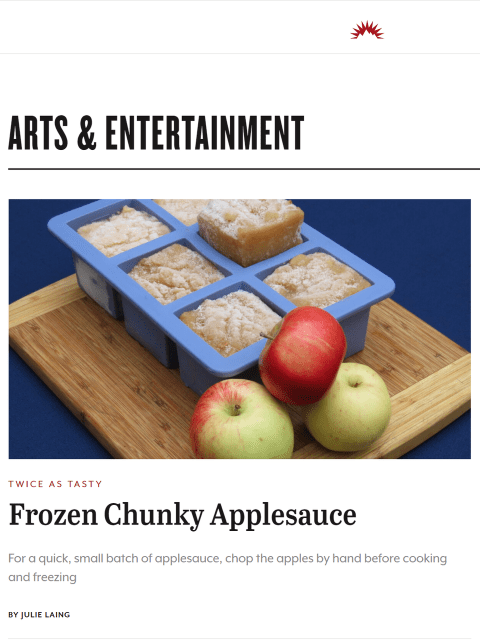
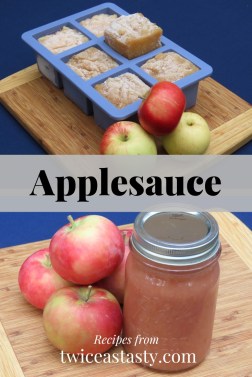
I share one of my favorite homemade versions this week in my Twice as Tasty column for the Flathead Beacon: Grandma Tiny’s Frozen Chunky Applesauce. This version requires no special tools (although I do like to freeze it in oversized silicone ice trays), and it can be made from just a few pounds of apples. My grandmother was probably in her mid-90s when she made her last batch, an indicator of how easy it is to make this recipe. If you have a lot of apples, you may want to scale this up to a canning project using the recipe I share later in this blog post.
Learn more about making and storing applesauce and get the complete recipe for Frozen Chunky Applesauce in my column.
 Make it, share it.
Tag @twiceastastyblog and #twiceastastyblog

Twice as Tasty
 When you’re making a small batch of frozen applesauce, you can chop all of the apples by hand fairly quickly. Start processing dozens of jars, and it becomes daunting.
A food strainer becomes an invaluable tool if you plan to sauce lots of apples, because it removes the peels, cores, and seeds. A range of sieve sizes make it equally useful for tomatoes, berries, and other foods. You can use a stovetop food mill or just hand-press the cooked apples through a sturdy sieve, but these options take more time and effort. I you don’t have a food strainer but want to can applesauce, I recommend just leaving the fruit chunky—and gathering a crew to help with peeling and chopping by hand.
I inherited a Victorio food strainer with my mom’s canning kettle, and it still churns through several boxes of apples with ease. I like its large, wide hopper, but the hand crank can be tiring by the second box. We modified it for battery power by attaching a Makita drill to the crank shaft and running it at low speed. The current model of this strainer, now made by VKP Brands, has an optional motor attachment. I recently had the chance to try a similar strainer that attaches to a KitchenAid mixer. It worked quite cleanly and smoothly, but I did miss the large hopper of the table-clamped model.
This canning recipe follows Ball and U.S. Department of Agriculture guidelines and can be safely made in a smooth or chunky style. You can find the detailed technique, along with info about other canning tools and tips, on the Canning Basics page. I’ve scaled this recipe for a 9-pint batch, which fits in my stovetop water bath canner. For a 7-pint batch and more detailed chunky-style instructions, see my original post.
Ready to give it a try? Full details are in the recipe below, but here are the basics:
You just need several pounds of apples plus some spices and a little sweetener, if desired. You’ll also need your canning setup and a food strainer to make smooth sauce.
1. Quarter the apples.
2. Cook them until soft.
3. Run them through the food strainer.
4. Heat the sauce and flavorings.
5. Process in a boiling water bath.
Make it, share it. Tag your photos: @twiceastastyblog and #twiceastastyblog
Canned Smooth-Style Applesauce

1/4 cup lemon juice
2/3 cup apple cider or water
2-1/2 tablespoons honey (optional)
2-1/2 teaspoons ground cinnamon
2/3 teaspoon ground nutmeg
Wash the apples, remove any stems, and cut the apples into quarters. As you work, add them to a very large, heavy-bottomed stockpot, tossing the fruit with the lemon juice to reduce discoloration. Add the cider or water.
Bring the apples to a boil over medium-high heat, stirring regularly. Decrease the heat to a simmer, partially cover the pot, and cook for about 10 minutes, until the apples soften. Stir often to keep the batch cooking evenly, and add water as needed to prevent the apples from burning. Remove the pot from the heat and let sit until the apples are cool enough to handle.
Set up your food strainer per the manufacturer’s instructions, installing the appropriate screen and spiral for apples. Working in batches, scoop the warm, cooked apples into the hopper until it is about half full. Turn the strainer to a low speed or start turning the hand crank, and use the food pusher to guide the food into the strainer, collecting the smooth sauce in a large bowl. Continue feeding apples through the strainer, swapping in clean bowls as they fill, until the stockpot’s contents have been processed.
Scrape the stockpot clean of any seeds and skins, and refill it with the strained sauce. Return the sauce to a boil over medium-low heat, stirring frequently. Stir in the honey, cinnamon, and nutmeg, and return the sauce to a simmer.
Ladle the hot applesauce into hot pint jars, leaving 1/2-inch headspace. Process in a boiling water bath for 15 minutes, plus your altitude adjustment. Makes about 9 pint jars.
Tips & Tricks
- You can safely can applesauce made with just apples and water, but I’ve found that the lemon juice helps them keep their color and that cider and spices improve the flavor. I like the hint of honey, but you can swap in maple syrup or brown or raw cane sugar or leave it unsweetened.
- The color of your applesauce may vary depending on the apples you choose. I prefer a mix of varieties, especially tart and sweet ones, but sticking with one variety can result in a pink or creamy sauce. The cinnamon will darken the finished blend slightly.
- Add some liquid to the pot to keep the fruit from burning while it comes to a boil. If you’ll be preparing multiple batches, you can leave some of the cooked-down apples and their juices in the pot to speed up the next round and then reheat the sauce batches in a separate stockpot.
- I find pint jars of applesauce to be most useful when I’m swapping it for oil in quick breads and cakes. You can also safely can it in quart jars, which may be ideal if you make a lot of fruit leather: just add 5 minutes to the processing time (before your altitude adjustment). Half-pint jars can be processed for the same amount of time as pint jars.
Want more Twice as Tasty recipes? Get my books! Click here to order a personally signed, packaged, and shipped copy of The Complete Guide to Pickling directly from me. I also share tasty ways to use pickles in The Pickled Picnic; it’s only available here.
Discover more from Twice as Tasty
Subscribe to get the latest posts sent to your email.

A food mill is a handy device to have in the kitchen.
LikeLiked by 1 person