Rhubarb–Vanilla Syrup

Fruit syrup concentrate is easy to make and stash in your fridge or freezer for homemade spritzers and cocktails. Learn more at TwiceasTasty.com.
We tend to buy fruity sparkling waters and hard seltzers in cans, but bottles of fruit syrup concentrate are easy to make and stash in your fridge, or freeze in ice trays, for homemade spritzers and cocktails. You can also play with flavors you’re unlikely to find on the store shelf, like the tart–sweet rhubarb syrup I share this week in my Twice as Tasty column for the Flathead Beacon.

The technique for making fruit syrups that you plan to use in beverages is simple. I make them from spring to fall with fresh fruit, cycling through flavors as they ripen. In winter, you can make them with fruit from the freezer in the same way you make Frozen Strawberry Syrup to pour over pancakes or waffles—just don’t let it cook as long to keep it fully pourable.
Learn to make Rhubarb–Vanilla Syrup

Homemade Vanilla Extract

If you store vanilla beans in alcohol, they not only create vanilla extract for you but also stay mold free. Learn more at TwiceasTasty.com.
I’ve been working on pieces lately with recipes that are so simple but that have become more common as store-bought items for most people, including salad dressings, herb salt, and the latest recipe in my Twice as Tasty column for the Flathead Beacon: homemade vanilla extract. Beyond all of the reasons I give in my column for turning vanilla beans into extract, I’ve found that the process essentially acts as my vanilla bean storage system, keeping the expensive pods from spoiling.

Most grocery stores sell vanilla beans a pod at a time, the long, thin, dark shape tucked into a vial. Depending on how well it’s been sealed, the bean might be oily and pliable or dry and brittle. Sellers recommend keeping the bean as packaged until you need to use it but airing it out if you still have it 3 to 6 months later. I hadn’t realized how crucial this was until a friend who had bought oily, pliable vanilla beans in a vacuum-sealed pack opened the bag one day to find they had molded. But if you store the beans in alcohol, they not only create vanilla extract for you but also stay mold free. Just make sure they’re completely submerged.
Learn to make Homemade Vanilla Extract

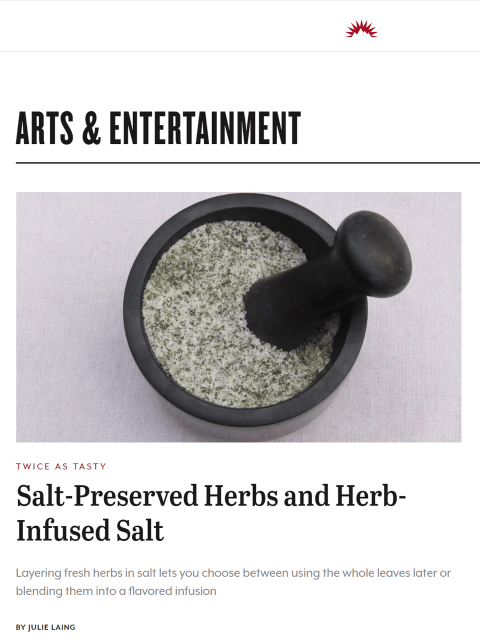
Salt-Preserved Herbs and Herb-Infused Salt

If you’re a fan of flavored salts, the recipe in my latest Flathead Beacon column is for you. Learn to make Salt-Preserved Herbs and Herb-Infused Salt. Learn more at TwiceasTasty.com.
If you’re a fan of flavored salts, for your own kitchen or to give to others, the recipe in my latest Twice as Tasty column for the Flathead Beacon is for you. Herb-infused salts are so simple to make, can be flavored with almost any homegrown herb, and keep a year or more. You can use them like plain salt when cooking or at the table, or you can intentionally showcase them as a finishing salt on any dish, sprinkling them on just before serving.

You can also swing the salt-and-herb pairing the other way, with more emphasis on using the herbs than the salt. Whole herb leaves preserved in salt stay soft and pliable, letting you use them like fresh leaves long after their parent plants have died back and gone dormant under a blanket of snow. The salt keeps bacteria and mold at bay and picks up hints of the herb’s flavor, remaining usable after you’ve pull the last leaf from the jar.
Learn to make Salt-Preserved Herbs and Herb-Infused Salt

Herbed Bean Salad

 After several evolutions, this salad has become a spring favorite, tossing warm beans with the first lettuces and herbs to appear in my garden. Learn more at TwiceasTasty.com.
The other day, I was asked how I come up with my recipes. The inspiration varies, but they’re like jazz tunes: once published, I continue to play and let them evolve. The recipe in my latest Twice as Tasty column for the Flathead Beacon is among those that I’ve been riffing on for years.

The salad began as a way to use some of my favorite homemade condiments, which I later included in my cookbook, The Complete Guide to Pickling: the bright pink vinegar and softened flowers of Pickled Chive Blossoms, the complementary flavor of German-Inspired Spicy Mustard, and Pickled Nasturtium Seeds as the homegrown stand-in for capers. To feature Quick Homemade Mozzarella, I plated the salad in layers with slices of fresh cheese and encouraged my cheese-making workshop students to do the same. Then I revised the recipe to share with buyers of vertically farmed fresh greens, using it to showcase the brand’s baby spinach, arugula, and chard. When the company shut down, I altered the recipe again, tossing the warm beans with the first lettuces and herbs to appear in my garden each spring: spinach, arugula, butter lettuce, chives, and sorrel.
Learn to make Herbed Bean Salad

Warm Quinoa and Feta Salad

There’s something special about salads made with spring's first herbs and greens from plants that bravely withstand 50°-plus temperature swings. Learn more at TwiceasTasty.com.
We’ve had our usual cyclic spring weather in Montana, with a high of 76°F on Sunday followed by nights in the 20s. It makes me appreciate even more the first spring greens and herbs that eagerly pop through the sun-warmed soil and then tough out the crisp nights and frosty mornings. As I share this week in my Twice as Tasty column for the Flathead Beacon, my first spring salads mainly consist of store-bought ingredients and sneak in handfuls of whatever garden treats appear first for fresh pops of green.

I make variations on these spring salads throughout the growing season, transitioning to homegrown summer vegetables and herbs as the weeks pass. But there’s something special about the ones made with those first perennial and self-seeded herbs and greens, the plants that bravely leaf out through 50°-plus temperature swings.
Learn to make Warm Quinoa and Feta Salad

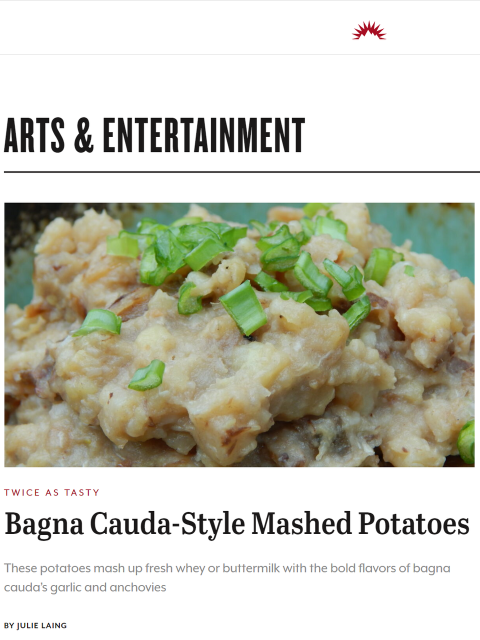
Bagna Cauda-Style Mashed Potatoes

As the first perennial edibles show off their bright green tops, I snip handfuls onto whatever I’m using up from last season’s harvest. Learn more at TwiceasTasty.com.
This time of year, I’m always pairing what remains of last season’s harvest with the first of spring’s perennial edibles. As they push through the ground and show off their bright green tops, I can’t help but snip a handful at a time onto whatever I’m trying to use up from dry storage or the freezer.

That approach to homegrown produce applies to this week’s Twice as Tasty column for the Flathead Beacon. In my unheated mudroom, the last of the potatoes that we dug and cured in October have begun to sprout in their storage box, an old, lidless cooler with a few shims in the bottom to allow air circulation and a towel thrown over the top to keep the light out and the potatoes from turning green. They’re still firm and ideal for mashed potatoes. The final garlic heads and onion bulbs are also trying to sprout but haven’t softened. All it takes is a sprinkling of the emerging onion tops cut from perennial walking onions to make the storage vegetables worthy of a spring meal.
Learn to make Bagna Cauda-Style Mashed Potatoes

Berry Chocolate Muffins

Once you start baking with whey and cultured dairy, you’ll find a place for them in everything from biscuits to cake. Learn more at TwiceasTasty.com.

As much as I enjoy baked goods, I don’t really have a sweet tooth. My favorite pastries minimize the sugar and boost the flavor, so I incorporate some unexpected ingredients into my recipes. One of those ingredients appears in the recipe I share this week in my Twice as Tasty column for the Flathead Beacon. I make Berry Chocolate Muffins with the whey left from draining Homemade Yogurt to thicken it. Not only does it add nutrients and tanginess to the muffins, but I avoid pouring the whey down the drain, a practice that can lead to environmental problems when dumped on a commercial scale.

My next choice for the liquid in these muffins is Cultured Buttermilk, the tastier and thicker version of an artificially thickened store-bought buttermilk or the milk you hastily spike with lemon juice to hint at the soured flavor. Once you start baking with these liquids, you’ll find a place for them in everything from biscuits to cake.
Learn to make Berry Chocolate Muffins

Golden Baked Custard

Once you become comfortable with making custard, fancier desserts are just a topping away. Learn more at TwiceasTasty.com.
Although my family probably ate baked custard for dessert, I mostly remember it as an afterschool snack, scooped from a well-worn casserole dish and served without ceremony. It seemed like the homemade, comforting equivalent of vanilla pudding.

It wasn’t until I started experimenting with custard-based desserts at home, like flan and crème brûlée, that I realized the creations that can fetch high prices at an upscale restaurant are really just stylish versions of old-fashioned baked custard. As I explain this week in my Twice as Tasty column for the Flathead Beacon, once you become comfortable with making custard, fancier desserts are just a topping away. The main transition from old-fashioned baked custard to the more exotic sounding desserts is a caramel sauce, made by simply heating sugar until it melts and becomes golden, or a crunchy caramelized sugar shell, best achieved with a kitchen torch.
Learn to make Golden Baked Custard

Weeknight Pasta with Roasted Pumpkin and Parmesan

I can’t think of a better way to celebrate the arrival of spring than with last season’s harvest. Learn more at TwiceasTasty.com.
When spring arrives, I start watching bulbs grow by the hour—and inspecting my storage vegetables for their waning freshness. Over time, I’ve become better at choosing varieties that keep well, curing them properly, and storing them so that they stay fresh and usable for many months. By the first day of spring, I still have dry-stored vegetables tucked away. As I dig through the stash, I usually find one surprising keeper that has held on longer than in any other year.

This year, it was winter squash, as I share this week in my Twice as Tasty column for the Flathead Beacon. I just made the column’s recipe with the last of my delicata squash, swapping it for the pumpkin. I’ve been growing long-keeping onions, which I used instead of shallots, and am still enjoying a small basket of garlic just making its first attempts to sprout. My supply of homegrown and dehydrated herbs has begun to wane but will see me through until the next crop. I can’t think of a better way to celebrate the arrival of spring than with last season’s harvest.
Learn to make Weeknight Pasta with Roasted Pumpkin and Parmesan

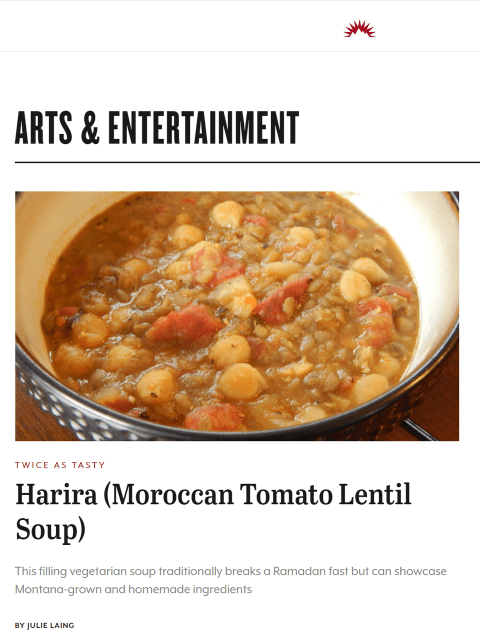
Harira (Moroccan Tomato Lentil Soup)

I’ve been playing with five varieties of lentils this month, including reds for dosas, Puy lentils for a crispy snack, and green ones in soup. Learn more at TwiceasTasty.com.
I’ve been having such fun with lentils since I taught a workshop on these little seeds at the beginning of the month for Free the Seeds. I took five varieties of lentils to the class, which means I now have five varieties at home to play with. I’ve been doing just that. In the workshop, we looked at of fermented Red Lentil and Basmati Dosa batter, so I spent a few days enjoying dosas wrapped, taco-style, around Indian-Inspired Sweet-and-Sour Potatoes or served under basted eggs.

We also looked at sprouted Puy or French lentils in the workshop, which I then baked into Crispy Sprouted Lentils. I’ve piled these on corn tortillas with avocado and Lime-Pickled Onions and even took them to a sushi workshop as a garnish. I share yet another recipe that uses green or brown lentils this week in my Twice as Tasty column for the Flathead Beacon.
Learn to make Harira (Moroccan Tomato Lentil Soup)