
Stir-fry, the technique and the dish, seems so straightforward and adaptable to so many ingredients that you don’t need a recipe. But a quick Web search pulls up endless recipes and varied methods for making them. Some geek out with tools like a wok burner, blow torch, or outdoor grill to mimic the ultrafast, high-heat smokiness achieved by a commercial range. Others vie for the title of easiest stir-fry by tossing sautéed vegetables with store-bought teriyaki sauce.
Whether you trend toward geeky or easy on the stir-fry scale, the recipe I share this week in my Twice as Tasty column for the Flathead Beacon fits into your regular meal rotation. It runs through the essential dos and don’ts and includes a quick, flavor-packed homemade sauce. The fresh vegetables you use make each one-dish meal unique.
Learn to make Mixed Vegetable Stir-Fry
Category: fresh eating
Crispy Pan-Fried Tofu

When I see recipes that aim to make tofu crispy, I’m often surprised by the various ingredients and effort applied—and even more surprised when I find they don’t achieve the desired effect. As I explain this week in my Twice as Tasty column for the Flathead Beacon, the process of making tofu crispy is simple. It requires just two ingredients, tofu and oil. It can be broken into just four key steps: remove excess moisture, use a hot pan and splatter shield, leave space around each piece, and wait to flip the tofu until it releases easily.
When I make tofu in this way, it comes out perfectly crisp every time, whether I’ve cut the tofu into cubes for a stir-fry, thick rectangles for a satay, or flat slabs for a sandwich. I typically reach for my largest cast-iron skillet, but any well-seasoned or nonstick pan that can be safely set over medium-high heat does the job. I prefer a mesh splatter shield to a silicone one; the latter tends to collect condensation that then drips back into the hot oil.
Learn to make Crispy Pan-Fried Tofu
Smashed Bean Pasta

We often put a meaty protein on pasta—fish and shellfish, chicken breast, all sorts of meat ground and shaped into meatballs. Yet we tend to overlook the pairing of pasta and beans, a prime vegetable source of protein. Whereas Mexican restaurants have made rice and refried beans an American staple and the Southern population has long served up red beans and rice, the Italian tradition of pairing pasta with beans hasn’t caught on.
That will hopefully change in your household with this week’s recipe in my Twice as Tasty column for the Flathead Beacon. It’s an easy, filling meal that can be made at the last minute from ingredients in the pantry. Leave off the cheese for a vegan version, and pile in olives for a little zing. By smashing some of the beans, they find their way, along with the tomato juices, into the pasta’s holes and pockets.
Learn to make Smashed Bean Pasta
Tomato–Basil Mac and Cheese

Mac and cheese lands firmly in my comfort food category, and I do my best not to feel guilty about biting into that cheesy, gooey pasta—especially when I make a pan that feeds eight people for our household of two. As I share this week in my Twice as Tasty column for the Flathead Beacon, one way I decrease the guilt factor while boosting the flavor is to load vegetables into the dish. This works in summer and fall with the garden harvest and in winter and spring with homegrown produce that I preserved for just such uses.
In fact, I originally wrote this recipe for frozen cherry tomatoes, frozen cubes of basil pesto, and grilled and frozen onion. Sometimes I use home-canned tomatoes instead or, when I deplete my stash, store-bought cans of diced tomatoes. Dried basil works well too. Still, when you have fresh in-season options, they give the best flavor and the prettiest meal.
Learn to make Tomato–Basil Mac and Cheese
Hot and Sour Shrimp and Noodle Soup

This week’s Twice as Tasty column for the Flathead Beacon takes the recipe from the prior week, Hot and Sour Broth Base, and walks you through one of my favorite ways to turn it into a full-fledged soup. Just looking at the photo makes me want to fix a bowl for lunch today.
That’s easily done: At lunchtime, I’ll rehydrate a couple of dried shitake mushrooms in hot water and thaw a few shrimp in cold running water while I gather the other ingredients. Cubes of broth base and Homemade Shrimp Stock pulled from my freezer go straight into the pot, as do the noodles. A handful of shrimp take seconds to peel, and I’ll add their shells to the bag in my freezer awaiting my next stock-making day. Shallots, garlic, and cilantro also take seconds to prep in such a small amount. By the time my prep is done, the mushrooms will be soft and I can fill the soup pot, with lunch ready in about 15 minutes.
Learn to make Hot and Sour Shrimp and Noodle Soup
Three-Bean Salad with Fresh Herbs

By the time the garden’s snap beans are ready, many of its salad greens have gone to seed. But that doesn’t mean I stop making salads. Instead, my salads become heartier, with varieties of snap and dried beans and fresh herbs standing in for greens. I share one of my favorite renditions, a three-bean salad with homemade Creamy Balsamic Salad Dressing, this week in my Twice as Tasty column for the Flathead Beacon.
Like all salads, you can adapt this one to the seasons and the ingredients you have on hand. My favorite cheeses for this salad include Cold-Smoked Mozzarella and Homemade Farmer’s Cheese. When I’ve put the garden to bed for the season, I still make this salad with the Classic Dilly Beans or the Szechuan-Peppered Snap Beans in my pickling cookbook. When even my herbs have died back for the year, my stockpile of homegrown and dried herbs provides plenty of flavor.
Learn to make Three-Bean Salad with Fresh Herbs
Green Goddess Salad Dressing

I’m such a lover of all things pickled and fermented that most of my salad dressings start with vinegar and oil. So when I was asked to create some condiments for a large dinner a few years back, I knew I needed to branch out not just with a creamy choice but also one that would appeal to as many dietary needs as possible: vegan, gluten free, keto friendly, and more. That’s why the salad dressing I share this week in my Twice as Tasty column for the Flathead Beacon eschews the original mayonnaise and other dairy-heavy renditions in favor of a dairy-free, avocado-based blend.
Avocados have grown in popularity as a nondairy fat replacement in baked goods—the same way I often replace oil and butter in quick breads with applesauce. I occasionally use avocados in this way, especially when making desserts for vegan friends. But I typically eat avocados sliced fresh, such as on corn tortillas with Crispy Sprouted Lentils, or turn them into Grilled Onion Guacamole. I even have a recipe for pickling them in my pickling cookbook. If you like tangy salads, try the pickled avocado slices in the green goddess dressing.
Learn to make Green Goddess Salad Dressing
Grilled Tomato Bloody Mary Mix

If you’ve been following the Twice as Tasty blog from the beginning, you might remember how the entire idea of writing a food blog started with my grilled tomato recipes, especially the bloody Mary mix recipe that I share this week column for the Flathead Beacon. The recipe has improved with every season as I fine-tuned a balance between chunky salsa in a glass and thin, overly drained juice. For a long time, I blended some tomato solids back into the juice, but this left slightly chewy bits and too many seeds. I’ve finally settled on using a large-holed colander to separate juice and solids and then pressing the result through a fine-mesh strainer to leave just the seeds behind.
This recipe has also evolved from one I jarred and sealed in a boiling water bath to one I prefer to make in batches from the freezer. The frozen juice tastes fresher, and it keeps the smoky tomato juice on hand for easy winter lunches like Tomato Juice Soup.
Learn to make Grilled Tomato Bloody Mary Mix
Stuffed Squash Blossoms

If you’re the type of person who picks honeysuckle blossoms on the trailside to taste drops of their sweet nectar, start looking around your garden for other edible flowers. The most obvious will likely be squash blossoms to stuff and fry, as I share this week in my Twice as Tasty column for the Flathead Beacon.
Squash blooms have delicate petals atop a stiff base, so handle them with care as you harvest them and fill their cavity. Cut them off where the green stem base meets the main plant, but wait to cut off the stems and remove the stamen, which can taste bitter, as you prep them for shallow pan frying.
Most edible garden blooms wilt quickly, so it’s best to use them as soon as you harvest them. But since I recommend a midmorning harvest, you can keep squash blossoms in a cool, dry place, or in a pinch in the refrigerator, if you won’t serve them until the evening. You might be able to get away with holding them over for a day to use as garnish, but they will be challenging to stuff and rip easily. If you do tear one down its side, fill it carefully and then try using a drop of batter almost like glue to hold it together until it hits the sauté pan.
Learn to make Stuffed Squash Blossoms
Watermelon and Feta Salad
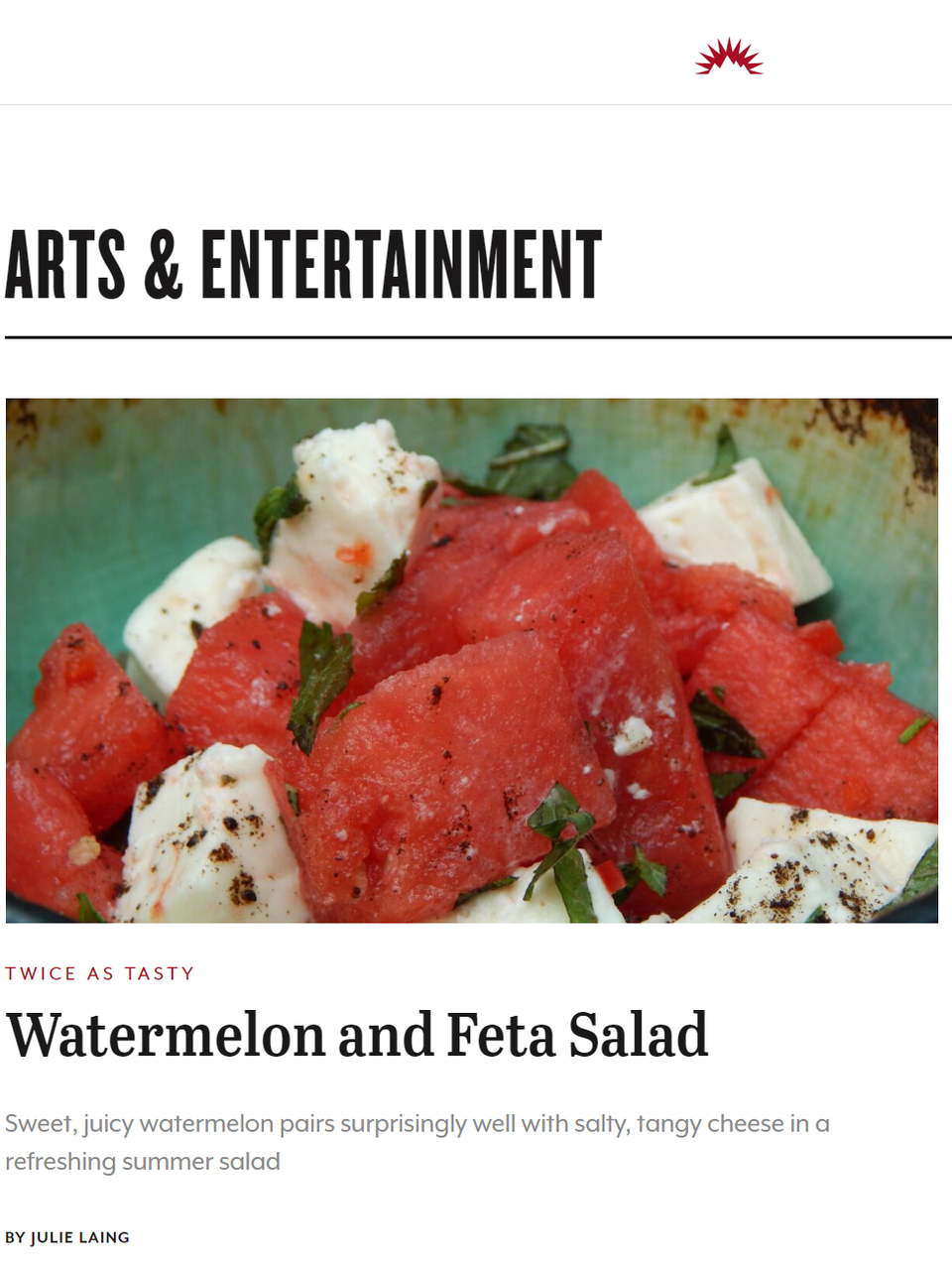
The recipe I share this week in my Twice as Tasty column for the Flathead Beacon gets right to the heart of summer, pairing sweet, juicy watermelon with tangy, salty feta cheese. Like many of my favorite recipes that use feta, you can buy a high-quality block in brine for this salad. I like a creamy Bulgarian sheep’s milk feta, which holds its shape well, or the sharp taste of Greek sheep’s milk feta alongside the sweet melon.
My favorite pairing is homemade Dry-Salted Feta. Even when I use whole cow’s milk instead of milk from goats or sheep, it has far superior flavor and texture to the crumbly, dry store-bought American feta made from skimmed cow’s milk. The hardest part about making feta is holding the milk at a steady temperature for a couple of hours—a challenge that is far easier amid summer’s heat than during freezing winter months.
Learn to make Watermelon and Feta Salad
