Fresh Yogurt Smoothie

If store-bought smoothies always seem more delicious than your homemade ones, start by adjusting the balance of thickener, fruit and vegetables, and add-ins. Learn more at TwiceasTasty.com.
When the smoothie shop craze took off in my college years, I was surprised by how popular such an easily made beverage became, particularly when shops included ingredients that made smoothies more like milkshakes. One reason for the popularity seemed to be the long menu of flavors and add-ins. As I explain this week in my Twice as Tasty column for the Flathead Beacon, you can create similar smoothies far more affordably and with local ingredients if you have a well-stocked freezer.

If store-bought smoothies always seem more delicious than your homemade ones, you might need to check the label for sugar and sodium content and alter your expectations. You also might need a higher-powered blender to liquify vegetables and break down chunks. As further adjustments, consider the balance of fruit and vegetables, add-ins, and thickener and using my favorite base, Homemade Small-Batch Yogurt.
Learn to make Fresh Yogurt Smoothie

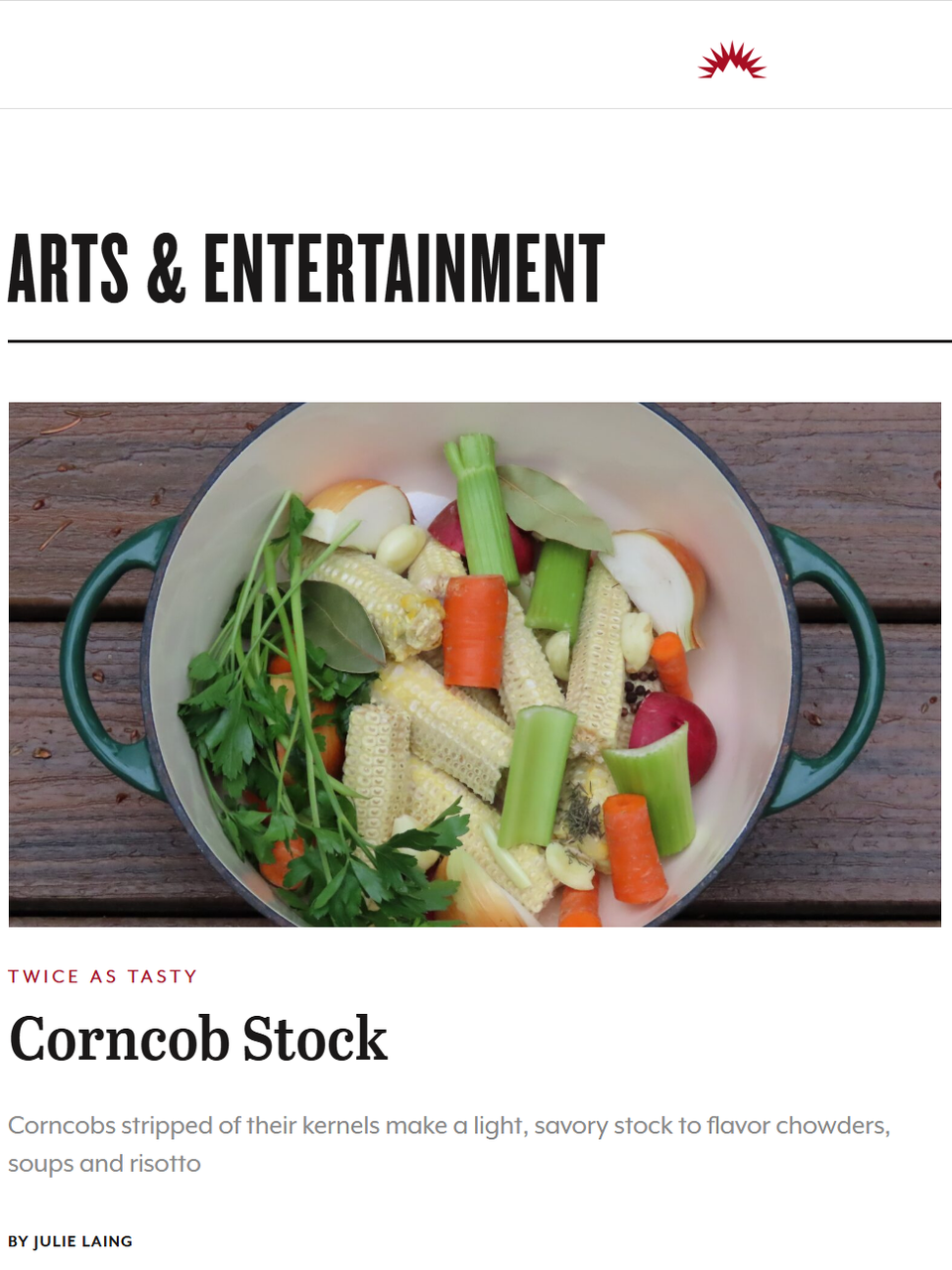
Corncob Stock

I make versatile, no-waste stock from a large batch of Husk-Grilled Corn after I’ve stripped the kernels off of the cobs to freeze for year-round use. Learn more at TwiceasTasty.com.
I love recipes like Corncob Stock because they turn food scraps into something delicious that you can’t easily buy. As I explain this week in my Twice as Tasty column for the Flathead Beacon, stock made from corncobs not only uses scraps but helps the cobs to break down faster in the compost.

I make this versatile stock from a large batch of Husk-Grilled Corn after I’ve stripped the kernels off of the cobs to freeze for year-round use in recipes like Corn Kernel Muffins with Sage. With the kernels set aside to eat and the cobs simmered into a flavorful stock, you’ve minimized waste and captured maximum flavor with little effort.
Learn to make Corncob Stock

Blackberry-Orange-Basil Sorbet

Nine years into writing this blog. I’m still having such fun playing with all sorts of food, including slipping botanicals into unexpected recipes. Learn more at TwiceasTasty.com.
We’ve had such warm weather lately that it was a joy to mix up a batch of berry sorbet in celebration of family birthdays—and 9 years of writing this blog. If you’ve been following along from the beginning, you’ve witnessed how my little personal food project expanded to include a pickling cookbook, the Twice as Tasty column for the Flathead Beacon, and articles and recipes for many other websites. I’m still having such fun playing with all sorts of food, especially slipping botanicals into unexpected recipes like sorbet.

Blackberries aren’t yet in season in the mountain and northwest regions, so I made this sorbet recipe from frozen fruit foraged last year and it tasted just as delicious as if the berries were fresh. Basil is just starting to produce enough leaves to sneak a few from the hoop house plants, although I also considered mint or thyme. The berries give this sorbet such an intense flavor that the herbal notes remain subtle, so experiment with whatever is at hand.
Learn to make Blackberry-Orange-Basil Sorbet

Hot and Sour Broth Base

For homemade soup that can be as effortless to serve as popping open a can, keep a soup base in the freezer. Learn more at TwiceasTasty.com.
The recipe I share this week in my Twice as Tasty column for the Flathead Beacon is all about the balance between effort and result. When you make real meals from scratch, the result can be phenomenal. But those meals usually take more effort than an off-the-shelf substitute.

I’ll always remember one of the comments I saw about my first recipe in the Flathead Beacon, 30-Minute Tomato Soup. Someone was appalled that it would take so long to make tomato soup when she could just pop open a can and heat it in the microwave. She completely missed the point of the recipe—and to this day is likely missing out on its rich flavor.

That reader will likely be just as snarky about this week’s recipe, even though its point is to achieve the equivalent of popping open a soup can by doing the bulk of the work ahead of time and keeping a hot and sour soup base in the freezer. But if you make that advanced effort, the result tastes amazing, even if all you do is heat up a couple of frozen cubes in a mug of stock.
Learn to make Hot and Sour Broth Base

Homemade Shrimp Stock

Homemade stocks are flavor-boost shortcuts in all sorts of dishes and cost nothing if you save trimmings and scraps. Learn to make Homemade Shrimp Stock. Learn more at TwiceasTasty.com.
Homemade stocks are one of my favorite shortcuts for an immediate flavor boost in all sorts of dishes. They cost nothing if you save vegetable trimmings, shrimp shells, and other scraps. They’re easy, adaptable, and take minimal effort. Save the scraps in a zip-close bag until it’s full, and you can make potful of stock to freeze in usable portions so that when you need it, it’s ready to go.

This week, I share my shrimp stock recipe in my Twice as Tasty column for the Flathead Beacon. It’s the bonus of buying raw shrimp in the shell and cleaning it yourself—beyond the improvements in flavor, texture, cost, and more that come from choosing raw over precooked, peeled shrimp. The recipe lists ingredients in whole counts, but you can save scraps to approximate equivalents. Bag and freeze enough tops and bottoms of onions and celery from nightly meals until you have the equivalent of two whole each. Zest the lemons before you add them to the stock pot, freezing the zest if you don’t have an immediate use for it. Fresh herbs that have gone soft and wilted, but not mushy, are ideal for use in stocks like this one.
Learn to make Homemade Shrimp Stock

Black Bean Veggie Burgers

Balancing flavor and freezability was my goal when developing a homemade black bean burger, and I succeeded with this recipe. Learn more at TwiceasTasty.com.
Like many homemade versions of popular prepackaged foods, veggie burgers can taste exponentially better when mixed from fresh ingredients than pulled from a grocery store’s freezer section. Unfortunately, scratch-made versions often underperform their commercial counterparts when it comes to structure. As I note this week in my Twice as Tasty column for the Flathead Beacon, I’ve eaten many delicious handmade veggie burgers that need to be eaten straight from the pan because the leftovers readily fall apart. Yet the ability to pull a vegetarian-friendly burger from the freezer and slap it on a clean grill is its key selling point for summer parties and quick dinners.

Balancing flavor and freezability became my goal when developing a black bean burger recipe, and I was so successful that I make double or triple batches for summerlong enjoyment. I’ve made these burgers with fresh-from-the-garden vegetables or ones pulled from the freezer, grilling or sautéing them to intensify their flavor and work out much of their natural moisture. A couple of patty-forming tricks create burgers dominated by vegetables and beans, packed with herbs and spices, and easy to freeze, reheat, flip, and serve, one compact patty at a time.
Learn to make Black Bean Veggie Burgers

Choosing Deep Freezers

For my first All Recipes article, I dug into my deep freezer and perused those of family and friends. Learn more at TwiceasTasty.com.
Of all the places I store the garden’s bounty and homemade treats, from canning to dehydrating to dry storage, my deep freezer is probably my favorite. Yet it’s one of the smallest models you can buy. That makes each cubic foot of space prime real estate in my world, and I’ve been filling every inch of it for more than 15 years. I explain why this little freezer works so well in my first piece for All Recipes.

If you’re looking for a deep freezer and have limited space, I’ve found my 7.0-cubic-foot model ideal for a couple. As I searched for the best models for homes with fewer space constraints, family and friends generously let me peruse their freezers to discover the styles and sizes they prefer and why. Their experiences shaped my choices for various freezer categories.
Learn about choosing and using deep freezers

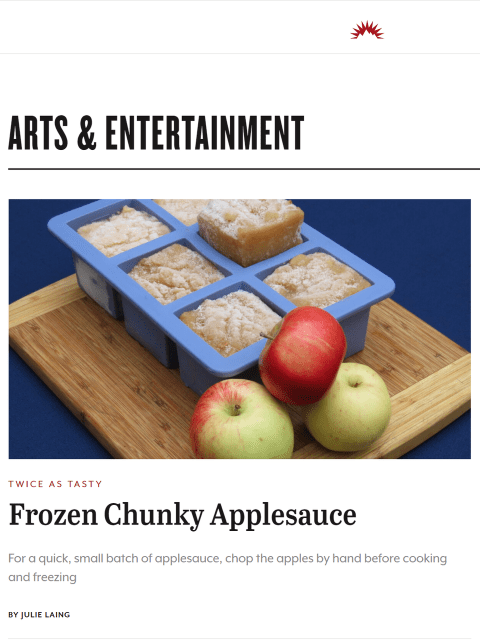
Frozen Chunky Applesauce

This version of homemade applesauce requires no special tools and can be made from just a few pounds of apples. Learn more at TwiceasTasty.com.
When I first moved to Montana and inherited my mom’s canning kettle, the first thing I canned was applesauce. I’ve never liked the flavor or texture of commercially made applesauce, and I’d missed the ready access to barely sweetened homemade versions every since I graduated high school and went off to university, a career, and traveling the world.

I share one of my favorite homemade versions this week in my Twice as Tasty column for the Flathead Beacon: Grandma Tiny’s Frozen Chunky Applesauce. This version requires no special tools (although I do like to freeze it in oversized silicone ice trays), and it can be made from just a few pounds of apples. My grandmother was probably in her mid-90s when she made her last batch, an indicator of how easy it is to make this recipe. If you have a lot of apples, you may want to scale this up to a canning project using the recipe I share later in this blog post.
Learn to make Frozen Chunky Applesauce and a smooth home-canned variation

Compound Herb Butter

I save homegrown herbs in many ways, but one of the easiest may be mixing them into butter. Learn more at TwiceasTasty.com.
I save homegrown herbs in many ways, but one of the easiest may be mixing them into butter and freezing them, as I share this week in my Twice as Tasty column for the Flathead Beacon. This technique for making compound herb butter is also ideal for a bunch of fresh herbs you’ve purchased but won’t use up before they start to fade, since you only need 2–4 tablespoons for each stick of butter.

I typically mix up small, fresh portions of flavored butters to use immediately, like my favorite lime butter for grilled corn. Small batches of compound butter keep well in the refrigerator for a few days. For longer storage, freeze “logs” of herb butters and use them throughout the year.
Learn to make Compound Herb Butter

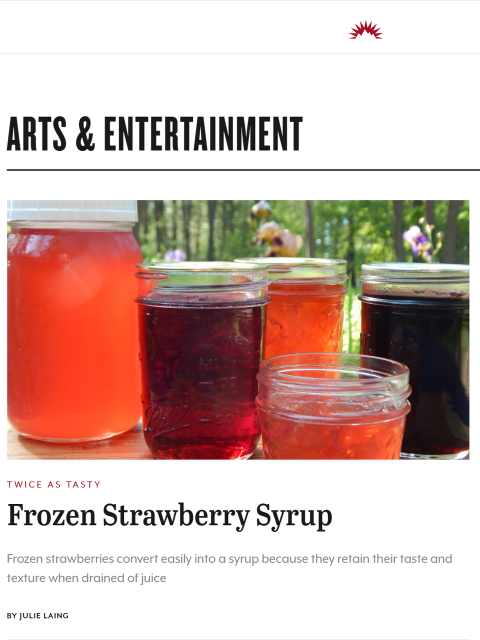
Frozen Strawberry Syrup

Take just one bag of fruit from the freezer and turn it into a jar of syrup for the fridge. Learn more at TwiceasTasty.com.
The first year I canned fruit syrups, I gifted my sister a couple of jars. The next year, she asked for a full box of jars filled with the jewel-toned syrups. In her house, they get used more often than jams: drizzled on pancakes or waffles, stirred into yogurt, blended into smoothies, and more.

I like making summertime fruit syrups because I can pair fruit and herbs in the same way I do for shrubs, ending up with a sweet concoction rather than a sweet-and-tangy vinegar-spiked one. The downside, as with jelly, is that it takes a lot of fruit to fill a canner-load of jars. So I created a recipe for my Twice as Tasty column this week for the Flathead Beacon that takes just one bag of fruit from the freezer and turns it into a jar of syrup you can keep in the fridge.
Learn to make Frozen Strawberry Syrup