
Smoky Homemade Chili Paste

Make chili paste as spicy as you like by featuring a single variety of fully ripened red chilies or a mix of heat and color. Learn more at TwiceasTasty.com.
Homemade hot sauces have become all the rage, because they’re simple to make, last for months, and customizable to an ever-widening variety of chilies at a range of heat levels. I included several in my pickling cookbook, from long-fermented red hot sauce and garlicy sriracha, to quick green and red vinegar-based hot sauces with red chilies and tomatillos, to thicker spicy pastes popular in Southeast Asia and North Africa. A home-smoked chili paste, the result of my first exploration into making hot sauce, didn’t make it into the book, but I share it this week in my Twice as Tasty column for the Flathead Beacon.

Like other hot sauces, you can make this paste as spicy as you like. My batch varies every year because I typically make it as the growing season is winding down. I usually grow a half-dozen types of hot peppers, from mild pepperoncini to spicy Thai chilies, and whatever is left on the plants in small enough quantities not to pickle or dry on their own ends up mixed together on a grill tray over a smoke tube.
Learn to make Smoky Homemade Chili Paste

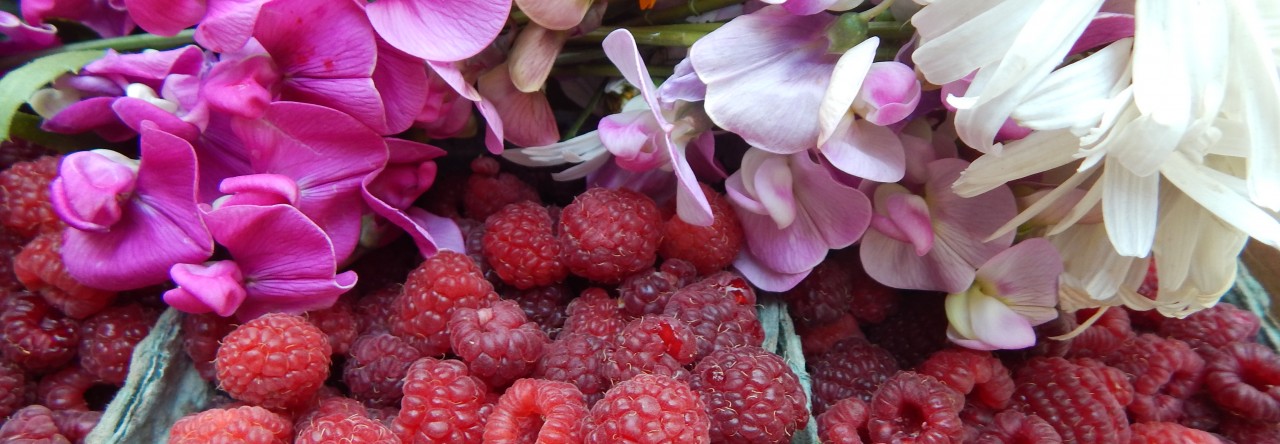
Roasted Raspberry Syrup

I use four techniques to separate fruit juice from pulp for fruit syrups and shrubs. Oven-roasting adds rich, caramelized notes. Learn more at TwiceasTasty.com.
Fruit syrups are easy to make—if you create a jar at a time or have a bumper crop of fruit and a plan to use the remaining solids. As I explain this week in my Twice as Tasty column for the Flathead Beacon, it takes about 3 pounds of berries to create about 2 cups of syrup. When you use raspberries for syrups or their tangy cousins, drinking shrubs, roasting the berries and straining off the juice leaves a couple of pounds of sweetened seedy pulp. I hate to dump such a large mound straight into the compost. I primarily freeze the pulp in cubes to blend into smoothies instead of whole raspberries and notice little difference in the overall seediness.

Other easy uses that make berry pulp versus whole fruit less noticeable include granola: Dry the pulp in sheets and crumble it into the mixture of grains, seeds, and nuts. Some baked goods, like quick bread, can handle a certain volume of seedy pulp. The berry pulp still has enough flavor to infuse vodka or vinegar.
Learn to make Roasted Raspberry Syrup

Lemon Tahini Sauce or Dressing

Brightening tahini with lemon makes it surprisingly versatile. Use it as a drizzle-worthy sauce, a pourable salad dressing, or a yogurt or herb-laden dip. Learn more at TwiceasTasty.com.
The first thing I thought when snapping and choosing photos for this week’s Twice as Tasty column for the Flathead Beacon was that everyone would think I’d squirted yellow American mustard on falafel. The impression couldn’t be further from the truth. The bright yellow sauce that I share in this week’s column does get its color from turmeric, but the flavor is entirely the bright citrus tang of lemon, the pungent bite of garlic, and the earthy, slightly bitter taste of tahini.

Given its layers of flavor, Lemon Tahini Sauce is surprisingly versatile. In my recipe, I give options for making it into a thicker drizzle-worthy sauce or a thinner pourable salad dressing. Leave the minced garlic chunky or puree the mixture until smooth. Add yogurt or fresh herbs to make it a dip, and swap in lime juice as a flavor variation.

Learn to make Lemon Tahini Sauce or Dressing

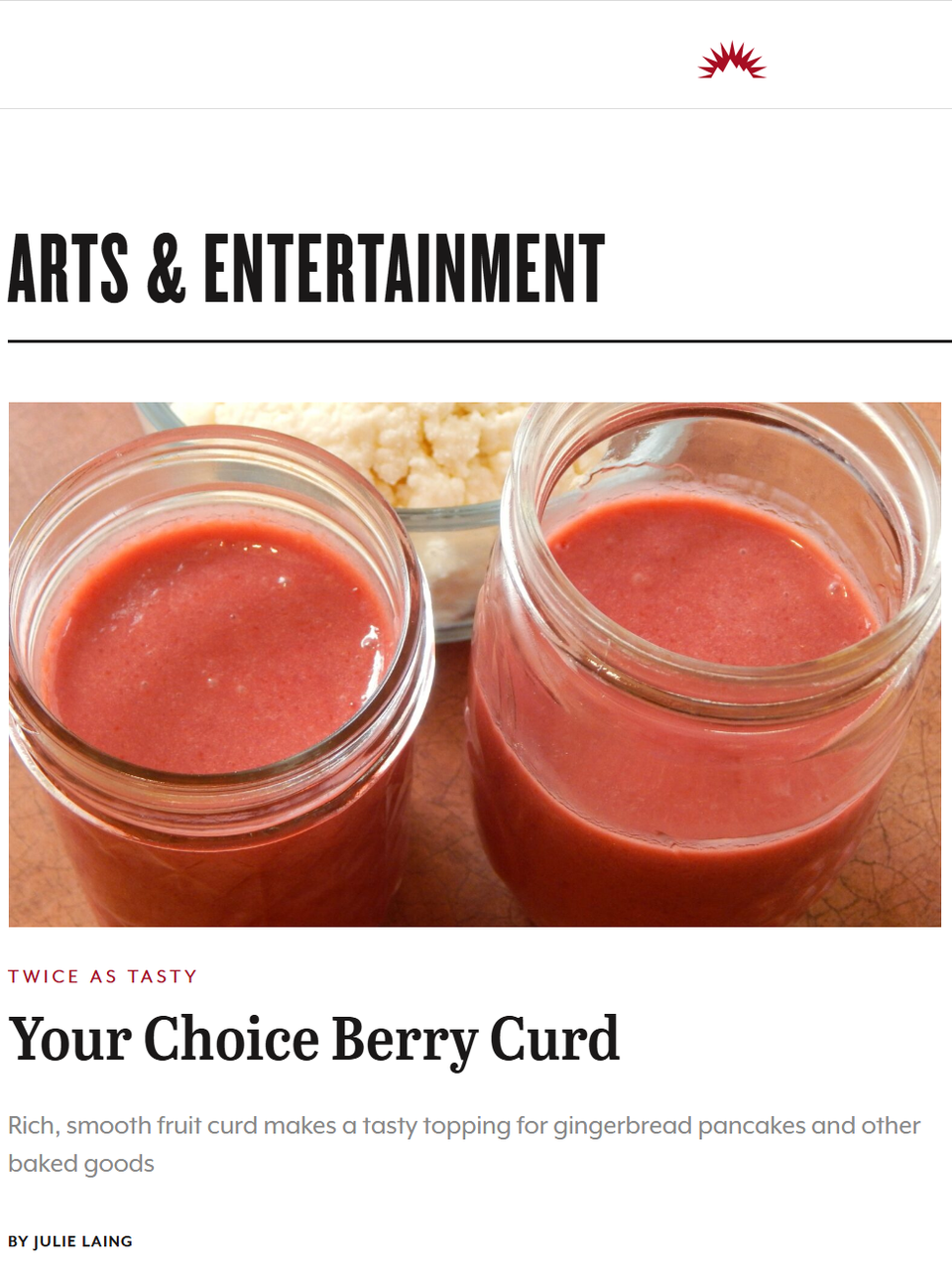
Your Choice Berry Curd

Fruit curd can be made with not just lemons and limes but also a range of berries and other fruits—fresh or frozen. Learn more at TwiceasTasty.com.
The first time you tasted fruit curd, it was most likely made with lemons or perhaps limes. But as I explain this week in my Twice as Tasty column for the Flathead Beacon, it can be made with a range of berries and other fruits—a big advantage if you don’t have access to backyard citrus but do grow or live in an area where berry crops are popular. Plus, you can make berry curd with frozen fruit.

Raspberries are my personal favorite for berry curd, but I’ve made it with everything from strawberries to gooseberries and huckleberries. Rhubarb Curd is another delicious variation this time of year. I get the best texture by using just egg yolks in the curd, so when I developed a recipe for Gingerbread Pancakes, one of my preferred pairings for fruit curd, I used the remaining egg whites in the pancake batter.
Learn to make Your Choice Berry Curd

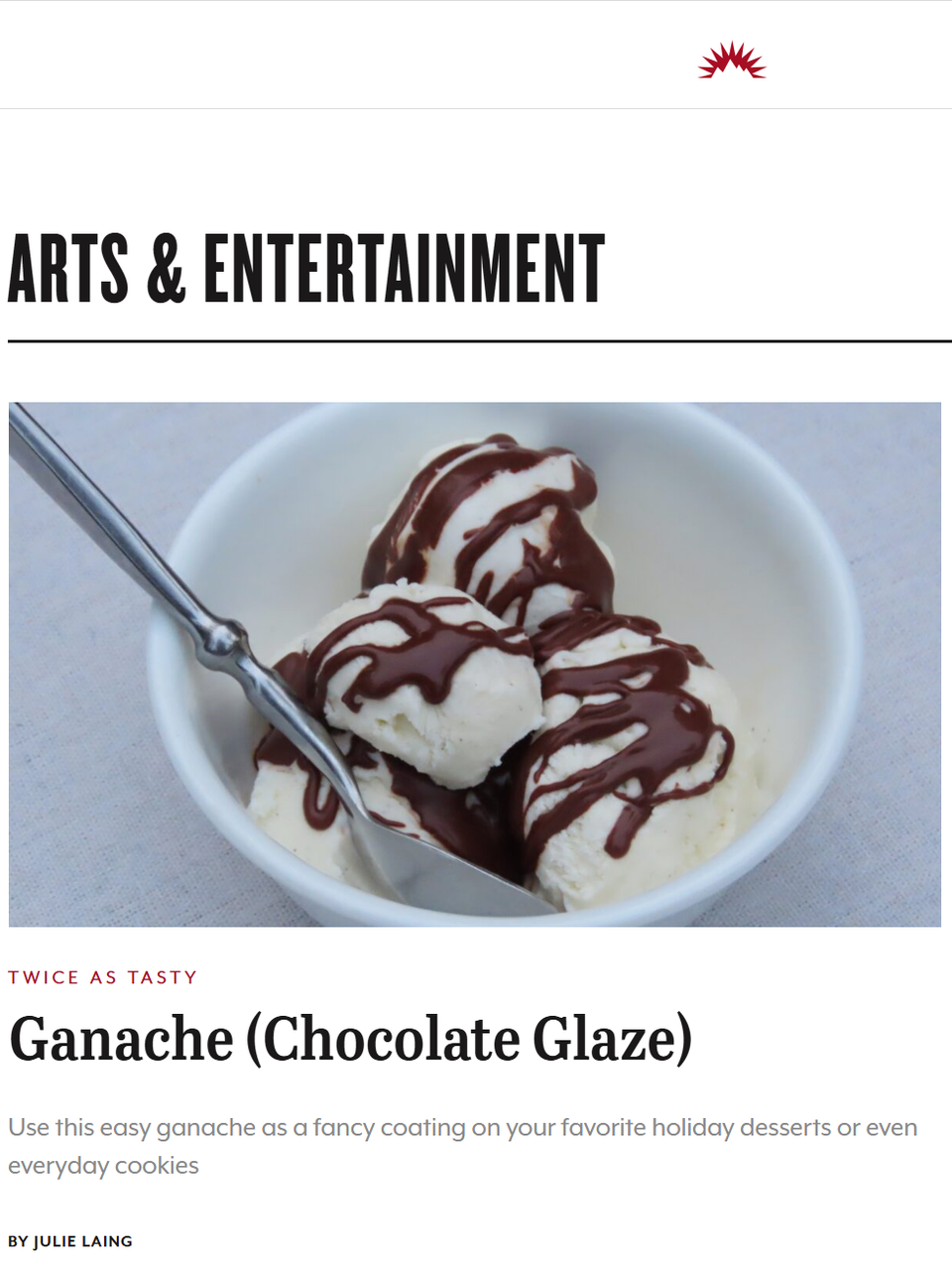
Ganache (Chocolate Glaze)

For holiday cookies—and even outside the holiday season—ganache is an easy and versatile upgrade that should be part of your baking skillset. Learn more at TwiceasTasty.com.
Whether you’re just starting your winter baking season or have already churned out dozens of cookies, no doubt holiday treats are on your mind. My family’s favorite Christmas cookies—Vanilla Bean Cookies and Chocolate Rum Balls—sit for several weeks to age, so my holiday baking traditionally starts the weekend after Thanksgiving. But when I need a last-minute batch for a cookie exchange or solstice party, my favorite upgrade for any cookie is the ganache recipe I share this week in my Twice as Tasty column for the Flathead Beacon.

Ganache is simply the French word for a mixture of chocolate and cream, but these two ingredients can take on so many textures depending on ratio and temperature. The ganache I make to drizzle over cookies flows easily for a chocolate glaze. The more it cools, the firmer it becomes, letting you also use it like a sauce, frosting, and firm candy truffles. Even outside the holiday season, this easy and versatile dessert upgrade should be part of your baking skillset.
Learn to make Ganache (Chocolate Glaze)

Homemade Caramel Sauce

Making caramel successfully at home is all about using the right tools and ingredients and becoming comfortable with the process. Learn more at TwiceasTasty.com.
My first experience with making “caramel” was in a high school home ec class. The recipe melted brown sugar, butter, and Karo syrup in the microwave, added baking soda, and then poured the concoction over a grocery bag full of popped corn and microwaved it until coated. It was so easy that when I began to make true caramel sauce, I lacked the trepidation that many people have about melting sugar until it is molten liquid.

As I explain this week in my Twice as Tasty column for the Flathead Beacon, making caramel successfully at home is all about becoming comfortable with the process and using the right tools. A pan that seems excessively large for the project is key to preventing a bubbling volcano of liquid sugar. A sturdy whisk is a must so that you can keep stirring the sugar steadily and constantly. Avoiding multitasking is crucial to controlling the process. But watching the sugar change as you stir—from white granules to tan clumps to pure liquid that darkens the longer you cook it—is part of the fun.
Learn to make Homemade Caramel Sauce

Rhubarb–Vanilla Syrup

Fruit syrup concentrate is easy to make and stash in your fridge or freezer for homemade spritzers and cocktails. Learn more at TwiceasTasty.com.
We tend to buy fruity sparkling waters and hard seltzers in cans, but bottles of fruit syrup concentrate are easy to make and stash in your fridge, or freeze in ice trays, for homemade spritzers and cocktails. You can also play with flavors you’re unlikely to find on the store shelf, like the tart–sweet rhubarb syrup I share this week in my Twice as Tasty column for the Flathead Beacon.

The technique for making fruit syrups that you plan to use in beverages is simple. I make them from spring to fall with fresh fruit, cycling through flavors as they ripen. In winter, you can make them with fruit from the freezer in the same way you make Frozen Strawberry Syrup to pour over pancakes or waffles—just don’t let it cook as long to keep it fully pourable.
Learn to make Rhubarb–Vanilla Syrup

Strawberry-Rhubarb Shrub

I usually find strawberries too sweet to pair with rhubarb, but the vinegar in a drinking shrub balances the combination for my taste buds. Learn more at TwiceasTasty.com.
If you’d walked into my kitchen late last night, you would have found me turning some of summer’s first fruit into a batch of shrub. A drinking shrub, as I share this week in my Twice as Tasty column for the Flathead Beacon, is an old DIY beverage that fans of today’s sparking water and hard seltzers should have on their radar. The combination of fruit, vinegar, and sugar into a concentrate that is then diluted with fizzy water to taste packs a flavor punch and quenches thirst of hot summer days. Mix in a couple of shots of alcohol and you end up with a sparkling evening cocktail.

I usually have several shrub flavors in my fridge, made with the current bumper crop of fresh fruit or whatever I squirreled away in the freezer for the off-season. Although I find strawberries too sweet to pair with rhubarb in desserts and jams, the vinegar in a shrub balances this popular combination for my taste buds.
Learn to make Strawberry-Rhubarb Shrub

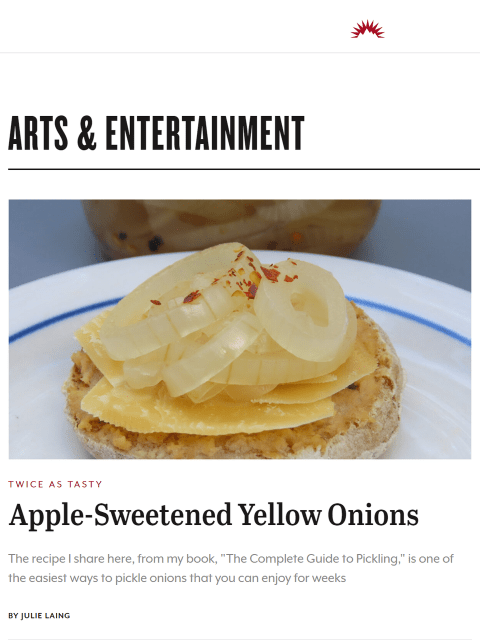
Apple-Sweetened Yellow Onions

When pickling, red onions are just as readily available as yellow ones for colorful combinations. Learn more at TwiceasTasty.com.
I have to admit: Before I wrote The Complete Guide to Pickling, I rarely thought about pickling onions. Onions land in just about every jar of pickles I make, from Spring Asparagus Pickles and Salt-and-Vinegar Winter Squash, to canned Honeyed Bread-and-Butter Chips, to Southern-Style Pickled Shrimp. If I wanted slices of pickled onions for a sandwich, I just fished them out of one of those jars.

But part of the fun of pickling onions is that red onions are just as readily available as yellow ones, making it easy to create colorful combinations. Lime-Pickled Onions, with thinly slices of red onion immersed in lime juice, become a shocking pink. Red Onions in Wine Vinegar turn a deeper reddish hue. For Fermented Red Onions, weighing down the onion rings with a red beet doubles down on the brightness. I even use red onions, and sometimes just their skins, in other recipes for an extra shot of color.

The pickled onions I share this week in my Twice as Tasty column for the Flathead Beacon keep their pale, nearly translucent color, but apple cider vinegar and a little bonus sugar make them a bit sweeter than these more colorful versions.
Learn to make Apple-Sweetened Yellow Onions

Cucumber-Dill Refrigerator Pickles

Fridge pickles can capture the classic, cucumber-and-dill flavor and crispness without the hassle of canning. Learn more at TwiceasTasty.com.
If there was any doubt that I love pickles, it was dispelled when my first cookbook focused entirely on pickling. Even I explored some new-to-me flavors and foods for that book, some of which has since become personal favorites: Lime-Pickled Onions, Cultured Curtido (Cabbage Slaw), Zucchini Escabeche (Grilled and Pickled Zucchini), Fresh Pears with Lemon, Tepache (Fermented Pineapple Beverage), Sweet Vinegar-Pickled Eggs, Scratch-Made Sriracha, and more. But I always leave space in the fridge for simple, classic, cucumber-and-dill pickles.

In my Twice as Tasty column this week for the Flathead Beacon, I share one of my simplest and most straightforward pickling cucumber recipes that can be eaten in about a day (if you just can’t wait) but will keep for weeks in the refrigerator. It’s a great way to use less than a pound of pickling cucumbers, whose importance I also explain in the column, or make a couple of jars with a larger crop but without the hassle of canning.
Learn to make Cucumber-Dill Refrigerator Pickles