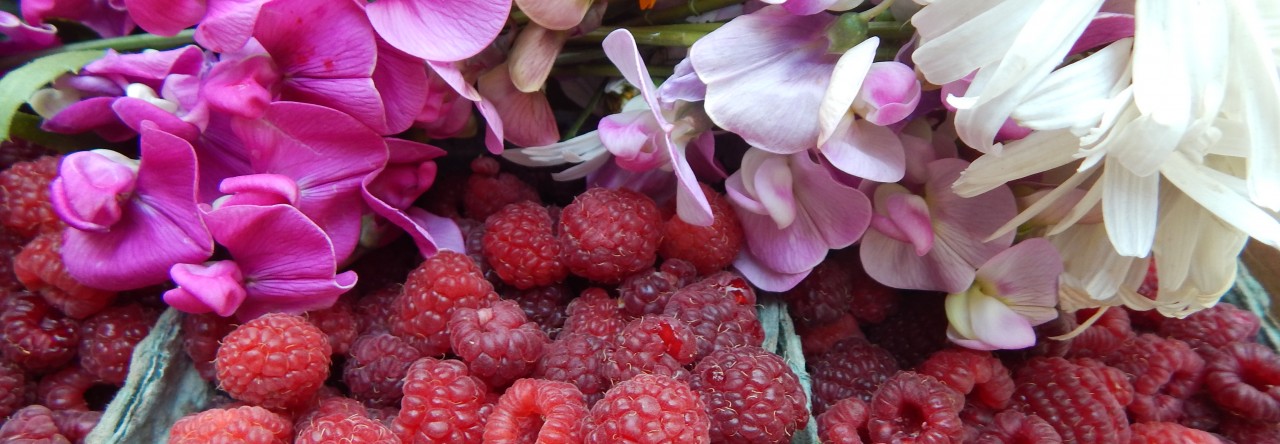

If you’re new to vegetable fermentation, you likely look at recipes and think, “Can it be that easy?” This instantly leads to the terrifying thought, “It can’t; surely I’ll get it wrong.” So to kick off this month’s recipes for vegetable ferments, I offer my most foolproof recipe for your first foray into fermentation. Here, the carrots actually aren’t fully fermented; they sit barely long enough to kick off the process. Still, they use a lot of the techniques that apply to full fermentation of other vegetables: salting, weighting to encourage the carrots to release even liquid, and a rest period to pull even more water and sugars from the produce. Because these carrots are prepared as thin ribbons, it’s easy to open the jar and slide a few onto a sandwich, into a sourdough pita, or straight into your mouth. The recipe is so simple that while you’re at it, you might as well prepare your own horseradish to go in the jar—especially if you’re growing it.
Learn to make Barely Fermented Carrots and Horseradish Paste
Category: Topic
Fall Ferments

Fermentation is one of the oldest ways to preserve food, but it’s a technique that has become unfamiliar for modern home cooks. We still consume a lot of fermented foods, including dairy and grains, and we may even be brave enough to try those at home. But somehow fermenting vegetables seems daunting, raising doubts about whether we’re preserving or spoiling food.
Essentially, fermenting is souring via microbes. Microorganisms break down the sugars and carbohydrates in food, causing a chemical change that increases acidity and ultimately preserves the food. The process leaves no room for microbes that spoil food to move in. Properly fermented food looks, smells, and tastes bright, crisp, and tangy. A fermentation that has problems will be discolored, soft, and rotten smelling; you’ll turn up your nose before it even gets near your tongue.
Most people think of pickled cucumbers or brined cabbage when they think of fermented vegetables. But many other vegetables, and even some fruits, can be fermented. In most cases, the only ingredients needed are fresh produce, salt, and water.
Read more about fermenting vegetables
Stir-Fry
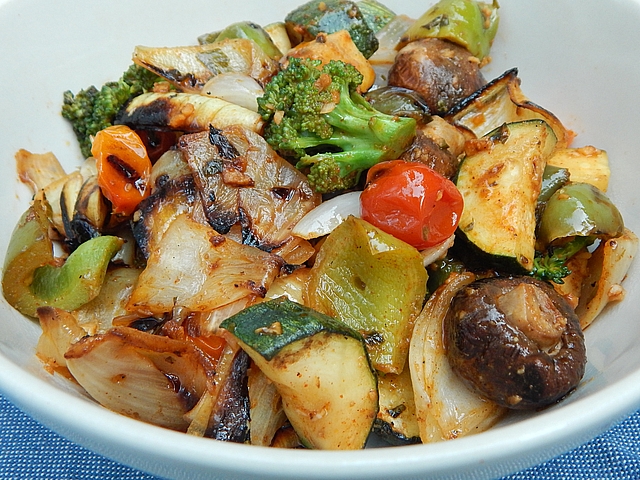
When the garden is in full swing and sailing season is on, one of my go-to meals is a stir-fry. In the time it takes to cook a pot of rice, the rest of the meal can be chopped, cooked, and ready to serve from one pan as a single-dish meal. In spring, asparagus, early onions, young garlic, snap peas, spinach, and herbs dominate the stir-fry; at the height of summer, freshly harvested onions, peppers, carrots, zucchini, and cherry tomatoes take over. By late summer, corn, eggplant, and fall broccoli and peas are ready to mix in.
When you’re rich in a particular vegetable, you can let it solo in a stir-fry, backed by aromatics such as garlic, ginger, and chilies. But my favorite stir-fries are created with dibs and dabs of many vegetables and a protein such as tofu. To guarantee success, fry quickly, at high heat, in an order that lets the ingredients brown evenly, with plenty of movement. It’s in the name: stir and fry.
Learn to make Fresh Improv Stir-Fry and Pan-Fried Tofu
Eating Local

I’ve been thinking a lot about local food lately. With last week’s official launch of Twice as Tasty Live, I’ve been making the rounds of local purveyors of flour, milk, coffee, tea, fish, and more to find ingredients for the first two Twice as Tasty house concerts coming up in the next week. I’ve also been inspecting progress in the garden, keeping tabs on what will be ready to harvest and take straight to the host’s table for each event.
But how to define “local food”? Some sources define the local food circle as within 100 miles of where it’s bought or eaten, but many federal assistance programs extend that range to 400 miles. Some define it as food grown and processed within a state, whereas others define local food systems by regions rather than borders. Giant chain stores sell local food; so do farmers from roadside stands and weekly markets.
My local food sources start with the ground I garden in, extend out to local producers and locally owned businesses, and continue down the road to the closest source for any item that isn’t grown in my backyard. I love the way Barbara Kingsolver put it in Animal, Vegetable, Miracle: A Year of Food Life
Read more about eating local
Summer Vegetables

If your garden isn’t in full swing yet, it’s about to be. Even here in Montana, with our long winters and short growing season, spring produce is beginning to wind down: Lettuces and spinach will soon be bolting, the asparagus crop has tapered off, and the strawberry bed has been picked nearly clean. In their place, summer produce is ready to burst forth, launching itself into the annual race to grow faster than I can harvest and process.
If you’ve been following along on Instagram, you’ve seen how I deal with spring’s vegetable bounty: #dailysalad. But with a large garden, summer vegetables need a different approach. The next few weeks are not just about filling bellies with the freshest produce possible but also about preserving those vegetables so that they can fill bellies the rest of the year. Here’s how I’ll be spending the next few weeks.
Read more about enjoying summer vegetables year-round
Birthday Cake: Year 2

It’s Twice as Tasty’s birthday month, and no birthday is complete without a celebratory dessert. I’m a fan of nontraditional birthday desserts, such as last year’s Strawberry Shortcake with Lilac Cream, Apple Crumble Pie, homemade sorbet, and even fruit crisps. But sometimes you just need cake. Rich, multilayered, chocolaty cake.
Unfortunately, party cakes tend toward a dry, crumbly texture held together by an overly sweet frosting. And unless you bake and decorate cakes regularly, you’re likely gambling when you try to layer and frost a creation worthy of the special occasion. But homemade cakes for birthdays, anniversaries, graduations, and other celebrations can be both delicious and beautiful. You simply need a recipe that ensures a moist cake and a few tips and tricks that make it easier to layer and decorate your baked creation.
Learn to make Layered Chocolate Pudding Cake and Chocolate Ganache
Raw Shrubs

Offering to pour someone a shrub usually requires an explanation. Clearly the noun is not referring to the leafy bush. But just what is a shrub? Why would you want to drink one?
The answer to the first question has a surprisingly long history. Mixologist Warren Bobrow calls drinking shrubs “the original energy drinks” and dates them back to the 1800s. The combination of vinegar, water, and sweetener gave farmworkers a refreshing boost while in the field. Then farmers discovered they could expand the range of flavors using their harvest and the preserving properties of vinegar and sugar. Add carbonated water, and the first soft drinks were born. But these aren’t our contemporary, corn syrupy sodas: shrubs, aka drinking vinegars, capture the bright flavors of fresh fruits and vegetables at the peak of their season.
Raw shrubs take little time to prepare but need a bit of foresight. The wait for cold processing means you don’t need to heat the shrub and lose some of its flavorful pop, a particular advantage with delicately flavored fruits like citrus and kiwi. They usually need 1–3 days to get to their final form but often taste best when left for at least a week. But shrubs last a long time too—I’m told up to a year, but I’ve never been able to keep one around that long.
This shrub recipe is a concentrate; you’ll want to dilute it to enjoy it. The simplest method is to pour 1/2 ounce of shrub into an 8-ounce or larger glass, top it with sparkling water or seltzer, and then add more shrub until you get a balance you like. Or upgrade your bar by using the shrub as the base for a cocktail.
Learn to make Raw-Fruit Shrub and Basic Shrub Cocktail
Favorite Books: Gardening

Tasty food starts in the garden. It’s rare for me to post a recipe without mentioning homegrown ingredients, freshly harvested produce, and other gardening thoughts. Sometimes I make suggestions for planning, growing, maintaining, and harvesting food from your garden, including herbs, fruits, and vegetables.
But the nitty-gritty on getting your hands dirty in garden soil would fill a separate blog. I share information I glean from other sources in every post on this blog, and I’m always happy to answer questions posed in post comments or the Twice as Tasty Facebook group. But if you want to learn even more about growing your own food, I suggest seeking out some of my favorite resources.
Read more about my favorite gardening resources
Herb Marinades

Some of my favorite travel memories linger from my time in Morocco. I had the good fortune to have Peace Corps connections that introduced me to volunteers in both tiny towns and large cities. I stayed in their houses, visited their host families and haunts, and ate dinner in the homes of their Moroccan friends. I could never repeat or improve on the experience.
But the food: some of that I can and do repeat, even though it’s never quite the same. For example, every time I ate chermoula in Morocco, the flavor was unique. The basic version is essentially a pesto featuring cilantro and parsley, but my favorite versions included a little fresh ginger and extra spices, and I replicate it as well as I can. I mostly ate it in a tagine while in Morocco, but I’ve since learn to love it as a grilling marinade, accompanied, of course, by couscous.
Learn to make Grilled Shrimp with Chermoula and Cinnamon Couscous
Fresh Salads
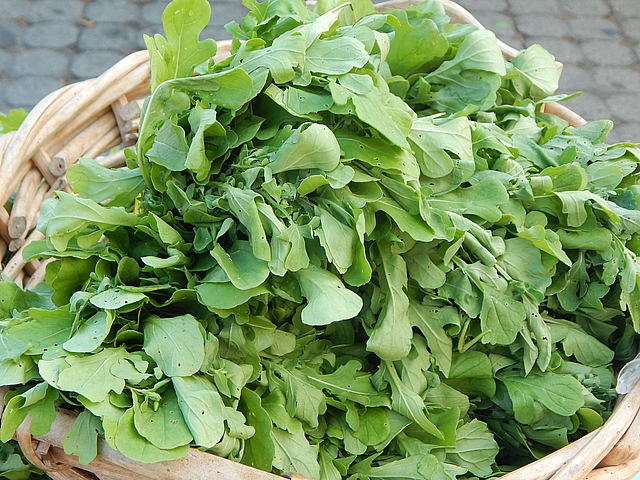
Using a recipe for a salad always seems silly: it’s just tossing a bunch of greens in a bowl, right? To be honest, my answer is yes—in terms of ingredient choices and their proportions. But the quality of those ingredients, how you toss them, and especially how you toss them in dressing can result in a soggy mess or a crisp, fresh delight.
My favorite salads have always been more stuff than greens. Even buried under a dozen freshly harvested vegetables, I can’t get excited about iceberg, Romine, or most leaf lettuces. I didn’t discover the appeal of salad greens until I lived in London and had my first taste of arugula or, as the Brits call it, rocket. Only recently sold in the United States as a loose salad green instead of in tiny, overpriced portions as an herb, arugula’s spicy, slightly bitter bite becomes the star on the salad plate. But you’ll still be disappointed in a light arugula salad—and heavier tuber-based ones—unless you dress it right.
Learn to make Arugula–Asparagus Salad and Mushroom–Sweet Potato Salad
