Maple-Glazed Carrots

 If Thanksgiving feast numbers swell and you have a bag of carrots at hand, glazing them quickly using kitchen staples creates a stress-free, last-minute side dish. Learn more at TwiceasTasty.com.
My Twice as Tasty column for the Flathead Beacon went live early this week so that you have ample time to add its recipe to your Thanksgiving meal. Maple-Glazed Carrots slide in easily among traditional dishes, offering a hint of sweetness and touch of spice without overfilling a plate or adding excessive time to your prep. Their simplicity belies their flavor, which is rich enough to nestle against more complex holiday dishes or gussy up a weeknight meal.

Because they’re made in one pan on the stovetop, they don’t need space in an oven already claimed by a Thanksgiving turkey, dressings, or pies. Best of all, if your feast numbers swell and you have a bag of carrots in your refrigerator, you can glaze them quickly using kitchen staples and add this stress-free side dish to the holiday spread at the last minute. If you just bought carrots with their tops intact, take a nibble of their greens: Those that were recently harvested and remain sweet can be blended into a delicious herb salsa garnish.
Learn to make Maple-Glazed Carrots

Vegetarian Mushroom Gravy

For a hearty, no-fail everyday or holiday gravy that thickens quickly and effortlessly and bursts with flavor, grab some mushrooms. Learn more at TwiceasTasty.com.
Earlier this month, a friend asked if I had “no-fail, hearty amount holiday gravy recipe for incompetent gravy makers.” It might seem like a tall order for someone who has always preferred cranberry sauce to gravy, even before giving up turkey, but I actually have a recipe that fits the bill: a mushroom gravy that comes together quickly, thickens effortlessly, can be made ahead and reheated just before the holiday feast, can be easily made in a double or trip batch, and bursts with flavor. I share it this week in my Twice as Tasty column for the Flathead Beacon and for the first time here on the blog.

You can certainly serve this gravy with any holiday meal. It’s so tasty that the carnivores and vegetarians at the table will all thank you. I primarily make it to serve on poutine with homegrown oven-fried potatoes and homemade fresh cheddar curds. It would also be delicious on a lentil loaf or meatloaf, mashed potatoes, or roasted root vegetables.
Learn to make Vegetarian Mushroom Gravy

Seared Shrimp in Garlic Oil

On icy nights when I stay indoors, I pull out a quick recipe that reminds me of meals I enjoyed in Spain’s tapas bars. Learn more at TwiceasTasty.com.
We grill outdoors year-round, but not every evening is ideal for stepping out and firing up a chimney of charcoal. On icy nights when I don’t want to be more than a few steps from the woodstove, I pull out the recipe I share this week in my Twice as Tasty column for the Flathead Beacon. I think of seared shrimp bubbling in hot oil as a Spanish dish because it reminds me of meals I enjoyed in Spain’s tapas bars. This dish is incredibly simple to make, and if you always keep a bag of raw shrimp in the freezer and a head of garlic on the counter, you can make it on a whim.

I like to serve these shrimp over Cinnamon Couscous, a recipe I picked up on my travels in Morocco, as a quick fusion meal. You can also simply cut some hunks of Sourdough Cabin Bread or the crusty white baguette in my new sourdough guide for the The Old Farmer’s Almanac website and dip them into the oil to munch alongside the shrimp, tapas style.
Learn to make Seared Shrimp in Garlic Oil

Making and Using Sourdough Starter

My beginner’s sourdough guide for the Old Farmer’s Almanac website includes how to make sourdough starter and historical recipes. Learn more at TwiceasTasty.com.
I’ve been baking with my sourdough starter for more than 9 years and teaching others to do so for nearly as long, but there’s always so much more to learn. So I was excited for the opportunity to research, write, and now share a sourdough guide on The Old Farmer’s Almanac website based on historical sourdough recipes from their archive.

This guide includes instructions for making a sourdough starter from scratch, which was a new project for me. I was gifted my existing sourdough starter in May 2014, and I’ve been baking with it, and sharing it with hundreds of people, ever since. The Beginner Sourdough Starter in the guide, which I based on archival recipes, is also fed and maintained a little differently from how I manage my established starter, which may appeal to sourdough bakers who don’t want to buy a kitchen scale or weigh out ingredients in grams. The four recipes in the guide use this scratch-made sourdough starter in quick breads and even a crusty white loaf.
Learn more about making and using sourdough starter

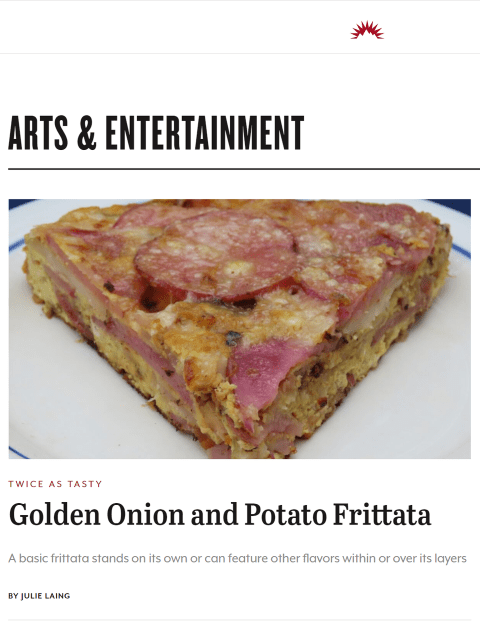
Golden Onion and Potato Frittata

Visualize frittata as a crustless quiche or open-face omelet that relies on a few core ingredients but can be filled with an array of flavors. Learn more at TwiceasTasty.com.
I was served my first frittata, an Italian dish, by a Spanish woman while I was visiting a Greek island. I loved the meal so much—and it’s affordable price on a backpacker’s budget—that I ate frittata daily during my stay.

Visualize this baked egg dish as a crustless quiche or open-face omelet. When I make it today, the core ingredients remain the same each time I enjoy it. I share that basic recipe this week in my Twice as Tasty column for the Flathead Beacon, but it’s just the start to what you can put into a frittata. During my initial weeklong frittata fest, the chef layered tomatoes and basil, peppers and greens, or eggplant and summer squash over this base, always with feta mixed in. At home, I might use mushrooms, arugula, asparagus, spinach, carrots, and chard, swapping in whatever cheese seems to fit best.
Learn to make Golden Onion and Potato Frittata

Pumpkin–Chocolate Cookies

Drop these cookies onto trays by the spoonful, or shape them into smoother balls and drizzle them with melted chocolate. Learn more at TwiceasTasty.com.
When I shared my technique for Roasted Winter Squash Puree last November in my Twice as Tasty column for the Flathead Beacon, I made it part of a series leading up to a classic Creamy Roasted Pumpkin Pie, just in time for Thanksgiving. It’s one of the many delicious reasons I grow, roast, puree, and freeze pumpkins and winter squash. The cookie recipe I share this week (in my 100th column) is another.

With dense pumpkin puree at the heart of these cookies, they’re almost cake-like in their consistency. They come out of the oven domed with soft centers, especially if you take the time to chill the dough before baking so that they hold their shape. I drop them onto cookie trays by the spoonful when I’m baking them for daily enjoyment. For a fancier presentation, you can use dampened fingertips to shape them into smoother balls and drizzle them with melted chocolate.
Learn to make Pumpkin–Chocolate Cookies

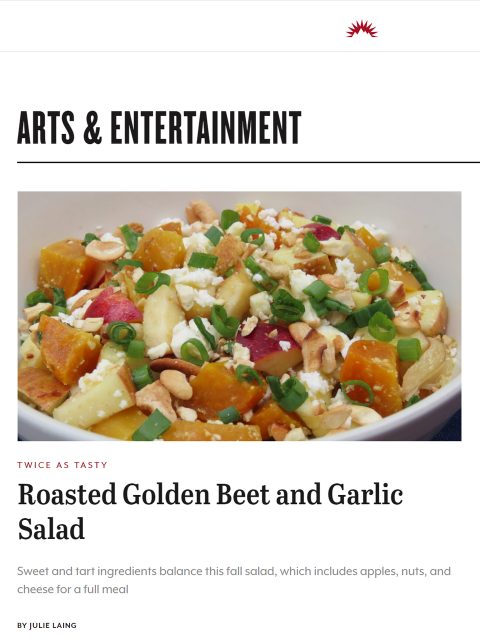
Roasted Golden Beet and Garlic Salad

I often wait until fall to make beet salad, but it really can be made with the season’s first beets. Learn more at TwiceasTasty.com.
I plucked my first beets in August, but somehow I always think of them as a fall crop. Earlier in the summer, I toss them into all sorts of mixed-vegetable recipes and no-recipe-required meals. They then become pickles when a large batch is ready; they keep so well in vinegar that I included four beet recipes, from quick to canned, in The Complete Guide to Pickling. Yet I often wait until fall to make the salad I share this week in my Twice as Tasty column for the Flathead Beacon.

The wait is primarily for our apples to fully ripen. Even though I like slightly tart ones in this salad, the ones on our trees typically have a starchy, chalky texture when picked too early. If you’re buying apples or grow ones that ripen early, this salad really can be made with the season’s first beets.
Learn to make Roasted Golden Beet and Garlic Salad

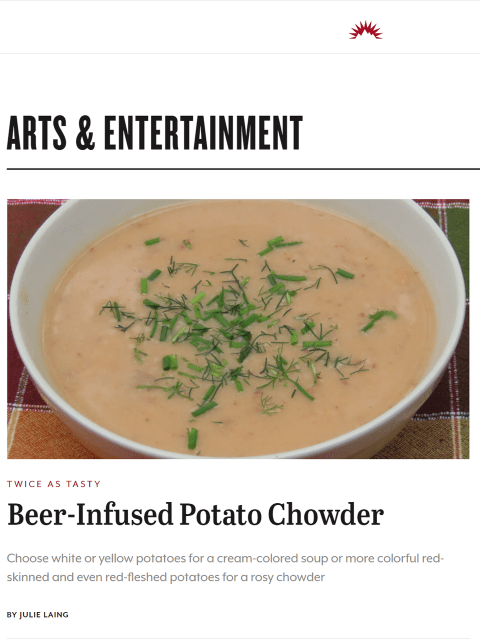
Beer-Infused Potato Chowder

Colorful potatoes look pretty when chopped, but expect their bright tones to alter mashed and blended dishes. Learn more at TwiceasTasty.com.
When I made a batch of potato, beer, and cheese soup so that I could take photos for my Twice as Tasty column for the Flathead Beacon, I immediately knew I’d have to write about my favorite potato varieties: The photos showed the rosy tone imparted by throwing a couple of my favorite red-fleshed potatoes into the pot.

Ever since we started growing them, we’ve been fans of Terra Rosa potatoes for their prolific plants, creamy flesh, and long storage life, with their pure red coloring inside and out a fun bonus to growing and eating them. They look so pretty alongside white-, yellow-, and purple-fleshed varieties when chopped into a potato salad or breakfast hash. But expect their bright color to also shine through in homemade gnocchi, mashers, and this week’s beer and cheese chowder recipe.
Learn to make Beer-Infused Potato Chowder

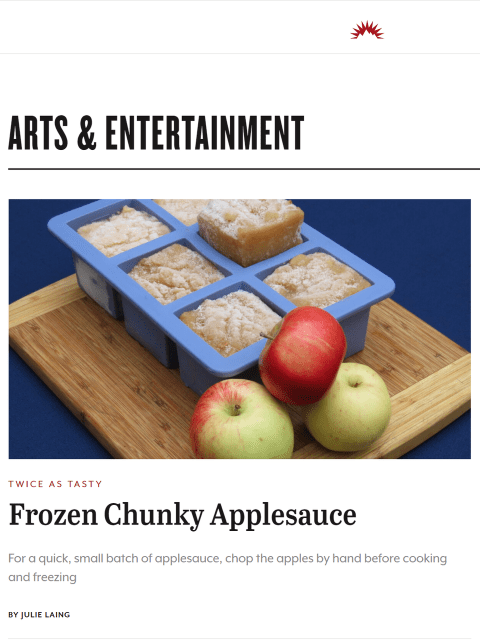
Frozen Chunky Applesauce

This version of homemade applesauce requires no special tools and can be made from just a few pounds of apples. Learn more at TwiceasTasty.com.
When I first moved to Montana and inherited my mom’s canning kettle, the first thing I canned was applesauce. I’ve never liked the flavor or texture of commercially made applesauce, and I’d missed the ready access to barely sweetened homemade versions every since I graduated high school and went off to university, a career, and traveling the world.

I share one of my favorite homemade versions this week in my Twice as Tasty column for the Flathead Beacon: Grandma Tiny’s Frozen Chunky Applesauce. This version requires no special tools (although I do like to freeze it in oversized silicone ice trays), and it can be made from just a few pounds of apples. My grandmother was probably in her mid-90s when she made her last batch, an indicator of how easy it is to make this recipe. If you have a lot of apples, you may want to scale this up to a canning project using the recipe I share later in this blog post.
Learn to make Frozen Chunky Applesauce and a smooth home-canned variation

Home-Smoked Chili Peppers

Smoke vegetables in a charcoal grill using briquettes and wood chips or in a charcoal or gas grill using a smoke tube and hardwood pellets. Learn more at TwiceasTasty.com.
When I first explored the idea of smoking food at home, I thought I was going to need to spend several hundred dollars on a large pellet smoker. I quickly learned that the typical smoker, while ideal for smoking meats, runs too hot for the food I was interested in smoking: vegetables, nuts, and especially cheese. So George and I started playing with the idea of smoking vegetables, like homegrown chili peppers, in a charcoal kettle grill.

As I explain this week in my Twice as Tasty column for the Flathead Beacon, our first smoking setup was affordable and low-tech but finicky. It was challenging to light just a handful of briquettes in a charcoal chimney, and we had to replenish the wood chips regularly. With charcoal heat, it could also be a challenge to keep the temperature low enough to smoke cheese, especially in summer. We loved the results but kept searching for a more straightforward process.

Then I stumbled onto smoke tubes, inexpensive perforated cylinders that hold hardwood pellets and burn slow and low for hours. We’ve been using one for the last year of home-smoked food projects, and this summer I tested several additional brands and sizes for The Spruce Eats. Keep an eye on my work for that website to read my reviews when the product roundup goes live.
Learn to make Home-Smoked Chili Peppers