
Grilling Alliums

Grilled alliums are delicious featured in dips and sauces but when frozen also enhance winter chowders, pastas, savory pancakes, and more. Learn more at TwiceasTasty.com.
When I’m not eating garden-fresh vegetables raw, my first choice is to cook them on a grill. Sautéing and roasting are fine, enhancing their flavor in ways steaming and boiling never do, but the grill adds that extra touch of charred smokiness—and lets me leave the stovetop and oven turned off.

The techniques I offer this week in my Twice as Tasty column for the Flathead Beacon focus on grilling different types of alliums: onions, garlic heads and scapes, and more. I eat a few on their own, munching grilled garlic scapes and spring onion tops straight from the grill, but most I incorporate into recipes. Grilled alliums are delicious featured in Onion Lover’s Dip and Grilled Onion Guacamole. The ones I freeze enhance recipes like Beer-Infused Potato Chowder, the pizza sauce I smear on sourdough pizza, and the pasta and savory pancake recipes I’ll share in the next couple of weeks.
Learn more about grilling alliums

Grilled or Baked Fish Cakes

My favorite fish cakes have just enough filler to keep the fish-loaded patties from falling apart, and plenty of flavor without overpowering the fish. Learn more at TwiceasTasty.com.
I have mixed feelings about fish cakes and burgers. The first versions I remember tasting were British patties heavy on potato with little fish flavor. Then I discovered small Thai-style cakes that tasted of the sea but whose spiciness sometimes overpowered the mild fish. My favorite fish cakes fall somewhere between: just enough filler to keep the fish-loaded patties from falling apart, and plenty of flavor without overpowering the fish.

The fish cake recipe I share this week in my Twice as Tasty column for the Flathead Beacon hits both marks. I originally created it as an oven recipe, because baking on trays let me leave some larger chunks of fish in the patties. It works well—if you don’t mind the heat and lingering aroma in the house. When I want to avoid those, I fire up the grill, both for the initial roasting of the vegetables, which adds flavor and removes moisture so that the cakes hold together without breadcrumbs or potatoes, and for the final cooking, which happens quickly on a hot grill mat.
Learn to make Grilled or Baked Fish Cakes

Smoked Cherries

Smoking vegetables and fruit is just as effective as grilling at adding flavor and can be done just as simply and affordably. Learn more at TwiceasTasty.com.
The summer grilling season typically conjures up images of burgers and brats, but I get fewer raised eyebrows these days when I suggest in my Grilled and Smoked workshop, and share recipes for, grilling asparagus, corn, and pineapple. Smoking vegetables and fruit is just as effective at adding flavor, as I explain this week in my Twice as Tasty column for the Flathead Beacon.

With smoking, you have the option of adding heat or not, which creates a different effect from a searing-hot grill. Cold-smoked vegetables retain more of their raw crispness, and cold-smoked fruits, like cherries, stay plumper and juicier. Hot smoking or preroasting works better for dense root vegetables that you want to make soft and tender, like beets.

Because produce absorbs smoke far more quickly than, say, brisket, you don’t need an expensive smoker—and some might actually get too hot for cold smoking. I smoke all of my vegetables, fruits, cheese, and fish in an old Weber kettle grill. I started with woodchips and a few briquettes and now use a smoke tube loaded with pellets to ensure the lowest smoking temperature.
Learn to make Smoked Cherries

Roasted and Smoked Beets with Orange Vinaigrette

When cooking the bulbous roots of beets, I think that the more time you invest, the better they taste. Learn more at TwiceasTasty.com.
Until I began growing beets, I underrated these fully edible plants and the many ways to prepare them. I prefer beet greens and stems when they’re young and tender, either raw or lightly wilted. But when it comes to the bulbous roots, I think that the more time you invest, the better they taste.

Raw beetroots sometimes taste slightly bitter. Boil or steam them, and their earthy flavor starts to sweeten. Roast them in the oven or on a grill, and their natural sugars caramelize. For ultimate flavor, I give cooked beets a secondary treatment and smoke them, as I explain this week in my Twice as Tasty column for the Flathead Beacon.

All beet varieties smoke equally well. Red ones retain their rich wine color, and sliced Chioggias show off their candy cane stripes. Golden ones keep their sunny hue when smoked and carry more flavor into Roasted Golden Beet and Garlic Salad.
Learn to make Roasted and Smoked Beets with Orange Vinaigrette

Romesco-Inspired Grilled Pepper and Almond Sauce

Sweet pepper sauces deserve as much attention as tomato ones—and are just as versatile. Learn more at TwiceasTasty.com.
Tomato sauce comes in so many variations that it’s easy to overlook equally delicious sauces that feature another nightshade: sweet peppers. I offer one version of a sweet pepper sauce this week in my Twice as Tasty column for the Flathead Beacon. I also explain why my recipe is merely inspired by romesco, which in Catalonia traditionally consists of mainly tomatoes and garlic underscored by mild ñora peppers but has been misrepresented as a roasted red pepper sauce by many American recipes.

Whatever you call them, sweet pepper sauces deserve as much attention as tomato ones—and are just as versatile. I’ve written about different ways to roast peppers for Taste of Home, but I typically make sauces with Grilled Sweet Peppers. The recipe in this week’s column includes nuts like romesco, and I typically make it in small batches to eat fresh. My Grilled Sweet Pepper Sauce recipe lacks nuts and garlic and freezes beautifully for quick meals all year.
Learn to make Romesco-Inspired Grilled Pepper and Almond Sauce

Grilled Sweet Peppers

I have a soft spot for roasting peppers on the grill because of the speed and ease—and especially when I’m roasting several pounds at a time. Learn more at TwiceasTasty.com.
Heat does something magical to sweet peppers. Hold one over an open flame until the skin blackens, and the flesh becomes even sweeter as it softens. There are many ways to achieve this affect, but as I explain this week in my Twice as Tasty column for the Flathead Beacon, using a grill is my favorite.

I’ve written about those many ways to roast sweet peppers for Taste of Home; you can learn about the different techniques in this article. But I have a soft spot for throwing them on the grill. This is especially true when I’m roasting several pounds at a time to turn into Grilled Sweet Pepper Sauce. Still, even if I’m roasting just one or two peppers for pasta and savory pancakes, I typically grill them in advance alongside another grilled meal or with a batch of vegetables because of the speed, ease, and other reasons I explain in this week’s column.
Learn how to grill sweet peppers

Marinated and Grilled Fish Skewers

Finfish works well on skewers as long as you choose a cut of a firm, meaty species that’s thick enough to cube and thread. Learn more at TwiceasTasty.com.
When I make kababs for the grill, I usually slide shrimp and vegetables onto skewers. But as I share this week in my Twice as Tasty column for the Flathead Beacon, finfish works equally well on skewers as long as you choose a cut of a firm, meaty species that’s thick enough to cube and thread.

My favorite grilled fish skewers start with offcuts of halibut, which my local fishmonger sells at a lower per-pound price than full fillets. Monkfish is another delicious fish kebabs option. The flesh of this rather ugly fish has a texture closer to lobster than to flaky white fish and stays intact on skewers. Striped bass, mahi-mahi, and Pacific cod loin, the thickest part of a cod fillet, also skewer well and soak up a lemon and herb marinade.
Learn to make Marinated and Grilled Fish Skewers

Grilled Tomato Pizza Sauce

In a pizza sauce, grilled tomato solids have a deep, smoky flavor enhanced by grilled onion and garlic and fresh homegrown herbs. Learn more at TwiceasTasty.com.
I’m sharing a series of recipes in my Twice as Tasty column for the Flathead Beacon that revolve around grilled tomatoes: first last week’s Grilled Tomato Bloody Mary Mix, continuing this week with a freezable pizza sauce, and next week with a recipe that can be paired with one or both.

We fill a good portion of a large hoop house with tomato plants each year. When the harvested crop starts to pile up in boxes, one of my favorite ways to deal with the overload is to grill the tomatoes. If I’m too busy to process them further, I stockpile the juice and solids separately in freezer-safe containers until I have time to turn them into sauce and more.

In a pizza sauce, grilled tomato solids have a deep, smoky flavor enhanced by grilled onion and garlic, as well as fresh homegrown herbs. I find it most useful to freeze the finished sauce in silicone ice trays that make cubes of various sizes, from a couple of tablespoons to 1-cup portions.
Learn to make Grilled Tomato Pizza Sauce

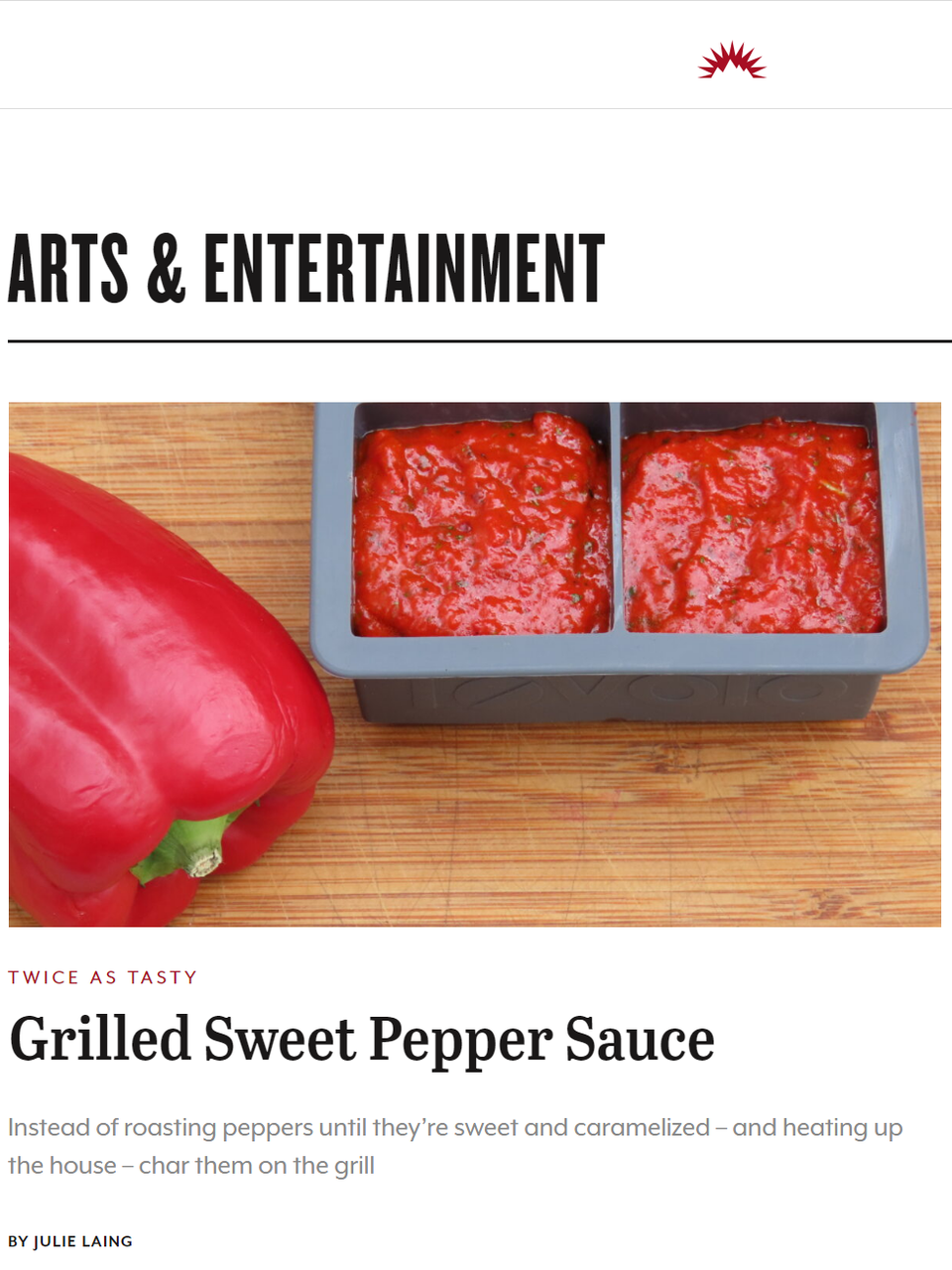
Grilled Sweet Pepper Sauce

I grill bumper crops of sweet peppers in large batches and then puree them into a sauce for pizza, pasta, and more. Learn more at TwiceasTasty.com.
So many vegetables become sweeter and smokier when roasted or grilled, including red bell peppers, as I explain this week in my Twice as Tasty column for the Flathead Beacon. I grill peppers as they ripen throughout the growing season, both to eat immediately and to gather in a zip-close bag in the freezer.

Soft roasted peppers peel more easily if you move them straight from the grill to a paper bag or airtight bowl, let them steam a bit, and then pull off the translucent skin while they’re still warm. They’re easiest to chop uniformly, either by hand or in a food processor, if you first spread them on a tray and freeze them until slightly firm.

When I have a bumper crop of sweet peppers, I grill and puree them into a sauce to use on pizza, pasta, and more. When making sauce, I still remove as much peel as possible, because it tends to be bitter. But I don’t bother chopping the peppers. A high-powered food processor easily breaks down halves or quarters. I’ve been using this food processor for years to make ultrasmooth Grilled Sweet Pepper Sauce.
Learn to make Grilled Sweet Pepper Sauce

Wasabi-Dusted Grilled Shrimp

I’ve learned to treat wasabi or horseradish powder like a finishing salt for hot food, sprinkling it on just before serving. Learn more at TwiceasTasty.com.
When I started making sushi at home and then teaching the techniques I use in workshops, wasabi powder became a staple in my kitchen—one I couldn’t resist finding other ways to use. But as I explain this week in my Twice as Tasty column for the Flathead Beacon, there are some tricks to working with wasabi powder and maximizing its flavor. I now treat it like a finishing salt for hot food, sprinkling it on just before serving, like with this week’s grilled shrimp recipe.

But really, I’ve stopped buying wasabi powder and switched to horseradish powder instead. It gives essentially the same effect—which makes sense, because most wasabi sold in the United States is primarily horseradish powder, perhaps with wasabi leaves and stems and artificial colors mixed in. Horseradish powder is usually more affordable and, if you grow horseradish root, easy to make in a well-ventilated space.
Learn to make Wasabi-Dusted Grilled Shrimp