Tzatziki (Cucumber Yogurt Sauce)

Yogurt makes a fantastic base for dips, sauces, and dressings—especially if you ferment it yourself. Learn more at TwiceasTasty.com.
Yogurt makes a fantastic base for dips, sauces, and dressings—especially if you ferment it yourself. It adds both a creamy and tangy flavor and can be thinned or thickened as needed. I often sneak a few tablespoons into recipes that lack it or instead use mayonnaise or sour cream, such as Roasted Garlic Hummus and other bean dips, quiche, and sourdough pancakes.

It can also play a more dominant role, such as in Dill-Infused Yogurt Sauce or Dressing, Indian-Inspired Shrimp in Yogurt, and the recipe I share this week in my Twice as Tasty column for the Flathead Beacon: the cucumber yogurt sauce or dip commonly known, even in America, as tzatziki.
Learn to make Tzatziki (Cucumber Yogurt Sauce)

Husk-Grilled Corn with Smoky Lime Butter

Freshly harvested corn comes as this perfect package ready to grill and eat: Just let the corn steam inside its husks. Learn more at TwiceasTasty.com.
Freshly harvested corn comes as this perfect package ready to cook and eat: Peel back the husks until they fan out around the ear’s base, remove the silk, and then fold the husks back up the ear and lay it on a grill, let the corn steam inside its own husks. Any silk you miss burns off with the heat or comes off when you pull away the warm husks, revealing the sweet, lightly charred kernels along the cob.

Since you’re pulling back the husks to get at the silk, it’s the perfect time to smear flavored butter down the ear so that it melts between the kernels as the corn cooks. The smoky lime butter recipe I share this week in my Twice as Tasty column for the Flathead Beacon is my favorite way to dress corn on the cob, but you can choose other blends instead, like lemon and oregano leaves, orange and nasturtium blossoms, or one you’ve already prepared as Compound Herb Butter.
Learn to make Husk-Grilled Corn with Smoky Lime Butter

Panzanella (Tomato and Bread Salad)

Late summer salads burst with color yet greens have likely bolted. That’s my excuse for tossing in chunks of homemade sourdough bread. Learn more at TwiceasTasty.com.
If you grow your own vegetables, spring salads feature shades of green: various lettuces, herbs, asparagus, scallions, and peas. Late-summer salads burst with color, but most of my lettuces have bolted by the time tomatoes, cucumbers, peppers, and red onions are ready. At least that’s my excuse for replacing greens with chunks of homemade sourdough bread that can soak up the tomatoes’ juices and oil-and-vinegar dressing.

I share my favorite variation of panzanella, a tomato and bread salad, this week in my Twice as Tasty column for the Flathead Beacon. It’s heavy on late-summer and early-fall vegetables and herbs, but I also throw in cheese and Kalamata olives. If your garden or farmer’s market features other produce, you can swap in plenty of other ingredients, drop the cheese for a vegan option, and replace the olives with capers or skip them altogether for less tang.

For a solo lunch, I use this recipe as a guideline when piling all of the ingredients straight into the bowl I’ll be eating from, only stopping when I reach the end of the list and the bowl is overflowing. The key is to start with a base of bread and tomatoes and build from there.
Learn to make Panzanella (Tomato and Bread Salad)

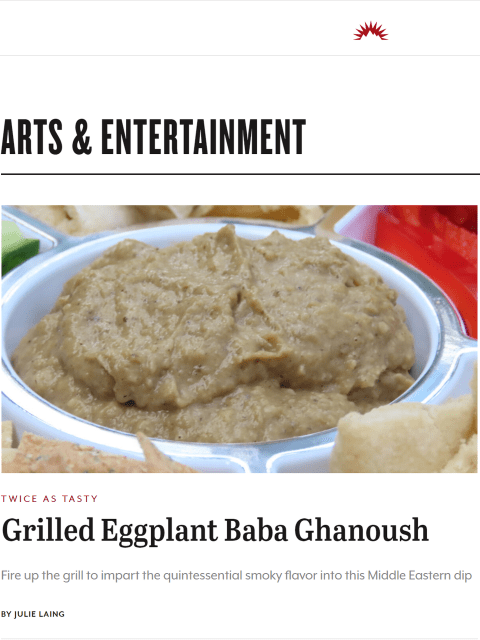
Grilled Eggplant Baba Ghanoush

For the best flavor, grill over charcoal the long, thin halves of Japanese eggplant or the round, thick slices of oval Italian ones. Learn more at TwiceasTasty.com.
You know how gardeners joke about stuffing bumper crops of zucchini in mailboxes or sneaking them onto neighbors’ porches? That’s my eggplant crop this year. Last year’s plants struggled, so we not only improved their soil and care but also planted more starts for good measure. The plants have responded, pumping out multiple full-size eggplant every few days.

My favorite eggplant dish is a smoky Middle Eastern dip called baba ghanoush, so I’ve been making a lot of it this summer. When I first started preparing it at home, I tried numerous techniques to give the eggplant the perfect smokiness. Roasting or broiling were tasty, but the best flavor came from grilling over charcoal the long, thin halves of Japanese eggplant or the round, thick slices of oval Italian ones. Once the eggplant are grilled and peeled, the dip takes about 2 minutes to make, as I share this week in my Twice as Tasty column for the Flathead Beacon.
Learn to make Grilled Eggplant Baba Ghanoush

Summer Rolls with Lime-Chili Sauce

The best part about the summer growing season is rolling all of those fresh flavors into daily meals—literally. Learn more at TwiceasTasty.com.
I grow enough vegetables to cook and squirrel away much of the harvest for winter, but the best part about the summer growing season is rolling all of those fresh flavors into daily meals. This means literally rolling them together in the recipe I share this week in my Twice as Tasty column for the Flathead Beacon.

Summer rolls have just a couple of cooked ingredients—noodles and perhaps a protein—but the rest of the filling and wrapper remain raw. This makes them ideal not just for at-home meals when you want to minimize oven time but also at a picnic, on the water, and anywhere else you can spread out some fresh vegetables and set up a rolling space. Summer rolls taste and hold together best when there’s minimal time between rolling and eating. So when we want to enjoy summer rolls on a lake cruise, I cook up the noodles and shrimp and mix the dipping sauce at home, cut up vegetables either before I leave the house or before we start rolling, and have everything spread out to grab and roll before I dampen the first wrapper.
Learn to make Summer Rolls with Lime-Chili Sauce

Vegan Memphis-Style Barbecue Sauce

You can’t buy a barbecue sauce off the shelf that duplicates this homemade, vegan, dairy-free, and gluten-free one. Learn more at TwiceasTasty.com.
Some barbecue enthusiasts will tell you it’s all about the sauce. That’s certainly the case with the new recipe I share this week my Twice as Tasty column for the Flathead Beacon. You can’t buy one off the shelf that duplicates it—especially if you want a vegan, dairy-free, and gluten-free option. Homemade barbecue sauces and other marinades also lack the high-fructose processed sweeteners so common in commercial bottles. Plus, you can make them for a fraction of the cost if you already have many of the base ingredients in your kitchen.

I developed this tomato-based barbecue sauce recipe intending to pair it with smoked and grilled mushrooms and then tested it with a couple of meaty types. Full-size portobellos pick up the most flavor in their large gills, but baby bella (aka cremini) mushrooms also work. The thick stalks and wide caps of King trumpet mushrooms would hold up as well to smoking as they do to pickling. As another variation, we’ve enjoyed this sauce with eggplant that has been smoked over very low heat, so that it stays firm, and then grilled until it softens but still holds shape. Of course, you can always serve this sauce with smoked brisket or pulled pork.
Learn to make Vegan Memphis-Style Barbecue Sauce

Pickling Salt and Other Canning Supplies

My canning-related pieces for several websites provide valuable insight and suggest handy supplies. Learn more at TwiceasTasty.com.
Canning season is upon us, and I’ve been writing canning-related pieces for several websites. If you’re new to home canning or experienced but looking to learn more about key ingredients and tools, these articles and product reviews provide valuable insight and suggest supplies you may want to keep handy over the next few months.

You can also find plenty of info on the basics of home canning, how to get ready to can, and other canning topics here on the blog. Beyond the new pieces I share in this post, you’ll want to check out the roundup of my go-to canning cookbooks for The Spruce Eats.

Personally, I’ve started my canning season with tart cherry pie filling, which I canned up using recipes from Preserving With Pomona’s Pectin and The All New Ball Book of Canning and Preserving so that I can compare the two versions and decide which I prefer. I’ve also made a batch of Roasted Raspberry Syrup, a particular favorite in my sister’s house. Using other preserving techniques, I’ve been playing with rhubarb, currant, cherry, mixed berry, and other shrub variations and keeping my fermentation crock full with curtido, an El Salvadoran cabbage slaw preserved with pickling salt, based on recipes from my pickling cookbook.
Learn about choosing Pickling Salt and Other Canning Supplies

Pasta That Pops

Pick fresh cherry tomatoes, or save them for later by freezing them, to cook into a pasta sauce that intensifies their tart-sweet taste. Learn more at TwiceasTasty.com.
We typically choose cherry tomatoes for fresh dishes, but they’re delicious when preserved and cooked. The easiest way to save cherry tomatoes is to freeze them, as I share this week in my Twice as Tasty column for the Flathead Beacon, along with my favorite way to cook cherry tomatoes and intensify their tart-sweet taste.

You can make this week’s pasta sauce with other tomatoes, fresh or frozen, but it won’t “pop” as the skins burst and you may want to stir in a tablespoon of honey or sugar at the end if the tomatoes aren’t as sweet. Larger tomatoes may also release more juice—which means you’ll need more of them to end up with the same volume of sauce and they’ll take longer to cook down. When freezing larger tomatoes to cook into pasta sauce, soup, or stew, you can cut them in chunks and bag them by weight. It takes a little more time than freezing them whole, but tomato chunks need far less freezer space.
Learn to make Pasta That Pops

Huckleberry–Rhubarb Galette

Once I’ve left a mountainside with a bellyful of huckleberries, I use my haul judiciously to stretch out the berry season. Learn more at TwiceasTasty.com.
Huckleberries are the flavor of summer in Montana, whether you venture into the woods to find your own or not. Pickers horde them to enjoy all year, reliving memories of summer days with each burst of the sweet, intense fruit. As I share this week in my Twice as Tasty column for the Flathead Beacon, once I’ve left a mountainside with purple-stained fingers and tongue and a bellyful—perhaps too full—of huckleberries, I use my haul judiciously to stretch out the berry season.

This week’s recipe, pairing huckleberries and rhubarb in a freeform tart, does just that. If you freeze hucks on a tray and then bag them for the freezer, and if you chop and bag rhubarb to freeze, you can make this tart off-season too. Blueberries can stand in for huckleberries if you don’t harvest the wild fruit, and tart apples can stand in for the rhubarb if you don’t grow and freeze the stalks.
Learn to make Huckleberry–Rhubarb Galette

DIY Herb Blends

If you start using a simple homemade herb blend in place of the dried or fresh herbs listed in a recipe, you have an immediate mealtime shortcut. Learn more at TwiceasTasty.com.
When I moved into my 500-square-foot cabin, building custom, open shelves for the tiny kitchen was a top priority. I designed them for exactly how I planned to use the limited space, sketching out what would live on each shelf. That included two 3- by 24-inch shelves where I could stack a set of little canisters holding 50 different spices.

I adhere to Madhur Jaffrey’s view on spices: “If you can put one spice into a pan, you can easily put in ten or even fifteen.” So I happily stored individual canisters of each spice and herb I use regularly and had little interest in premixed blends. But I slowly started to see their value: pickling spices for canning, a version of a favorite restaurant’s Cajun mix, za’atar to sprinkle on just-boiled bagels and popcorn, a friend’s sweet spice blend to replace cinnamon in almost anything.

When my parents asked for easy ways to keep their meals flavorful yet simple, my first thoughts turned to spice blends. Mom knows the value and versatility of individual spices, but aging dulls taste and smell and makes small kitchen tasks more challenging. Topping my list to prepare for her was a simple blend of homegrown, home-dried herbs she could sprinkle on anything. I share it this week in my Twice as Tasty column for the Flathead Beacon.
Learn to make DIY Herb Blend