Gourmet Granola with Nuts and Fruit

My food dehydrator sees regular, year-round use but is filled most often with granola. Learn more at TwiceasTasty.com.
My food dehydrator sees regular, year-round use: drying homegrown herbs and vegetables during the growing season, making fruit leather to give my nephew and niece for birthdays and Christmas, and dehydrating sourdough starter for my annual January giveaway. Still, I fill it most often with a blend of grains, spices, and sweeteners that become granola.

In my latest Twice as Tasty column for the Flathead Beacon, I share one of my favorite granola recipes and explain why I make it in a food dehydrator. If you don’t own one, don’t worry—I give instructions for baking it in the oven too.
Learn to make Gourmet Granola with Nuts and Fruit

Choosing Chip and Dip Sets

With the chance to test nine chip and dip sets, I spread out homemade dippers, fresh dips, and home-canned salsas. Learn more at TwiceasTasty.com.
I recently had the chance to test and photograph nine chip and dip bowls and platters for The Spruce Eats—much to the pleasure of munchie-loving friends who got to dig into the photo-shoot spread. I was surprised not just by the variety of sets and styles but also by the ways I could fill them. I’m not sure what my editor expected when she asked me to test whether the sets could hold “other finger food,” but I took the opportunity to spread out homemade pita wedges and crackers, home-smoked cheese, fermented pickles, and every type of salsa in my home-canned stash.

Each set had ideal uses, even if you just want to dump in a bag of chips and jar of queso. Some would be ideal for a fancy holiday spread, others can be taken to a bonfire party, and still others are made for curling up solo by a fire.
Learn about choosing and using chip and dip sets

Kitchen Favorites: Kitchen Knives

Between canning and teaching, cooking and testing, I’ve learned the value of a sharp knife. Learn more at TwiceasTasty.com.
One thing I’ve learned from teaching workshops in other people’s kitchens is the value of a sharp knife. At home, it can be easy to ignore the dullness of a blade because we’re used to the feel of it in our hand. We think, “Oh, I just want to finish cutting this tomato and eat; I’ll sharpen after I clean up” (and then rarely do). When I’m in someone else’s kitchen, and especially if I’m trying to show off neat, clean slices, dullness becomes obvious—and embarrassing if I brought my own knives.

So I started paying more attention to the knives I own and how I treat them. I offer one of my favorites in my recent piece for The Spruce Eats: a Misen Chef’s Knife. I’ve relied on it heavily through canning and teaching, cooking and testing, for the last 18 months, and I still can’t believe how sharp it was out of the box and how easy it is to keep sharp. I’m such a fan of this knife that I gifted it (and its smaller sibling, the paring knife) to family last Christmas, along with ceramic honing rods for continual sharpness.
Learn about choosing and using kitchen knives

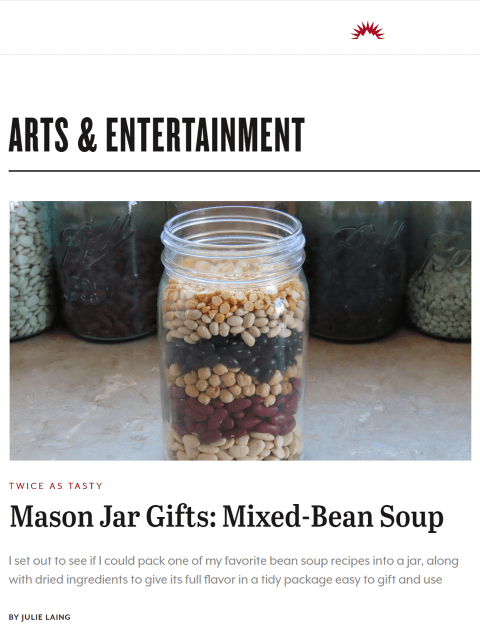
Mason Jar Gifts: Mixed-Bean Soup

When adapted to be gifted in a jar, one of my favorite soups packs in all of the flavor of the fresh recipe. Learn more at TwiceasTasty.com.
Every December, I share ideas and recipes that make delicious food gifts. These ideas have ranged from tags and bags to suggestions for food gifts that include homemade treats, kitchen tools, and of course my books.

This year, I’ve added to the food gift ideas with a meal-in-a-jar recipe in my Twice as Tasty column for the Flathead Beacon. It was surprisingly straightforward to adapt one of my favorite fresh soup recipes so that it could be gifted in a jar, ready to by pulled from the cupboard and made on a chilly night with minimal added ingredients. It still packs all of the flavor of the fresh recipe without relying on salt-heavy bouillon cubes or store-bought seasoning blends. It’s also easy to scale up or down for larger or smaller households and to make multiple jars to cover everyone on your gifting list.
Learn to make Mixed-Bean Soup as a mason jar gift

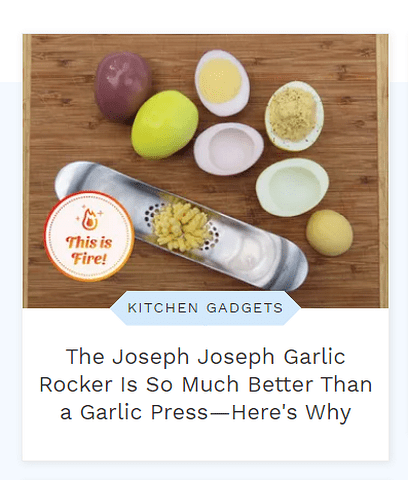
Kitchen Favorites: Garlic Rocker

When I kept the Joseph Joseph Garlic Rocker, I was determined to justify its position in my tiny kitchen. And I’ve done just that. Learn more at TwiceasTasty.com.
When I was asked to test an array of garlic presses last year, I hadn’t expected to keep any for my own kitchen. I grow and use piles of garlic; I’m just comfortable rock-chopping it for Sourdough Garlic Knots, slicing it for Spanish Shrimp in Garlic Oil, and roasting and squeezing it onto everything. When I owned a garlic press, it just took up space in my utensil drawer, sitting unused far too long before I gave it away.

Then, when I’d finished testing garlic presses, the look, feel, and easy use of the Joseph Joseph Garlic Rocker made it hard to give up. So I tucked it into my utensil drawer, determined to make it useful enough to justify its position in my tiny kitchen. And I’ve done just that, as I share in my latest piece for The Spruce Eats.
Learn about choosing and using garlic rockers and presses

Choosing Wooden Spoons

I reach for wooden spoons all of the time; when baking, sturdiness and handle comfort matter most. Learn more at TwiceasTasty.com.
As the holiday baking and gifting season begins, you may want to check out my recent piece for The Spruce Eats. I tested a dozen wooden spoons for the website earlier this year, using each of them to stir multiple batches of cookie dough or quick bread batter, as well as sautés, soups, pasta, and more.

I reach for wooden spoons all of the time in my kitchen, but they probably get the most use when I’m baking. Overall, I found that sturdiness and handle comfort mattered most when mixing doughs, especially dense ones. Some spoons I tested had additional features, like an edge shape that easily scraped down a mixing bowl or a small rubber scraper on the top of the handle that could clear out a measuring cup. A few had a shape that worked best when gripped a certain way to mix dough.
Learn about choosing and using wooden spoons

Vanilla Bean Cookies

These cookies are special to me because of their family history that has spread to friends’ holiday traditions. Learn more at TwiceasTasty.com.
To kick off the December holiday season, I shared a favorite family cookie recipe this week in my Twice as Tasty column for the Flathead Beacon. Vanilla Bean Cookies are an appropriate way to start a month that emphasizes baking not only for their flavor but also because of how you create them: by making the cookies and letting them sit for several weeks. They’re the first cookies I make each holiday season, quickly followed by Chocolate Rum Balls, and they’re some of the first to be devoured when I crack open the cookie tins.

These cookies are special to me because of their history in my family and because friends continue to adopt them and include them in their own holiday traditions. My grandmother’s original recipe seemed untouchable, but I recently improved on it by switching to organic ingredients, especially a tapioca-based powdered sugar instead of one laced with cornstarch to prevent caking. After years of making this recipe, the flavor and texture were better than ever, making the extra cost well worth it.
Learn to make Vanilla Bean Cookies

Creamy Roasted Pumpkin Pie

Here’s my favorite pumpkin pie recipe and all of the homemade components I put in it. Learn to make Creamy Roasted Pumpkin Pie. Learn more at TwiceasTasty.com.
This week, I share my favorite pumpkin pie recipe in my Twice as Tasty column for the Flathead Beacon. It seems fitting not just for the season but also because the introduction to my first column a year ago began with Mike Kordenbrock’s story and Hunter D’Antuono’s photos of another family favorite: Crumble-Top Deep-Dish Apple Pie.

I almost always make one or both of these pies for Thanksgiving gatherings, and they’re delicious for other winter holiday feasts, birthday parties, family meals, and more. If you’re just now stumbling on this recipe, don’t worry: read it completely, decide how many of the components you want to make from scratch, and then remember it for a future holiday.
Learn to make Creamy Roasted Pumpkin Pie

Cinnamon-and-Sugar Pie Crust

To master the technique of making any type of pie or quiche, start with a simple homemade pie crust recipe. Learn more at TwiceasTasty.com.
My family has a long history of homemade pie fillings and crusts, as I’ve shared in the past and this week in my Twice as Tasty column for the Flathead Beacon. I can’t remember when I ate or even exactly when I helped to make my first pie, but in my mother’s and grandmother’s kitchen, the crust was always mixed from scratch and the extra dough was always rerolled, sprinkled with cinnamon and sugar, and baked as a treasured snack.

These homemade pie crusts tended to consist of the same simple ingredients—the ideal setup for mastering the technique of making them. Once you find a pie dough recipe you like, whether it’s the one I share in my column this week or from another source, I recommend sticking with it and using it for everything from fruit and cream pies to quiche. When it becomes your go-to recipe, you’ll never worry about making a mistake, and you’ll never need to buy a premade shell.
Learn to make Cinnamon-and-Sugar Pie Crust

Roasted Winter Squash Puree

This month, I’m breaking down my favorite pumpkin pie recipe by its homemade components. Learn more at TwiceasTasty.com.
When I planned my Twice as Tasty column for the Flathead Beacon this month, I knew I wanted to share my favorite recipe for pumpkin pie. But I quickly realized I didn’t have enough space to print the full scratch-made version. Instead, I’m breaking down the pie recipe by its homemade components: spice mix, pumpkin puree, pie crust, and the final filling and baking.

There are several advantages to this—beyond staying within my word-count limit. Each component is presented as a standalone recipe, showing you how it can be made in advance and put to other uses. You can also choose how homemade you really want your finished pie to be. You could make your own spice mix but buy canned puree. Or you could mix and roll your own crust but use a store-bought spice blend that’s already in your cupboard.

If you do decide to go entirely homemade, spreading out these recipes over a few weeks will hopefully make the project seem less daunting. You’ll also get to enjoy bonus goodies, like roasted pumpkin seeds, pumpkin cookies, and pie crust snacks, along the way.
Learn to make Roasted Winter Squash Puree