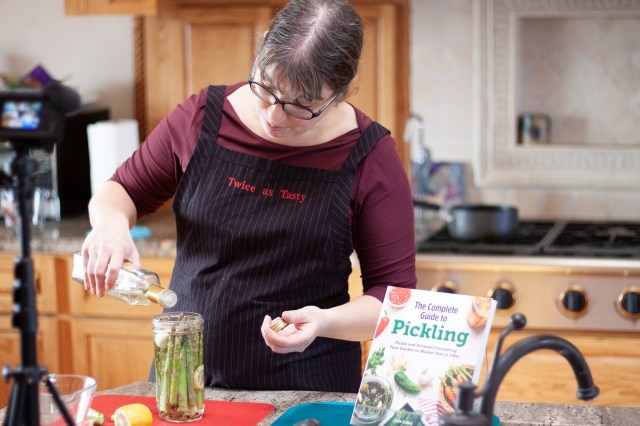

I’m excited to share two pieces I worked on earlier this year that have made it live on The Spruce Eats: one on stackable cookware and one on canning books. The topics may seem to have little in common, but both articles feature favorites in my personal kitchen and will hopefully help you in choosing tools and resources.
Read more about cookware and canning books
Author: Julie Laing | Twice As Tasty
Preserving Chilies

Just like the cabbage I wrote about last week, chilies feature heavily in my pickling cookbook, The Complete Guide to Pickling. I pickle and preserve them on their own in recipes ranging from Beer-Pickled Jalapenos to Spicy Vinegar and from quick-pickled Chile Rings to fermented hot sauces. I also drop them into many of the savory pickles in the book and even a few of the sweeter ones, like Jerk-Spiced Banana Pickles.
Do I preserve so many chilies because we grow more than 40 pepper plants every year, or do we grow that many plants so I have boxes of chilies? It’s hard to say, but at least half of our homegrown peppers carry a mild to a fiery heat. Jalapenos and poblanos take up much of the hoop house space, but I bump up the Scoville scale with serranos, bird’s eye chilies, habaneros, and cayenne peppers.
The mix varies each year—as does the quality and size of the harvest. After buying and pickling pepperoncini to test for a new recipe for the cookbook, I grew some of these mild chilies for the first time last year. They started turning red when they were smaller than my thumb, so I pickled them in pint jars. This year, a plant from Swan River Gardens has grown taller than the cherry tomato cages and produced peppers longer than my index finger. Two half-gallon jars are stuffed full in my fridge, and more peppers are ready to harvest.
Read more about preserving chilies and learn to make Sambal Oelek (Chile Paste)
Preserving Cabbage

When Americans think of pickled foods, they often start with two vegetables: cucumbers and cabbage. For both types, the options extend far beyond basic dill slices and sauerkraut. I included 11 cucumber and 7 cabbage pickles in The Complete Guide to Pickling, ranging from quick pickles to relishes to ferments.
In the cabbage category, curtido has become one of my favorites. This pickled cabbage slaw originated in El Salvador and typically combines cabbage, onion, and oregano, sometimes adding other flavors like carrot, chili, garlic, lime, and cilantro. It comes together in just 20 minutes, but letting it sit in salt for a couple of hours to draw out the vegetables’ natural liquid keeps the mixture from becoming watery. After it sits another 6 hours, the curtido is ready to eat—but it keeps in the fridge for several weeks.
Read more about preserving cabbage and learn to make Eight-Hour Curtido
A Year of Pickles

It’s hard to believe that this time last year I was gearing up for the launch of my first cookbook, The Complete Guide to Pickling. The timeline of writing and publishing a book means that I spent September 2020 sitting on my hands, resisting the urge to share my favorite recipes from the book ahead of the sales schedule and Brenda Ahearn’s stunning photos from my side project, The Pickled Picnic recipe collection, before the cookbook’s release.
As the cookbook’s official on-sale and launch party dates approached, I shared a handful of recipes from the book and offered details on some helpful tools I’d discovered while working on the project. This year, I’m able to get a jump on sharing new recipes from the book while many of us are still in the heart of harvest season.
Sample recipes from The Complete Guide to Pickling
Baking with Zucchini

I lost all sense of theme in this month’s blog posts, which ranged from grilling tofu, to induction cooking and canning, to pickling eggs. So I might as well round it out with another random topic: baking with zucchini.
People rarely plant zucchini seeds without later bemoaning the endless crop. It’s hard to plant just the two or three hills recommended for a family and even harder to thin each zucchini hill to a single plant. I watched my dad make this mistake every season and then watched my mom as she stared at a kitchen counter hidden under baseball bat-sized zukes, wondering what to do with them all. Yet year after year, I make the same planting mistake, and although I’m diligent about plucking zucchini when they’re about the thickness of an empty paper towel roll, some always get away.
So every year I eat, process, and give away lots of zucchini. But only recently have I returned to, and improved on, one of my mom’s staples for feeding zucchini to kids: Chocolate Zucchini Cake.
Learn to bake with zucchini and make Chocolate Zucchini Cake
Pickled Eggs

Harvest is in full swing, which means my canning and fermenting supplies dominate my mudroom and my refrigerator is packed with produce waiting to be preserved. But after the successful launch of my pickling cookbook, The Complete Guide to Pickling, last fall, I’ve made time for some recipes that make minimal use of my homegrown produce, including pickled eggs.
We have a rich supply of eggs on the farm where I garden. As I created pickled egg recipes for my cookbook, I fell in love with the rich colors of brine-infused egg whites against bright orange yolks. Since then, I’ve been playing with all sorts of brines—reused from other pickles and made from scratch—to produce a range of colors and flavors.
Pickled eggs keep and travel well, and we’ve been eating them regularly all summer. They have become staples for multiday cruises aboard The Blue Mule, and they make a great post-yoga snack or grab-and-go breakfast with the garden’s latest berries. I’ve learned a few tricks along the way that will help you when making pickled eggs.
Learn to reuse pickle brine and make pickled eggs
Choosing Portable Burners

Our Montana heatwave rolls on, so I’m moving as may food projects as I can out of the hot kitchen to a shady, breezy space. Fortunately, there are plenty of options when cooking outdoors. As I blogged about all last month, a grill is my favorite summertime tool. It adds another layer of flavor whether I’m cooking a meal, preparing food for the freezer and midwinter use, or firing off rounds of vegetables to stockpile for canning.
But the grill is just one of my outdoor cooking tools. Aboard The Blue Mule, we carry a grill, a two-burner camp stove, and a Jetboil backpacking stove, covering every cooking need while on the water. At home, large canning sessions happen outdoors on a heavy-duty, two-burner cooker. The most recent addition to my cooking arsenal has been a portable electric burner. As long as I have access to a flat surface and an electrical outlet, I can set up this burner for Twice as Tasty live events, workshops, or anywhere else I want to go.
Off the blog, I’ve been researching the best portable burners for The Spruce Eats. My latest lineup has been focused on induction models.
Read more about induction cooking
Grilled Tofu

Since last week’s post, I’ve been continuing to sample and enjoy recipes from The ‘Ohana Grill Cookbook. One of the first to catch my eye continues to be a favorite, so I was thrilled when author Adrienne Robillard and photographer Dawn Sakamoto Paiva allowed me to share it in a bonus grilling post this week.
The book’s 50 recipes put Hawaiian flavors on the grill, no matter where your grill is located. I had no trouble finding most of the ingredients listed, even in northwest Montana, and my homegrown vegetables had plenty of chances to play with pineapple, mango, and other tropical flavors. I tried many fish and shellfish recipes from the collection—and more than 20 recipes will satisfy meat lovers. But one I’m going to be making again and again should be on everyone’s list, from carnivores to vegans: Grilled Tofu and Veggies.
Learn to make Grilled Tofu and Veggies from The ‘Ohana Grill Cookbook
Cookbook Review: Grilling, Hawaiian Style

Besides grilling and sharing my own recipes this month, the authors of the new ‘Ohana Grill Cookbook offered me a copy to check out. The Hawaiian-inspired recipes range from Pineapple Chicken to Curry Coconut Shrimp with a side of Sesame Eggplant and Grilled Bread Salad. Of the recipes I’ve tried, we’ve had wiped-clean plates after every meal. To put it simply: making the recipes from The ‘Ohana Grill Cookbook has been such delicious fun.
Read more about The ‘Ohana Grill Cookbook
Grilled Shrimp

In case you haven’t noticed, I love the flavor of smoky chilies. I buy cans of chipotle chilies for my favorite salsa. I also home-smoke homegrown chilies to dry or turn into paste and then use in everything from spiced nuts to cheese dip to fish cakes. In my pickling cookbook, I recommend Fresno chilies in many recipes because of their natural slightly smoky flavor.
Chipotle peppers are actually jalapenos; they’ve just been smoked and dried. When you buy them canned, they’ve been rehydrated and stored in a spicy tomato-based sauce. The sauce can be as flavorful as the peppers, and they boost the heat and smoky flavor of a marinade. You only need a little chipotle flavor for a marinade, but don’t let that stop you from opening a can. Scoop any leftover chilies and adobo into an ice cube tray, and then freeze and bag the cubes for future use. A standard ice-cube tray holds about 2 tablespoons per cube.
After I’ve used a marinade for grilling, I hate to toss what’s left. So I boil it into a sauce and mix it into a second meal.
Learn to make Chipotle-Marinated Grilled Shrimp and Spanish-Inspired Fried Rice