Kitchen Favorites: Cheese Plane

Three generations of Norwegian cheese planes remain favorite tools in my family—including the one I’ve used for more than 40 years. Learn more at TwiceasTasty.com.
It’s been a busy few weeks of workshops and projects, so I’m finally getting a chance to share my latest piece for The Spruce Eats. This was such a fun story to write, because it combines my love of a tool that sees daily use in my kitchen with a bit of family history that let me reach back for memories from my childhood and beyond. It’s funny how sometimes the smallest things can stick with you the longest—like this cheese slicer that I’ve been using for more than 40 years.

I was able to work on this story while I was visiting my family, so I had a chance to shoot the generations of Norwegian cheese planes that remain favorite tools. In my mom’s kitchen, you’ll find my grandmother’s cheese slicer. The one I grew up with has moved to my kitchen, and a Norwegian cousin kept my sister in the loop by gifting her a lovely silver cheese plane for her wedding.
Learn about choosing and using a cheese plane

Making Friends with Ferments

I’m excited to be teaching a free workshop, Making Friends with Ferments, on March 4 at the 8th annual Free the Seeds. Learn more at TwiceasTasty.com.
One of my favorite spring-transition traditions in Montana is Free the Seeds, a free, daylong seed giveaway and workshop fair that teaches about real seeds, real food, and real skills. I’ve been teaching workshops at the event for several years and am excited to be back in person for the 8th annual Free the Seeds on March 4.

As I share this week in my Twice as Tasty column for the Flathead Beacon, my Making Friends with Ferments workshop is just 1 of 27 on the day’s schedule for this year, with the others ranging from garden plants and skills, to keeping bees and chickens, to topics aimed at this year’s theme: cultivating community.
Learn to make more about making friends with ferments

Apple-Sweetened Yellow Onions

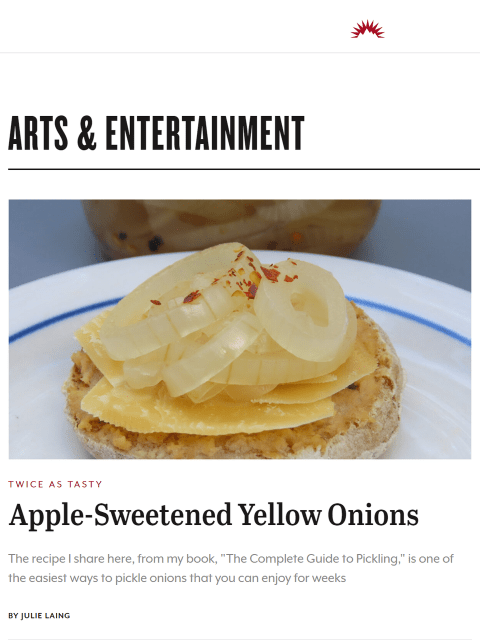
When pickling, red onions are just as readily available as yellow ones for colorful combinations. Learn more at TwiceasTasty.com.
I have to admit: Before I wrote The Complete Guide to Pickling, I rarely thought about pickling onions. Onions land in just about every jar of pickles I make, from Spring Asparagus Pickles and Salt-and-Vinegar Winter Squash, to canned Honeyed Bread-and-Butter Chips, to Southern-Style Pickled Shrimp. If I wanted slices of pickled onions for a sandwich, I just fished them out of one of those jars.

But part of the fun of pickling onions is that red onions are just as readily available as yellow ones, making it easy to create colorful combinations. Lime-Pickled Onions, with thinly slices of red onion immersed in lime juice, become a shocking pink. Red Onions in Wine Vinegar turn a deeper reddish hue. For Fermented Red Onions, weighing down the onion rings with a red beet doubles down on the brightness. I even use red onions, and sometimes just their skins, in other recipes for an extra shot of color.

The pickled onions I share this week in my Twice as Tasty column for the Flathead Beacon keep their pale, nearly translucent color, but apple cider vinegar and a little bonus sugar make them a bit sweeter than these more colorful versions.
Learn to make Apple-Sweetened Yellow Onions

Roasted Garlic Hummus

Homemade sourdough pita deserves homemade hummus, which you can whip up in minutes with ingredients in your kitchen. Learn more at TwiceasTasty.com.
You can’t go wrong with the classic pairing of pita bread and hummus. Although hummus has become popular enough to earn cold-case space in most grocery stores, your homemade Pillow Sourdough Pita deserves a homemade spread. Fortunately, you can easily whip up a batch in minutes in your kitchen, as I share this week in my Twice as Tasty column for the Flathead Beacon.

For maximum flavor and creaminess in my hummus, I use roasted garlic, a little Homemade Yogurt, and home-cooked dried chickpeas. My hummus is still ready in minutes because I always have a stash of roasted garlic and fresh yogurt in my fridge for all sorts of uses. Then I’ll cook up a large batch of beans for a couple of meals and throw in an extra 2/3 cup of dried beans to pull out for hummus. But for spontaneous hummus, I always have a can or two of low-sodium chickpeas in my pantry.
Learn to make Roasted Garlic Hummus

Toaster vs. Toaster Oven

My love of toaster ovens comes down to their versatility and my lifestyle, but my family would disagree. Learn more at TwiceasTasty.com.
I’ve been a toaster oven fan since my days of melting marshmallows and chocolate chips onto graham crackers in the little model on my grandmother’s counter for my after-school snack. But my parents always kept a pop-up toaster on their kitchen counter, preferring it to this day. My sister owns both, but there’s a clear preference: the pop-up toaster claims counter space, but the toaster oven lives in a cupboard until needed for a special meal, like mini English muffin pizzas.

I listened to all of their pros and cons, along with some deeper research, for my latest piece for The Spruce Eats. Although I wasn’t swayed to give up my toaster oven, I found several sound reasons for choosing a pop-up toaster instead.
Learn about choosing and using toasters and toaster ovens

Corn and Potato Chowder

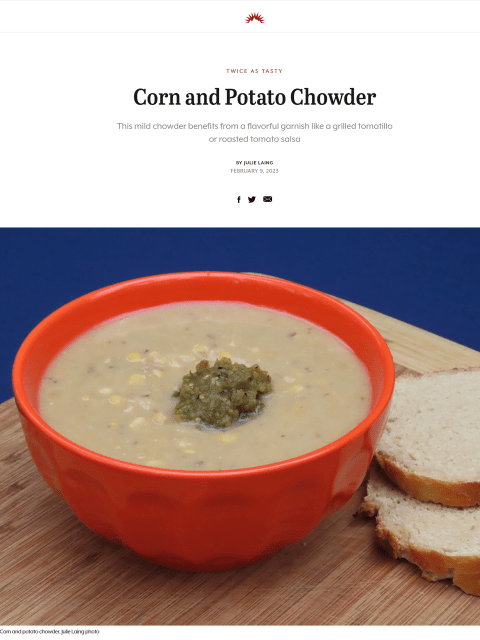
Vegetarian chowder has become one of my après ski favorites because it’s so easy to make with ingredients I keep in my house. Learn more at TwiceasTasty.com.
Just setting at a bowl of chowder on the table cuts my hunger pains. The thick soup immediately looks warming and filling. After a ski day, I don’t even feel guilty about dipping a slice or two of sourdough bread into the bowl.

The chowder recipe I share this week in my Twice as Tasty column for the Flathead Beacon has become one of my après ski favorites because it’s so easy to make with ingredients I keep in my house. Even if you don’t grow and store boxes of your own onions, garlic, and potatoes, they’re affordable and keep well. The same goes for frozen corn and stock. With a little butter, and some cream and salsa if it’s on hand, you have everything you need for a filling meal.
Learn to make Corn and Potato Chowder

Frozen Strawberry Syrup

Take just one bag of fruit from the freezer and turn it into a jar of syrup for the fridge. Learn more at TwiceasTasty.com.
The first year I canned fruit syrups, I gifted my sister a couple of jars. The next year, she asked for a full box of jars filled with the jewel-toned syrups. In her house, they get used more often than jams: drizzled on pancakes or waffles, stirred into yogurt, blended into smoothies, and more.

I like making summertime fruit syrups because I can pair fruit and herbs in the same way I do for shrubs, ending up with a sweet concoction rather than a sweet-and-tangy vinegar-spiked one. The downside, as with jelly, is that it takes a lot of fruit to fill a canner-load of jars. So I created a recipe for my Twice as Tasty column this week for the Flathead Beacon that takes just one bag of fruit from the freezer and turns it into a jar of syrup you can keep in the fridge.
Learn to make Frozen Strawberry Syrup

Kitchen Favorites: Canning Cookbooks

I’ve updated my list of favorite canning books with new editions plus newer releases worth adding to your canning bookshelf. Learn more at TwiceasTasty.com.
It might not feel like canning season with garden beds buried in snow. Still, seed catalogs keep arriving. To my mind, the smart way to grow and preserve your own food is to follow the progression from buying seeds to planting to harvesting to canning. That means that now, as I choose varieties from seed catalogs, I’m noting the recipes that I hope to can in summer or fall.

If you think the same way, you’ll want to be leafing through some of the canning cookbooks in my recent piece for The Spruce Eats. I originally wrote this roundup in 2021 and shared more about sourcing safe canning recipes in a related blog post. I’ve updated the list with new editions of some of my favorite canning books plus a couple of newer releases worth adding to your canning shelves.
Learn about choosing and using canning cookbooks

Stovetop Sourdough English Muffins

After long ignoring my sourdough English muffin recipe, I am now baking a new batch every time we polish off the last one. Learn more at TwiceasTasty.com.
I baked up a batch of sourdough English muffins a few weeks ago and rediscovered just how easy they are to make. That’s not how I had remembered them, and looking back over my notes, I realized it was because it took several tries to create a recipe that had almost no kneading, allowed a long ferment time, and could be cooked entirely on the stovetop.

That latter quality was the reason I pulled out the recipe after ignoring it for so long: we’re in the middle of a house remodel, so I’ve been a bit transient for the last few months, most recently staying in a family guesthouse with a functioning stovetop but a nonworking oven. I’m now baking a new batch of sourdough English muffins every time we polish off the last one. It seemed well worth sharing as the final Sourdough Month recipe in my Twice as Tasty column for the Flathead Beacon.

The 6th Annual Sourdough Giveaway has been a huge success; so far, I’ve sent out more than 250 packets of sourdough starter! It is winding down, so sign up by January 31, 2023, if you want me to send you a free packet of my own sourdough starter.
Learn to make Stovetop Sourdough English Muffins

Kitchen Favorites: Snack Bowls

Testing kitchen products puts pieces in my hands that I never would have bought yet now find they fit perfectly into my tiny kitchen. Learn more at TwiceasTasty.com.
Testing kitchen products for The Spruce Eats puts pieces in my hands that I never would have sought out, like the four Corelle Classic Winter Frost White Bowls I feature in my latest article for the website. These 12-ounce bowls were chosen by another writer as part of a cereal bowl roundup, but after they arrived at my house for testing, it was clear I wanted to bump up a size. Instead of immediately returning the bowls, I held onto them to judge their overall usefulness—and decided they were worth the shelf space to keep permanently.

I rarely eat cereal from these bowls, reserving that for a larger-capacity set that I tested and kept for sailing, picnicking, road tripping, and more. But Corelle’s smaller bowls travel just as well. I use them often at home, too, for snacks, small portions, meal prep, and serving.
Learn about choosing and using snack bowls