Pick a Pickle

Almost every vegetable garden explodes in July. My first July harvest included the last of the spring greens and asparagus, midcycle broccoli and garlic scapes, and the first snap peas, carrots, beets, and bulb onions. The harvest will go straight into our mouths, but as the yields grow jugs of vinegar and a box of salt will be front and center, ready for pickling.

All of my recently harvested vegetables can be pickled, along with snap beans, summer squash, tomatoes, peppers, eggplant, garlic, cabbage, and even fruit. That’s the beauty of pickling: it lets you preserve any low-acid vegetable safely. And like many of my favorite processing techniques, it’s endlessly variable. Various pickling techniques let you preserve everything from a single cucumber to a box of cukes. You can flavor them to fit any meal: American dills or bread-and-butters with burgers, Japanese kyuri asazuke with sushi, Indian kheer uragai with curry—and that’s just a few variations on cucumber pickles.
Read more about quick and easy pickling

Any-Fruit Jam

Sweetness defines jams—and sometimes overpowers them. To my mind, a jam that leaves a lingering coat of sugar on your tongue misses the point: savor the fruits of summer. Making fruit-forward jam is simple once you understand a bit of the science behind it.

Fruit needs three things to set, or thicken, a spreadable consistency: acid, sugar, and pectin. Think of the molecular interactions in fruit like a high-school romance: Pectin molecules are attracted to water, but water is attracted to sugar. If water and sugar “hook up,” the pectin molecules will bond—with a little encouragement from their best friend, acid—and the jam will thicken.

The traditional method of encouraging this interaction is to throw enough sugar into the batch to distract all the water molecules. But more sugar is not the only option. An acidic pectin, like one based on citrus fruits, is an effective matchmaker for pectin molecules. Another method to encourage pectin couplings is to reduce the pool of available water molecules.
Learn to make Any-Fruit Jam without Added Pectin and Any-Fruit Jam with Added Pectin

Fruit Syrups

Syrup. For most of us, the word brings to mind pancakes or waffles drizzled with—OK, drowning in—liquid maple sugar or its cheaper, corn syrup–based counterpart. But as you start harvesting from your garden, the word expands to endless options based on the fruits of summer and enhanced with herbs.

My love of fruit syrups grew when I learned how to extract bonus jars of the flavor-packed liquid from fruit solids intended for jam—and make jam more easily in the process. Syrups are less finicky than jelly but can still be processed for long-term storage or simply stashed in the fridge. Traditionally made from boiled fruit that’s been strained to separate its juice, I’ve found a cold method separates the juice even more effectively from almost any fruit and a roasted method gives an extra boost of flavor.
Learn to roast and freeze fruit for syrup

Fruits of Summer

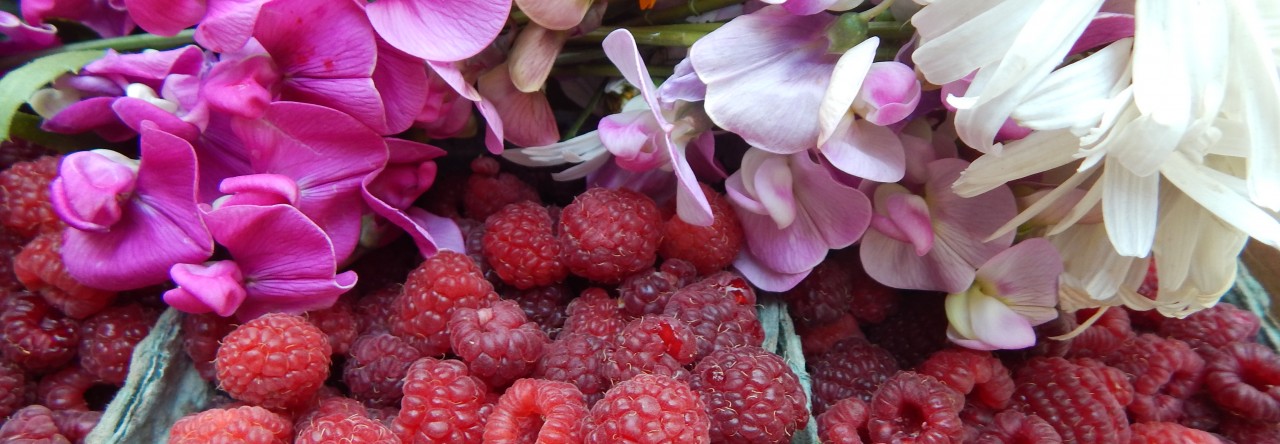
June has me craving garden sweets. Rhubarb has been gracing my table for weeks; now strawberries are reddening to join it. In warmer areas, you’re probably anticipating blackberries, blueberries, and tart cherries before the month is out. As we roll into July, raspberries, apricots, and early plums will all start to appear. It’s hard to resist summer’s sweet bounty.

It’s also hard to overcome the desire for fruit out of season. Although American grocery stores stock nearly every vegetable imaginable all year, some fruits can be harder to come by outside their harvest window. Those that do appear year-round, or close to it, lack that fresh summer flavor that makes them so appealing. How they are grown is also of concern; more than half of the Dirty Dozen list (foods with the worst pesticide residue based on USDA and FDA data) is fruit. These are all good reasons to grow—and save—fruit yourself.
Read more about preserving the fruits of summer

Planning the Season

Seed catalogs have been arriving for weeks, making me think about planning the garden despite the 5 feet of new snow that buried our local mountains in the last few days. This past weekend only enhanced the spring fever: I led a workshop at the 2nd annual Free the Seeds event and was impressed by not just the four-digit turnout but also the number of booths, workshops, and talks. The local Farm Hands organization lists more than 110 farms, ranches, community gardens, farmers markets, and restaurants and grocers that emphasize local food for a county with a population of under 100,000; nationally, the U.S. Department of Agriculture’s most recent survey found that 167,000 U.S. farms locally produced and sold food through farmers markets, on-farm sales, and other direct farmer-to-eater sales.

This means that no matter where you live, it should be possible to grow or purchase locally grown food and use it in Twice as Tasty recipes. Now’s the time to start thinking about what you want to grow in your new garden, add to your existing plot, or ensure will be delivered by your community-supported agriculture (CSA) farmer.
Read more about planning the season

Made with Love

I’m a perennial giver of food. Whether it’s for a holiday, at an event, or just because someone expresses random interest in something I made, I can’t help myself: I have to gift a jar or bag of homemade goodness.

I love receiving food too, but sometimes even I—someone who processes hundreds of jars a season, dehydrates and freezes, ferments and smokes—am hesitant to open a gifted jar. These are usually the ones that have perhaps a single word on the lid identifying the contents. No date, no maker, and no suggestions for putting it to use. These jars often work their way to the back of my canning shelves, hiding behind the familiar and loved. It makes me think some of my gifts go just as astray. So I’ve devise a way to change that—and I’m gifting my idea to you.
Read more about gifting food

Under Pressure

I have vivid memories of a giant silver kettle rattling away on the stovetop, letting off steam like a rocket about to head to the moon. But I was likely too young to be involved in actually running this pressure canner. And by the time I was old enough, my mom had acquired a vacuum sealer and exchanged the steamy heat-of-summer process for extra chances to open the freezer door.

When I inherited my mom’s canning equipment more than a decade ago (with the caveat that I fill both our shelves with its results), I also inherited “the beast”: the heavy pressure canner capable of holding 7 quarts. I promptly broke it before I could even get its old seal tested. It now makes a lovely open kettle for cooking down applesauce and other large batches. I’ve never replaced it, and I’ve never missed it. And here’s why. Read more about (not) pressure canning

Apples

Applesauce is among my earliest canning memories, in the kitchen and on the tongue. My dad grew several varieties of apples, and every year my mom would puree the fruit into dozens of quarts of applesauce. I recall pushing down on softened apples with a wooden mallet while my mother cranked away on the handle of the Victorio food strainer. I called it the “Victoria strainer” and clung to the idea that the British queen once used a similar device.

But my favorite applesauce was made by my grandmother. Grandma Tiny chopped apples by hand for small batches she stored in her freezer. Her “chunky applesauce” outshined all others. Mom’s applesauce did have one advantage: we could pour it onto dehydrator trays and dry it into fruit leather for school lunches. Between the two versions, I was spoiled to all other applesauce and have never been able to stomach commercial forms.
Learn to make Grandma Tiny’s Chunky Applesauce and Auntie Julie’s Fruit Leather

Tomatillos

If you’re a gardener, you likely end your season with a rack of green tomatoes and a quest to find a way to use them. Sorry, but this is not that recipe. I gave up on green tomato salsas several years ago—the vinegar required to make the salsa shelf stable when water-bath canning has always seemed overpowering.

Instead, I fell for the lovely green lanterns that grow into tomatillos, the traditional base for salsa verde. These little husked fruits clock in at pH 3.83, according to the U.S. Food and Drug Administration, well below the safe level for water-bath canning. The added acid covers the secondary low-acid vegetables and boosts the flavor. Even so, grilling and draining vegetables hasn’t been lab tested by National Center for Home Food Preservation, so I heavily researched and meticulously calculated the acidity for safe canning; to double-check my calculations, I test the recipes with a ThermoWorks high-accuracy pH meter. More details are in the Tips & Tricks for the recipe.

Tomatillos are as easy to grow as tomatoes; just be sure to buy two plants so that they cross-pollinate. Not surprisingly, I prefer them grilled like tomatoes—and have found yet another beverage use for their juice. Learn to make Grilled Tomatillo Salsa and Grilled Tomatillo Margaritas

Tomatoes

Hopefully you were swayed by my argument for grilling vegetables last month. In this week’s recipes, the grilled flavor shines. The salsa has evolved over the years from fresh to roasted and finally to grilled. We get more compliments for it than for anything else we process, and no matter how much we put up each year, our stash barely lasts to the next canning season.

The grilling creates intense flavor, but it also lets you stretch out the process to suit both your harvest and your schedule. We harvest and grill the ingredients as they come ripe, separating the tomato juice and solids. Then we stash everything in the freezer until we have enough for at least one full canner batch of salsa. It’s also a fabulous recipe for a canning party, particularly when paired with a tasty beverage to celebrate your hard work.
Learn to make Grilled Tomato Chipotle Salsa and Grilled Tomato Bloody Mary Mix