Wasabi-Dusted Grilled Shrimp

I’ve learned to treat wasabi or horseradish powder like a finishing salt for hot food, sprinkling it on just before serving. Learn more at TwiceasTasty.com.
When I started making sushi at home and then teaching the techniques I use in workshops, wasabi powder became a staple in my kitchen—one I couldn’t resist finding other ways to use. But as I explain this week in my Twice as Tasty column for the Flathead Beacon, there are some tricks to working with wasabi powder and maximizing its flavor. I now treat it like a finishing salt for hot food, sprinkling it on just before serving, like with this week’s grilled shrimp recipe.

But really, I’ve stopped buying wasabi powder and switched to horseradish powder instead. It gives essentially the same effect—which makes sense, because most wasabi sold in the United States is primarily horseradish powder, perhaps with wasabi leaves and stems and artificial colors mixed in. Horseradish powder is usually more affordable and, if you grow horseradish root, easy to make in a well-ventilated space.
Learn to make Wasabi-Dusted Grilled Shrimp

Grilled Portobello Mushrooms

Before the garden produces its first asparagus and after I’ve cut fall’s last broccoli, my favorite grilling vegetables are mushrooms. Learn more at TwiceasTasty.com.
I’ve shared several grilled vegetable recipes in my Twice as Tasty column for the Flathead Beacon, mostly featuring summer’s harvest. We grill several meals each week in summer, piling on eggplant, corn, and other homegrown vegetables. Yet we get coals going throughout the year, regardless of temperatures and weather. Before the garden produces its first crop of asparagus and after I’ve cut the last broccoli florets of fall, my favorite grilling vegetables are mushrooms.

I briefly explained my technique for smoking and then searing mushrooms when I shared my recipe for Vegan Memphis-Style Barbecue Sauce. The preparation is delicious but takes a few stages. For a simpler approach still loaded with flavor, I marinate the mushrooms, grill them until cooked through, and serve.
Learn to make Grilled Portobello Mushrooms

Home-Smoked Chili Peppers

Smoke vegetables in a charcoal grill using briquettes and wood chips or in a charcoal or gas grill using a smoke tube and hardwood pellets. Learn more at TwiceasTasty.com.
When I first explored the idea of smoking food at home, I thought I was going to need to spend several hundred dollars on a large pellet smoker. I quickly learned that the typical smoker, while ideal for smoking meats, runs too hot for the food I was interested in smoking: vegetables, nuts, and especially cheese. So George and I started playing with the idea of smoking vegetables, like homegrown chili peppers, in a charcoal kettle grill.

As I explain this week in my Twice as Tasty column for the Flathead Beacon, our first smoking setup was affordable and low-tech but finicky. It was challenging to light just a handful of briquettes in a charcoal chimney, and we had to replenish the wood chips regularly. With charcoal heat, it could also be a challenge to keep the temperature low enough to smoke cheese, especially in summer. We loved the results but kept searching for a more straightforward process.

Then I stumbled onto smoke tubes, inexpensive perforated cylinders that hold hardwood pellets and burn slow and low for hours. We’ve been using one for the last year of home-smoked food projects, and this summer I tested several additional brands and sizes for The Spruce Eats. Keep an eye on my work for that website to read my reviews when the product roundup goes live.
Learn to make Home-Smoked Chili Peppers

Chipotle Grilled Shrimp

Make shrimp marinade with fresh vegetables or freshly grilled ingredients, whipping up the marinade and firing the shellfish last. Learn more at TwiceasTasty.com.
When I want a quick and easy dinner during harvest season, I often fire up the grill. With an abundance of fresh vegetables at hand, the grill does double duty: lightly cooking while adding flavor to vegetables I want to save for winter and getting off the evening meal before the coals die out.

We might making an entire vegetarian meal from the homegrown produce that comes off the grill on a given night, but shrimp tends to be my go-to protein when I want some skewers on the plate. You can make the recipe I share this week in my Twice as Tasty column for the Flathead Beacon with fresh tomatoes, onion, and garlic—or grill these first, whip up the marinade while grilling the next rounds of vegetables, and fire the shrimp last.
Learn to make Chipotle Grilled Shrimp

Husk-Grilled Corn with Smoky Lime Butter

Freshly harvested corn comes as this perfect package ready to grill and eat: Just let the corn steam inside its husks. Learn more at TwiceasTasty.com.
Freshly harvested corn comes as this perfect package ready to cook and eat: Peel back the husks until they fan out around the ear’s base, remove the silk, and then fold the husks back up the ear and lay it on a grill, let the corn steam inside its own husks. Any silk you miss burns off with the heat or comes off when you pull away the warm husks, revealing the sweet, lightly charred kernels along the cob.

Since you’re pulling back the husks to get at the silk, it’s the perfect time to smear flavored butter down the ear so that it melts between the kernels as the corn cooks. The smoky lime butter recipe I share this week in my Twice as Tasty column for the Flathead Beacon is my favorite way to dress corn on the cob, but you can choose other blends instead, like lemon and oregano leaves, orange and nasturtium blossoms, or one you’ve already prepared as Compound Herb Butter.
Learn to make Husk-Grilled Corn with Smoky Lime Butter

Grilled Eggplant Baba Ghanoush

For the best flavor, grill over charcoal the long, thin halves of Japanese eggplant or the round, thick slices of oval Italian ones. Learn more at TwiceasTasty.com.
You know how gardeners joke about stuffing bumper crops of zucchini in mailboxes or sneaking them onto neighbors’ porches? That’s my eggplant crop this year. Last year’s plants struggled, so we not only improved their soil and care but also planted more starts for good measure. The plants have responded, pumping out multiple full-size eggplant every few days.

My favorite eggplant dish is a smoky Middle Eastern dip called baba ghanoush, so I’ve been making a lot of it this summer. When I first started preparing it at home, I tried numerous techniques to give the eggplant the perfect smokiness. Roasting or broiling were tasty, but the best flavor came from grilling over charcoal the long, thin halves of Japanese eggplant or the round, thick slices of oval Italian ones. Once the eggplant are grilled and peeled, the dip takes about 2 minutes to make, as I share this week in my Twice as Tasty column for the Flathead Beacon.
Learn to make Grilled Eggplant Baba Ghanoush

Vegan Memphis-Style Barbecue Sauce

You can’t buy a barbecue sauce off the shelf that duplicates this homemade, vegan, dairy-free, and gluten-free one. Learn more at TwiceasTasty.com.
Some barbecue enthusiasts will tell you it’s all about the sauce. That’s certainly the case with the new recipe I share this week my Twice as Tasty column for the Flathead Beacon. You can’t buy one off the shelf that duplicates it—especially if you want a vegan, dairy-free, and gluten-free option. Homemade barbecue sauces and other marinades also lack the high-fructose processed sweeteners so common in commercial bottles. Plus, you can make them for a fraction of the cost if you already have many of the base ingredients in your kitchen.

I developed this tomato-based barbecue sauce recipe intending to pair it with smoked and grilled mushrooms and then tested it with a couple of meaty types. Full-size portobellos pick up the most flavor in their large gills, but baby bella (aka cremini) mushrooms also work. The thick stalks and wide caps of King trumpet mushrooms would hold up as well to smoking as they do to pickling. As another variation, we’ve enjoyed this sauce with eggplant that has been smoked over very low heat, so that it stays firm, and then grilled until it softens but still holds shape. Of course, you can always serve this sauce with smoked brisket or pulled pork.
Learn to make Vegan Memphis-Style Barbecue Sauce

Cheese- and Bacon-Stuffed Burgers

Mitchell Farm, where I garden, raises and sells all-natural, purebred Red Angus beef and shares a favorite recipe for meat-loving followers. Learn more at TwiceasTasty.com.
One of the perks about writing my Twice as Tasty column for the Flathead Beacon is that I learn about food I don’t eat personally. Mitchell Farm, where I garden, raises and sells all-natural, purebred Red Angus beef. So I was excited when the owner and my garden partner, Leah Mitchell, offered to share a favorite recipe with my meat-loving followers.

On a recent evening, I learned the ins and outs of burger making and how to get the right sear on a Traeger Grill, a tool I’d never used and was eager to try. My contributions to the meal were mainly burger toppings: German-Inspired Spicy Mustard, Half-Sour Dill Pickles, Grilled Onion Relish, and other options from my pickling cookbook. I also found my own spin for the main recipe: The cheese filling, without the bacon, makes a delicious pescatarian-friendly topping for grilled salmon.
Learn to make Cheese- and Bacon-Stuffed Burgers

Roasting Peppers

 I use not one but four techniques to roast peppers of all colors, sizes, and heat levels. Learn more at TwiceasTasty.com.
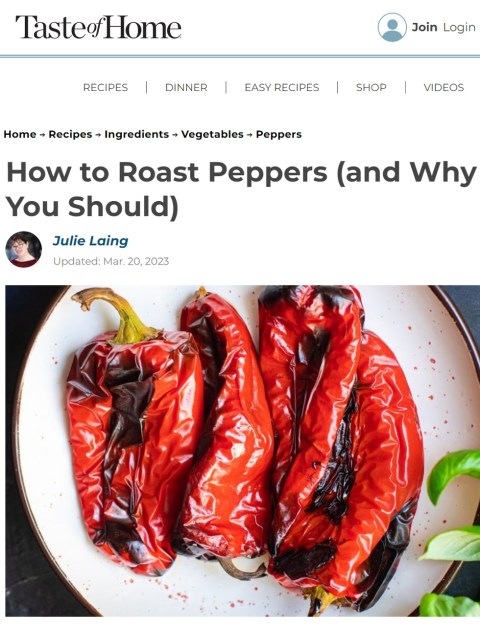
In one of my recent pieces for Taste of Home, I had a chance to share techniques for one of my favorite vegetable upgrades: roasting. I mainly roast homegrown peppers, so it’s an easy seasonal choice to char them on the grill. But if you’re buying peppers out of season or keeping an eye on a simmering pot in the kitchen, indoor techniques may make more sense. So I share not one but four ways to roast peppers of all colors, sizes, and heat levels.

Once glance at the price on a jar of roasted peppers in the store makes clear a key advantage to roasting your own. Other reasons include the ability to get them just the right softness to use in chunks in fresh dishes—jarred roasted peppers tend to be soft and slippery. I don’t just roast the standard red bell peppers, either: green bells, Gypsy peppers, Poblanos, and chilies all carry a smoky note when their charred.
Learn more about Roasting Peppers

Veggie Shish Kebabs with Garlicy Marinade

Almost any vegetable can be speared on a skewer and grilled. Learn more at TwiceasTasty.com.
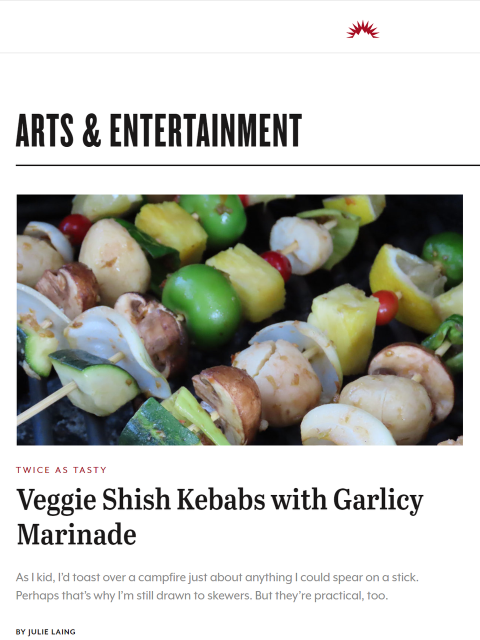
We give the grill a workout every summer, often with small items that want to fall through the grate no matter how carefully they’re arranged on the open surface. I have two grill trays that work well when smoking cherries or cheese or charring large batches of thin asparagus spears. I also have a pair of copper grill mats ideal for sourdough pizza and other soft ingredients—we even grilled scrambled eggs and potatoes on one when I forgot to put a skillet on the sailboat. But for grilled meals with more emphasis on variety than quantity, I reach for skewers.

As I share this week in my Twice as Tasty column for the Flathead Beacon, you can spear so many foods on a stick and cook them over an open flame. A simple marinade can tie the ingredients together, playing well with flavors that range from sweet tomatillos, to mild potatoes, to spicy peppers. Skewers are also ideal for grilling shrimp, scallops, meaty fish, and cubed meats.
Learn to make Veggie Shish Kebabs with Garlicy Marinade