Fried Green Tomatoes

To successfully make fried green tomatoes, choose the right tomatoes and prepare them properly for the pan. Learn more at TwiceasTasty.com.
If you grow a garden, especially in a climate with a short growing season, you know that one of your last harvest decisions is what to do with green tomatoes. If you harvest them before they are damaged by frost, many green tomatoes will ripened indoors. You can also preserve tomatoes while they are still green. Some can be eaten fresh too.

I share one of my favorite ways to eat fresh tomatoes this week in my Twice as Tasty column for the Flathead Beacon: dredged in cornmeal and fried in a pan. Successfully making fried green tomatoes, with a just-soft, sweet interior and crisp outer shell that stays attached to each tomato slice, depends on the tomatoes you choose and the way you prepare them before you add them to the pan.
Learn to make Fried Green Tomatoes
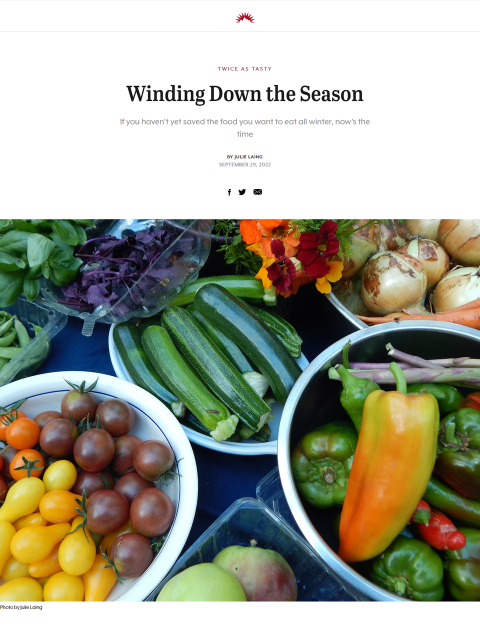
Winding Down the Season

Techniques that rely on freezing, dry storing, and dehydrating let you quickly save the garden’s last fruit and vegetables. Learn more at TwiceasTasty.com.
This September, we’ve been lucky to have fairly warm days and nights in Montana, with just a couple of hints at a killing frost that we were able to protect against temporarily. But the garden is still winding down. In the main garden, I’m finding fewer cucumbers and snap beans, with vines starting to dry and lose leaves. In the greenhouse, tomatoes and tomatillos are putting all of their energy into ripening existing fruit. It’s time to grab the last of the garden’s treats and stash it all away for winter.

This week, in my Twice as Tasty column for the Flathead Beacon, I share some of my favorite storage techniques for a range of vegetables. The article focuses on easy ways to save individual vegetables without needing to can or ferment them or changing their base flavor into a pickle or sauce. The techniques rely on freezing, dry storing, and dehydrating and can be done quickly with minimal prep.
Learn about winding down the season

Late Tomatoes

Late tomatoes never match midsummer fruit, but I treasure them as the season’s final flush. Get tomato recipes at TwiceasTasty.com.
Tomatoes are the last true summer crop that I grab from the garden. The shift comes as swiftly as the fall back to standard time: one deep temperature swing makes every green fruit still on the vine inedible. Each fall, I follow weather forecasts, gamble on their accuracy, and try to pluck every fully formed tomato before the first killing frost.

Even if I succeed, the reward isn’t the perfectly red, juicy treats I’ve been feasting on all summer. It’s boxes of hard, underripe tomatoes. Some I’ll eat or preserve while green, but most sit for weeks beside my desk, where I watch them gradually ripen.

These tomatoes never match the bright, sweet bite of sun-kissed midsummer fruit, but I treasure them as the season’s final flush. Rather than eating them out of hand, I’ve found that letting them cook slowly, like in this savory pie, maximizes their maturing flavor.
Learn to make Late-Season Tomato Pie and Herb and Cheese Pie Crust

Last Bites

A portion of my end-of-season harvest lands in my favorite fresh meals. Get the recipes at TwiceasTasty.com.
It’s that time: Time to savor the last fresh bites from the garden. With the first new moon of October, I begin closely watching the forecasted nighttime temperatures. One clear night is all it takes to zap the remaining outdoor vegetables and threaten even the greenhouse goodies. Even though local weather stations recorded 79°F on Tuesday, I could be frantically harvesting before a potential freeze tomorrow night.

Fall’s weather swings are always unexpected, and every year I try—and fail—to time each plant’s final harvest just right. Instead of bemoaning the last round of beans that froze on the vine, I look instead to the boxes of produce all over my little cabin, ripening and waiting to be eaten and preserved.
Read more about enjoying the garden’s last bites

Filling Salads

Salads are so versatile: chop up some ingredients, toss them with dressing, and your fresh, one-dish meal is ready to eat. Get salad recipes at TwiceasTasty.com.
Salads dominate my harvest menu. They’re so versatile: chop up some ingredients, toss them with a bit of dressing, and your fresh, one-dish meal is ready to eat. I start making homegrown salads as soon as spring greens show true leaves and don’t stop until the ground freezes.

Most salads fit the “no recipe required” category. Once you find your preferred ratios, even the dressing can be made on the spot with whatever’s at hand. If you follow @twiceastastyblog on Instagram you’ll find plenty of my daily salads. But I still get enough requests for ingredients and proportions that you’ll find a couple dozen salad and dressing recipes on the blog and can even gather your friends for a workshop. Some of these recipes are traditional, like panzanella, sunomono, and the two American classics in this week’s post. But as you’ll learn, all of these salads can be adapted based on what’s in season and what you have on hand.
Learn to make Three-Bean Salad and Taco Salad

Flavors of Fall

Even though September means hours of putting up homegrown food, much of the garden will offer portions suitable for fresh meals. Learn more at TwiceasTasty.com.
Of all the growing months, September holds the garden’s greatest bounty. I’ll harvest the widest variety of produce over the next few weeks, some of it from plants that are in their prime but much of it from those that are yielding their final offerings. In my garden, many plants will release preservable quantities this month, including nightshades, cucumbers, squash, and if a frost hits before the month’s end, apples. Plums and pears will be the only new arrivals, but they’ll all be ready at once.

Even though I spend plenty of hours in September putting up homegrown food, much of the garden will offer portions suitable for fresh meals. Broccoli and even asparagus are still putting out a handful or two of new shoots at a time. Corn and snap beans just passed their peak but will continue to give up enough for immediate use. Cherry tomato and basil plants will keep reminding me of summer even as the days shorten and cool. So I’m taking a break from sharing canning recipes this month to pass on some of my favorite ways to savor the flavors of fall.
Read more about the flavors of fall

Savory Spreads: Toms and Zukes

High-pectin, high-acid fruits are natural partners for low-pectin, low-acid vegetables in savory spreads. Get canning recipes at TwiceasTasty.com.

The first savory spread I canned, from Liana Krissoff’s Canning for a New Generation, featured tomatoes and basil. It inspired me not only to evolve the recipe but also to make other spreads that feature vegetables. Krissoff’s book also showed me the advantages of incorporating fresh fruit into these spreads. Pectin occurs naturally in fruits, and some fruits, like apples and oranges, have lots of it. Most fruits also have enough natural acid that you don’t need to add vinegar to preserve them safely. This makes them natural partners for low-pectin, low-acid vegetables.

In this week’s recipes, the apples don’t have to look or even taste perfect: you’re mainly interested in their pectin. So save your sweetest apples for fresh eating and use tart, underripe ones with your tomato and zucchini. You also have lots of choices for tomatoes and basil, but for the prettiest jars, stick to one color of each per batch.

Learn to make Tomato–Apple–Basil Jam and Fall Marmalade

Processed Green Tomatoes

When I asked members of the Twice as Tasty Facebook group for recipes they’d like to see on the blog, green tomato requests poured in. I try to ripen my late-season tomatoes and eat the stubborn ones fresh, so my green tomato repertoire was limited. Perfecting long-term storage of green tomatoes called for experimentation, practice—and some unannounced taste testing at Twice as Tasty-catered events.

After sampling a range of pickled and fermented green tomatoes and salsa, sauce, relish, and chutney recipes, a few trends appeared. Pickled greenies are best stored in the refrigerator, where they never feel the heat of a boiling water bath and retain their shape and texture. Salsas could go either way. If you can’t create Grilled Tomatillo Salsa, you can process a green tomato salsa—but I prefer it fresh. In contrast, processing is ideal for a thick, rich chutney.
Learn to make Curried and Pickled Green Tomatoes and Green Tomato Chutney

Fresh Green Tomatoes

As the growing season slows, the primary complaint I hear is “but my tomatoes are still hard and green!” The lament is loudest in northwest Montana, where our growing season is about 90 days. Tomatoes need 50–100 days to mature, so it’s easy to see why so many green fruits remain on our vines as the first frost approaches. My solution, as I explained last week, is to let most remaining tomatoes ripen indoors. But I always set some green tomatoes aside to eat fresh.

What comes to mind when you think of eating a green tomato? For many, it’s a plate of breaded and fried slices. Although Fried Green Tomatoes aren’t as Southern as you might think, they are delicious, easy to make, and suitable just about any time of day. Your mind may also turn to a Mexican salsa verde. The traditional recipes—and to my palate, the tastiest versions—are made with tomatillos, but green tomatoes are suitable stand-ins.
Learn to make Fried Green Tomatoes and Fresh Green Tomato Salsa

Season Wrap-up

After a scorching-hot summer in Montana—literally, with more than 1 million acres burned—fall has come on fast and furious, with a chance of snow at my house this morning. The quick downshift from summer to practically winter instantly affected the garden. Overnight, cucumbers and snap beans stopped growing, apples began falling, and large leaves of self-seeded spinach reappeared in my overgrown and ignored spring cold frame.

Within the hoop house, plants are weathering the weather better, but it won’t be long before I’m forced to admit the final round of peppers and tomatillos won’t grow larger and the remaining tomatoes won’t turn red on the vine. Fortunately, unripened produce can still land in the kitchen instead of the compost. With the right timing, you can enjoy every last late-season vegetable.
Read more about wrapping up the garden