
Grilled Portobello Mushrooms

Before the garden produces its first asparagus and after I’ve cut fall’s last broccoli, my favorite grilling vegetables are mushrooms. Learn more at TwiceasTasty.com.
I’ve shared several grilled vegetable recipes in my Twice as Tasty column for the Flathead Beacon, mostly featuring summer’s harvest. We grill several meals each week in summer, piling on eggplant, corn, and other homegrown vegetables. Yet we get coals going throughout the year, regardless of temperatures and weather. Before the garden produces its first crop of asparagus and after I’ve cut the last broccoli florets of fall, my favorite grilling vegetables are mushrooms.

I briefly explained my technique for smoking and then searing mushrooms when I shared my recipe for Vegan Memphis-Style Barbecue Sauce. The preparation is delicious but takes a few stages. For a simpler approach still loaded with flavor, I marinate the mushrooms, grill them until cooked through, and serve.
Learn to make Grilled Portobello Mushrooms

Herbed Bean Salad

 After several evolutions, this salad has become a spring favorite, tossing warm beans with the first lettuces and herbs to appear in my garden. Learn more at TwiceasTasty.com.
The other day, I was asked how I come up with my recipes. The inspiration varies, but they’re like jazz tunes: once published, I continue to play and let them evolve. The recipe in my latest Twice as Tasty column for the Flathead Beacon is among those that I’ve been riffing on for years.

The salad began as a way to use some of my favorite homemade condiments, which I later included in my cookbook, The Complete Guide to Pickling: the bright pink vinegar and softened flowers of Pickled Chive Blossoms, the complementary flavor of German-Inspired Spicy Mustard, and Pickled Nasturtium Seeds as the homegrown stand-in for capers. To feature Quick Homemade Mozzarella, I plated the salad in layers with slices of fresh cheese and encouraged my cheese-making workshop students to do the same. Then I revised the recipe to share with buyers of vertically farmed fresh greens, using it to showcase the brand’s baby spinach, arugula, and chard. When the company shut down, I altered the recipe again, tossing the warm beans with the first lettuces and herbs to appear in my garden each spring: spinach, arugula, butter lettuce, chives, and sorrel.
Learn to make Herbed Bean Salad

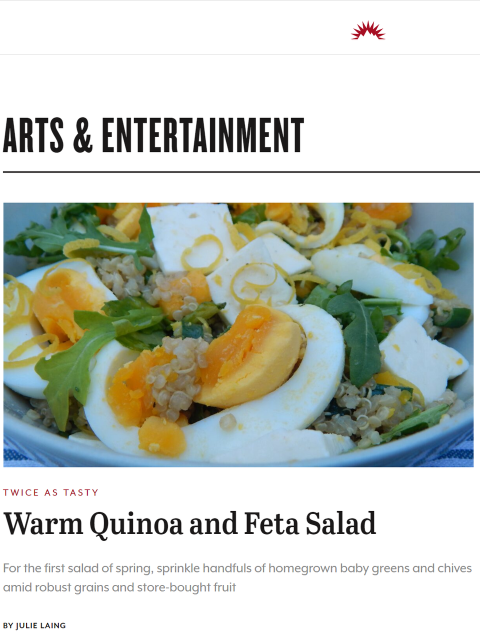
Warm Quinoa and Feta Salad

There’s something special about salads made with spring's first herbs and greens from plants that bravely withstand 50°-plus temperature swings. Learn more at TwiceasTasty.com.
We’ve had our usual cyclic spring weather in Montana, with a high of 76°F on Sunday followed by nights in the 20s. It makes me appreciate even more the first spring greens and herbs that eagerly pop through the sun-warmed soil and then tough out the crisp nights and frosty mornings. As I share this week in my Twice as Tasty column for the Flathead Beacon, my first spring salads mainly consist of store-bought ingredients and sneak in handfuls of whatever garden treats appear first for fresh pops of green.

I make variations on these spring salads throughout the growing season, transitioning to homegrown summer vegetables and herbs as the weeks pass. But there’s something special about the ones made with those first perennial and self-seeded herbs and greens, the plants that bravely leaf out through 50°-plus temperature swings.
Learn to make Warm Quinoa and Feta Salad

Tomato, Potato, and Garlic Soup

Whether you grow your own food or seek out in-season produce, it’s worth freezing it for out-of-season use. Learn more at TwiceasTasty.com.

When I’m harvesting tomatoes and other sun-ripened vegetables in summer, I look forward to enjoying them not just fresh that same day but also from the freezer midwinter in soups and other recipes. As I explain this week in my Twice as Tasty column for the Flathead Beacon, having year-round access to the flavor of produce picked at the peak of its growth is the main reason I preserve food by freezing, canning, and more. Out-of-season produce shipped thousands of miles just can’t compete.

Even if you don’t grow your own food, it’s worth seeking out in-season produce and freezing it for out-of-season use. You still capture some of that fresh flavor, and you then have a freezer full of options for soups that can be made at a moment’s notice without a trip to the store. The tomatoes in this soup are among the easiest vegetables to freeze; potatoes, onions, and garlic can be stored even more simply in a dry, dark, cool place.

Learn to make Tomato, Potato, and Garlic Soup

Choosing Deep Freezers

For my first All Recipes article, I dug into my deep freezer and perused those of family and friends. Learn more at TwiceasTasty.com.
Of all the places I store the garden’s bounty and homemade treats, from canning to dehydrating to dry storage, my deep freezer is probably my favorite. Yet it’s one of the smallest models you can buy. That makes each cubic foot of space prime real estate in my world, and I’ve been filling every inch of it for more than 15 years. I explain why this little freezer works so well in my first piece for All Recipes.

If you’re looking for a deep freezer and have limited space, I’ve found my 7.0-cubic-foot model ideal for a couple. As I searched for the best models for homes with fewer space constraints, family and friends generously let me peruse their freezers to discover the styles and sizes they prefer and why. Their experiences shaped my choices for various freezer categories.
Learn about choosing and using deep freezers

Cooking with Bulgur Wheat

A chewy, nutty form of wheat, bulgur cooks relatively quickly and contains loads of nutrients and fiber. Learn more at TwiceasTasty.com.
Although I use many grains when cooking at home, I tend to overlook bulgur. When it sits at the front of my shelves, I reach for it as a base under everything from shrimp to shish kebabs, but I forget about it as soon as the jar gets shoved to the back. So I was excited to dig out my jar and create a primer about cooking with bulgur in my latest piece for Taste of Home.

This chewy, nutty form of wheat cooks relatively quickly and contains loads of nutrients and fiber. It comes in grinds ranging from fine to extra coarse—info that isn’t always listed on bulk bins or packaging. In the Taste of Home article, I explain how to identify the size, and thus the cooking time, as well as offering tips on preparing and using it.
Learn about cooking with bulgur wheat

Sweet Potato-Mushroom Salad

Hearty and sturdy, this packable salad keeps well enough that the leftovers become an easy bonus meal. Learn more at TwiceasTasty.com.
The sweet potato salad I share this week in my Twice as Tasty column for the Flathead Beacon is one of those recipes that has cycled in and out of my diet over the years. I started making it more than 20 years ago, when it became a go-to, packable workday lunch. After I moved to Montana, I stopped making it as my garden grew. I haven’t been successful in growing sweet potatoes or mushrooms, so my root-vegetable salads shifted to homegrown potatoes with fresh and pickled vegetables.

I brought this salad back to my menu when we started multiweek sailing trips. This salad has become one of my staples for launch day. I make it the night before, keeping the dressing separate, so that it’s ready to eat after we hoist sails and start cruising away from the mainland. It makes a large enough batch and keeps well enough in our ice chest that the leftovers can be enjoyed as a second meal a day or so later.
Learn to make Sweet Potato-Mushroom Salad

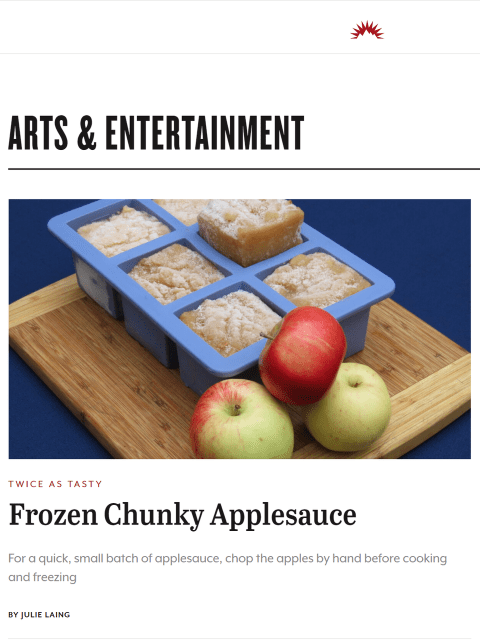
Frozen Chunky Applesauce

This version of homemade applesauce requires no special tools and can be made from just a few pounds of apples. Learn more at TwiceasTasty.com.
When I first moved to Montana and inherited my mom’s canning kettle, the first thing I canned was applesauce. I’ve never liked the flavor or texture of commercially made applesauce, and I’d missed the ready access to barely sweetened homemade versions every since I graduated high school and went off to university, a career, and traveling the world.

I share one of my favorite homemade versions this week in my Twice as Tasty column for the Flathead Beacon: Grandma Tiny’s Frozen Chunky Applesauce. This version requires no special tools (although I do like to freeze it in oversized silicone ice trays), and it can be made from just a few pounds of apples. My grandmother was probably in her mid-90s when she made her last batch, an indicator of how easy it is to make this recipe. If you have a lot of apples, you may want to scale this up to a canning project using the recipe I share later in this blog post.
Learn to make Frozen Chunky Applesauce and a smooth home-canned variation

Arugula Salad with Asparagus and Shaved Parmesan

Homegrown greens have flavor that is muted or missing from store-bought ones. Learn more at TwiceasTasty.com.
One of my favorite things about the start of garden season is clipping the first homegrown spring greens. If you grow lettuce, spinach, arugula, or other greens, you know what I’m talking about. If you don’t, I highly recommend getting a few seeds and giving it a try. Homegrown greens have flavor that is often muted or missing from store-bought ones, and you can buy seeds in varieties that grocery stores won’t carry. These seeds grow easily in the ground or in pots. My sister seeds two “lettuce bowls”—wide, low plastic pots—for my parents each year that sit in the shade on their porch all summer. When the supply gets low, they simply pull the straggly plants and tuck in a few new seeds.

My homegrown lettuces and other greens mainly land in salads, as I share this week in my Twice as Tasty column for the Flathead Beacon. I also tuck them into tacos and sandwiches, fold them into hot pasta or curry, and pair them with eggs.
Learn to make Arugula Salad with Asparagus and Shaved Parmesan

Beyond Tasty

I’m excited to announce that my writing endeavors have been expanding to include several new-to-me publications. Learn more at TwiceasTasty.com.
I’m excited to announce that my writing endeavors have been expanding to include several new-to-me publications—and going beyond featuring recipes, cooking techniques, and kitchen tools.

When I started this food blog in 2016, I was primarily working as a freelance editor with a few writing projects for some of my editing clients. After I published my cookbook The Complete Guide to Pickling in 2020, I began writing more pieces for other publications. With the launch of my Twice as Tasty column in the Flathead Beacon in 2021, I continued to spend less time editing and more time writing. In recent months, I’ve begun to work with an even wider range of publications.

You can now find my writing and photography on Kitchn, Taste of Home, and Health.com, even as I continue to write for The Spruce Eats and my weekly Flathead Beacon column.
Learn more about my latest projects