Wild Berries

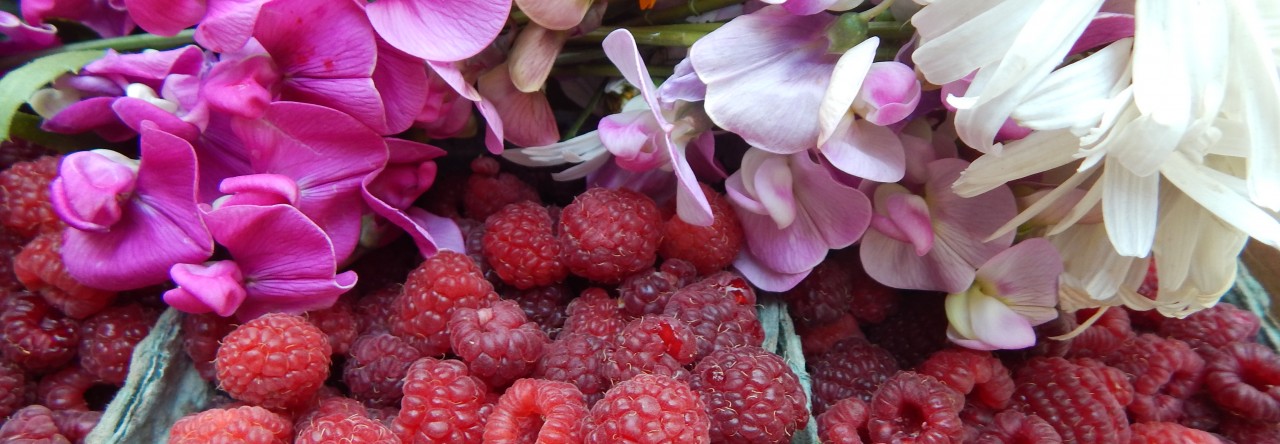
We interrupt the regularly scheduled post to bring you…huckleberries! Regardless of where you live, some foraged fruit or vegetable likely draws people out of their gardens and into the wild. But if you live in the high country, you know that regularly scheduled activities get shunted aside when hucks ripen on mountain slopes. As the season progresses, the most accessible berries are snatched up by other omnivores—human and bear—so pickers must go farther and higher to find these treasures. In my case, a 3-mile roundtrip hike and 3-hour picking session yielded about half a gallon of tiny purple gems.

With that much effort and time involved, I tend to hoard my huckleberries and dole them out in small doses—no small feat when I will happily eat a cup of fruit on one bowl of granola and yogurt. So you won’t find me rolling the results of a day of foraging into a pie or jars of jam. Instead, I prefer recipes that highlight smaller amounts of fruit, whether for breakfast or for dessert.
Learn to make Crepes with Wild Berries and Lemon Cheese and Rhubarb–Huckleberry Galette

Garlic and Nasturtiums

When it comes to making pickles, I often think big: pounds of produce, half-gallon jars for fermenting, multiple batches of quart and pint jars for canning, and hours spent cleaning, preparing, and processing. But when it comes to eating pickles, a few often go a long way: a couple of Definitely Dilly Beans in a Grilled Tomato Bloody Mary, a few slices of Better Bread-and-Butter Pickles to serve with or stuff in Gorgeous Grilled Cheese, a handful of Cumin-Spiced Zucchini Refrigerator Pickles to accompany Indian dishes.

As I’ve already shared this month, some pickles are best in both small batches and small doses. This makes them ideal condiments to pack quickly and easily into small jars, store in your fridge, and dip into as needed. Two I always try to have on hand are pickled garlic and nasturtium “capers.”
Learn to make Pickled Garlic and Pickled Nasturtium Seeds

Refrigerator Pickles

I don’t advocate small-batch canning, but I am a fan of quick and easy pickling that fills your refrigerator one jar at a time. If your only experience with pickling is opening a store-bought jar, then refrigerator vinegar pickles will convert you to homemade. Even if you grew up in a household that put up shelves of pickled vegetables every summer, like I did, refrigerator pickles have surprising benefits.

The disadvantage of refrigerator pickles—that they aren’t sealed in heated jars and thus shelf stable—can be an advantage in freshness and crispness. Small-space gardeners or CSA members can put up a jar at a time as produce ripens. Even expansive gardeners can use fridge pickles to test new flavor combinations. Cucumbers are ideal refrigerator pickles, because they soften so quickly when heated. You should still only use pickling cucumbers; the thick-skinned slicing cucumbers you find in grocery stores and even lemon cucumbers are really only useful as fresh pickles. After years of pasteurizing summer squash, I’ve switched from the canner to the fridge to keep the pickles’ crunch.
Learn to make Cucumber Refrigerator Pickles and Cumin-Spiced Zucchini Refrigerator Pickles

Fresh Pickles

When I think of fresh pickles, I immediately envision a platter of sushi, accompanied by pickled ginger (gari) and preceded by a quickly pickled cucumber salad (kyuri asazuke). The Japanese know a thing or two about pickling. They find a range of uses for pickled foods, including condiment, relish, garnish, palate cleanser, and digestive aid. Small portions of these foods can appear at any meal, even breakfast. Traditional Japanese pickles feature ingredients ranging from vegetables to eggs to fish to even cherry blossoms.

In America, the primary exposure to Japanese pickles comes as an appetizer before a meal and as a palate cleanser during it. A favorite local sushi restaurant serves sunomono, small portions of freshly pickled cucumber salad, before every meal—so of course I needed to come up with a version for our home-rolled, and more importantly boat-rolled, sushi nights. This salad is best made fresh when cucumbers are in season. Learn to make Quick-Pickled Cucumber Salad and Pickled Ginger

Any-Fruit Jam

Sweetness defines jams—and sometimes overpowers them. To my mind, a jam that leaves a lingering coat of sugar on your tongue misses the point: savor the fruits of summer. Making fruit-forward jam is simple once you understand a bit of the science behind it.

Fruit needs three things to set, or thicken, a spreadable consistency: acid, sugar, and pectin. Think of the molecular interactions in fruit like a high-school romance: Pectin molecules are attracted to water, but water is attracted to sugar. If water and sugar “hook up,” the pectin molecules will bond—with a little encouragement from their best friend, acid—and the jam will thicken.

The traditional method of encouraging this interaction is to throw enough sugar into the batch to distract all the water molecules. But more sugar is not the only option. An acidic pectin, like one based on citrus fruits, is an effective matchmaker for pectin molecules. Another method to encourage pectin couplings is to reduce the pool of available water molecules.
Learn to make Any-Fruit Jam without Added Pectin and Any-Fruit Jam with Added Pectin

Homemade Sorbet

I started making sorbets a few years ago after tasting rhubarb–rosemary sorbet created by our local Sweet Peaks shop. I believe these purveyors of handcrafted ice creams had recently opened and were peddling their chilly concoctions from a converted horse trailer at the weekly farmer’s market. The sorbet was to die for. I immediately thought, “I can grow rosemary, and my shady property produces rhubarb all summer. I could make this!”

A bit of research revealed that I needed to make sorbet: not only does it burst with fruit flavor undiluted by dairy, but it requires no special equipment, like an ice cream maker (although if you own one, you can put it to use). A few tricks and techniques produce a silky sorbet from just about any fruit you can think of and show off herbs and other botanicals. I use two methods, depending on the featured fruit.
Learn to make Raw Fruit Sorbet and Cooked Fruit Sorbet

Birthday Desserts: Year 1

I am all about birthdays—especially mine. I’ve long moved on from celebrating for a day, to a week, and now to a month. So it’s not a stretch to spend much of this month celebrating the first year of Twice as Tasty.

It’s not a birthday without dessert, but I’ve never been a huge fan of the traditional cake loaded with frosting. As a kid, I always wanted homemade angel food cake, buried in berries and carrying a dollop of home-whipped cream. Pies have also topped my list of celebratory sweets, particularly when you can load a table with a dozen varieties. But both of these choices can be labor intensive for a crowd. For today’s party, it was hard to resist easily created desserts that show off freshly harvested botanicals and fruits of summer.
Learn to make Strawberry Shortcake with Lilac Cream and Rhubarb Crisp

Fruit Syrups

Syrup. For most of us, the word brings to mind pancakes or waffles drizzled with—OK, drowning in—liquid maple sugar or its cheaper, corn syrup–based counterpart. But as you start harvesting from your garden, the word expands to endless options based on the fruits of summer and enhanced with herbs.

My love of fruit syrups grew when I learned how to extract bonus jars of the flavor-packed liquid from fruit solids intended for jam—and make jam more easily in the process. Syrups are less finicky than jelly but can still be processed for long-term storage or simply stashed in the fridge. Traditionally made from boiled fruit that’s been strained to separate its juice, I’ve found a cold method separates the juice even more effectively from almost any fruit and a roasted method gives an extra boost of flavor.
Learn to roast and freeze fruit for syrup

Frittata

If you like quiche but hate to roll crust, or if you crave omelets but your homemade ones always turn into scrambled eggs, you really should be making frittata. This crustless quiche or open-face omelet is just as adaptable to the ingredients you have on hand as its more finicky cousins. You can eat it at any meal and serve it as a tapa or a main. What’s not to like?

My first memorable frittatas were made by a Spanish woman running a hostel in Greece, so in my mind a frittata must have potatoes and the best additional ingredients are homegrown tomatoes, onion, bell pepper, and basil and homemade feta. I include the potatoes in my base recipe, but you can easily drop them and highlight other ingredients—or just use whatever’s in your fridge. Before summer crops explode, I tend to fill my frittatas with baby chard or spinach and herbs.
Learn to make Basic Potato Frittata and Spinach and Herb Frittata

Herb Infusions

Salt and sugar get a bad rap for their effects on our bodies when consumed in large quantities, but their ability to act as a preservative is often underappreciated. Salt and sugar prevent spoilage and make it difficult or impossible for undesirable bacteria to grow. The rule of thumb for salt curing is that 20% salt keeps most undesirable bacteria at bay.

Although dehydrating and freezing are the most common ways to preserve herbs, the rising popularity of artesian salts and infusions has brought attention to herbs preserved in salt or sugar. The preservative pulls moisture from the herbs while keeping their flavor intact. Leaves plucked from the jar can be used as though they were fresh. The remaining herbed salt works best as the finishing touch, but infused sugar can also work within a recipe. A little of the flavored salt or sugar goes a long way, and the herbs keep a long time.
Learn to make Salt-Preserved Herbs and Herb-Infused Sugar