
Cooking with Bulgur Wheat

A chewy, nutty form of wheat, bulgur cooks relatively quickly and contains loads of nutrients and fiber. Learn more at TwiceasTasty.com.
Although I use many grains when cooking at home, I tend to overlook bulgur. When it sits at the front of my shelves, I reach for it as a base under everything from shrimp to shish kebabs, but I forget about it as soon as the jar gets shoved to the back. So I was excited to dig out my jar and create a primer about cooking with bulgur in my latest piece for Taste of Home.

This chewy, nutty form of wheat cooks relatively quickly and contains loads of nutrients and fiber. It comes in grinds ranging from fine to extra coarse—info that isn’t always listed on bulk bins or packaging. In the Taste of Home article, I explain how to identify the size, and thus the cooking time, as well as offering tips on preparing and using it.
Learn about cooking with bulgur wheat

Pickling Salt and Other Canning Supplies

My canning-related pieces for several websites provide valuable insight and suggest handy supplies. Learn more at TwiceasTasty.com.
Canning season is upon us, and I’ve been writing canning-related pieces for several websites. If you’re new to home canning or experienced but looking to learn more about key ingredients and tools, these articles and product reviews provide valuable insight and suggest supplies you may want to keep handy over the next few months.

You can also find plenty of info on the basics of home canning, how to get ready to can, and other canning topics here on the blog. Beyond the new pieces I share in this post, you’ll want to check out the roundup of my go-to canning cookbooks for The Spruce Eats.

Personally, I’ve started my canning season with tart cherry pie filling, which I canned up using recipes from Preserving With Pomona’s Pectin and The All New Ball Book of Canning and Preserving so that I can compare the two versions and decide which I prefer. I’ve also made a batch of Roasted Raspberry Syrup, a particular favorite in my sister’s house. Using other preserving techniques, I’ve been playing with rhubarb, currant, cherry, mixed berry, and other shrub variations and keeping my fermentation crock full with curtido, an El Salvadoran cabbage slaw preserved with pickling salt, based on recipes from my pickling cookbook.
Learn about choosing Pickling Salt and Other Canning Supplies

Roasting Peppers

 I use not one but four techniques to roast peppers of all colors, sizes, and heat levels. Learn more at TwiceasTasty.com.
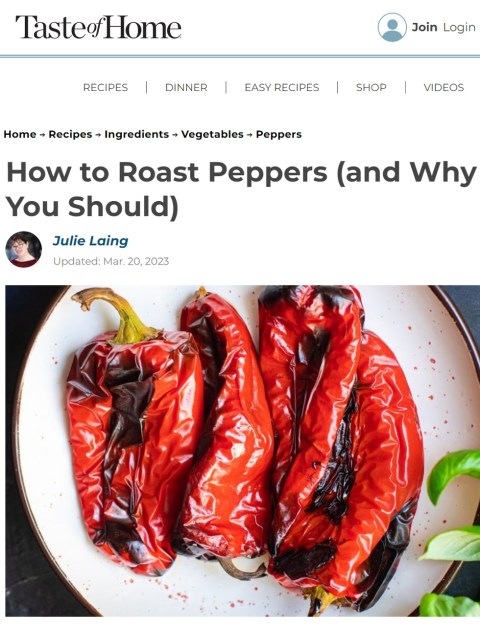
In one of my recent pieces for Taste of Home, I had a chance to share techniques for one of my favorite vegetable upgrades: roasting. I mainly roast homegrown peppers, so it’s an easy seasonal choice to char them on the grill. But if you’re buying peppers out of season or keeping an eye on a simmering pot in the kitchen, indoor techniques may make more sense. So I share not one but four ways to roast peppers of all colors, sizes, and heat levels.

Once glance at the price on a jar of roasted peppers in the store makes clear a key advantage to roasting your own. Other reasons include the ability to get them just the right softness to use in chunks in fresh dishes—jarred roasted peppers tend to be soft and slippery. I don’t just roast the standard red bell peppers, either: green bells, Gypsy peppers, Poblanos, and chilies all carry a smoky note when their charred.
Learn more about Roasting Peppers

Beyond Tasty

I’m excited to announce that my writing endeavors have been expanding to include several new-to-me publications. Learn more at TwiceasTasty.com.
I’m excited to announce that my writing endeavors have been expanding to include several new-to-me publications—and going beyond featuring recipes, cooking techniques, and kitchen tools.

When I started this food blog in 2016, I was primarily working as a freelance editor with a few writing projects for some of my editing clients. After I published my cookbook The Complete Guide to Pickling in 2020, I began writing more pieces for other publications. With the launch of my Twice as Tasty column in the Flathead Beacon in 2021, I continued to spend less time editing and more time writing. In recent months, I’ve begun to work with an even wider range of publications.

You can now find my writing and photography on Kitchn, Taste of Home, and Health.com, even as I continue to write for The Spruce Eats and my weekly Flathead Beacon column.
Learn more about my latest projects

Million-Dollar Deviled Eggs

 I’m a definite fan of deviled eggs, so my first assignment for Taste of Home was perfect. Learn to make Million-Dollar Deviled Eggs. Learn more at TwiceasTasty.com.
I’m excited to share my first article for Taste of Home: How to Make Million-Dollar Deviled Eggs. I’m a definite fan of deviled eggs, including versions with bonus flavor and homemade ingredients, so it an ideal first assignment.

The recipe, developed by Taste of Home, has a secret ingredient that I tried for the first time when I made a test batch. They’re called million-dollar deviled eggs because they’re that rich. I made them by mashing the yolks with a fork, but they’d be just as easy to press through a garlic rocker, like I shared in another recent story.
Learn to make Million-Dollar Deviled Eggs