Savory Spreads: Toms and Zukes

High-pectin, high-acid fruits are natural partners for low-pectin, low-acid vegetables in savory spreads. Get canning recipes at TwiceasTasty.com.

The first savory spread I canned, from Liana Krissoff’s Canning for a New Generation, featured tomatoes and basil. It inspired me not only to evolve the recipe but also to make other spreads that feature vegetables. Krissoff’s book also showed me the advantages of incorporating fresh fruit into these spreads. Pectin occurs naturally in fruits, and some fruits, like apples and oranges, have lots of it. Most fruits also have enough natural acid that you don’t need to add vinegar to preserve them safely. This makes them natural partners for low-pectin, low-acid vegetables.

In this week’s recipes, the apples don’t have to look or even taste perfect: you’re mainly interested in their pectin. So save your sweetest apples for fresh eating and use tart, underripe ones with your tomato and zucchini. You also have lots of choices for tomatoes and basil, but for the prettiest jars, stick to one color of each per batch.
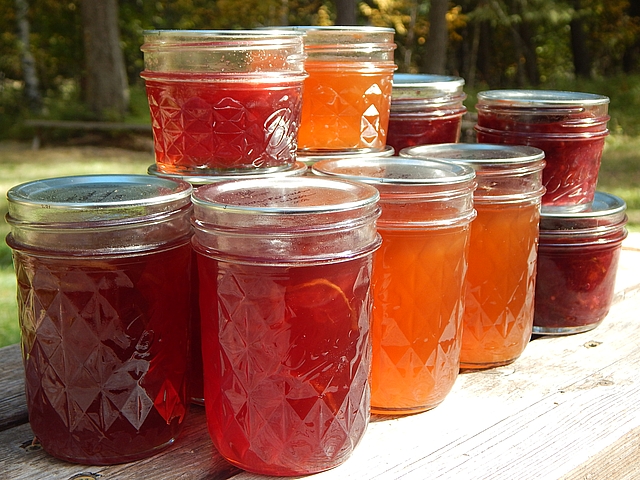
Learn to make Tomato–Apple–Basil Jam and Fall Marmalade

Sweet and Savory

Savory spreads come in many styles, have many names, and can use fruits and vegetables. Learn more at TwiceasTasty.com.

When we think of homemade preserves and spreads, we often picture the sweet fruits of summer, like berries and cherries. But they can be so much more, especially in fall. Late-ripening tomatoes and peppers and fall-harvested onions, apples, and plums are just a few of my favorite ingredients in jams, jellies, and other spreads.

You might be thinking, “Do you really put vegetables in jam?” Yes, I do! These savory spreads are thick with flavor but not as sweet as spring and summer spreads. Because many of the vegetables are low in acid, they need to be treated differently from fruit preserves. Some have a fair amount of sugar, some are heavy on vinegar or another acidic ingredient, and many use a combination of both to create a sweet and savory blend that’s safe to process in a boiling water bath.

Read more about making savory spreads

Fermented Cabbage

I’m a latecomer to the enjoyment of sauerkraut and kimchi, but I love that I can make both from a head of cabbage. Get home fermentation recipes at TwiceasTasty.com.
I have to admit that I’m a latecomer to the enjoyment of sauerkraut and other cabbage ferments and pickles. Perhaps it’s because I moved straight from a little kid eating processed hot dogs to a teenager refusing all meat—I’m not sure I’ve ever had a real sausage smothered in German sauerkraut. I’m not even a fan of coleslaw: it’s usually too heavy on the vinegar or the mayo and still fairly flavorless. It doesn’t help that for years I couldn’t grow brassicas without harvesting more cabbage moth larvae than edible cabbage leaves.

A couple of years ago, we mastered the cabbage moth problem, covering a hoop tunnel frame with mosquito netting and diligently clamping it down when we weren’t harvesting or weeding the broccoli, cauliflower, and cabbage protected beneath it. Once I started growing cabbage, I needed another way to deal with the enormous heads besides my favorite use: fresh, raw Asian Cabbage Salad. In discovering fermented cabbage, I learned that the variations developed around the world—from German sauerkraut to Korean kimchi—are as endless as they are for any other pickle.
Learn to make Apfel Sauerkraut and Head-Cabbage Kimchi

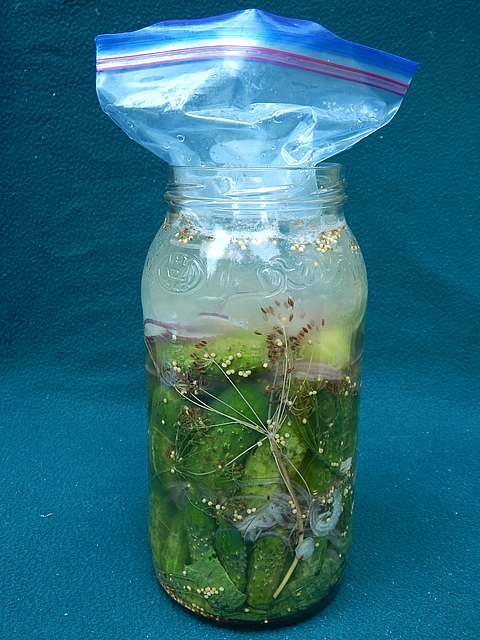
Fermented Cucumbers

I’ve loved cucumber pickles since I was a kid. Fermentation takes them to a new level. Get fermented vegetable recipes at TwiceasTasty.com.
I’ve loved pickles since I was a kid. My mom put dozens of jars of dill and “sweet” (bread-and-butter) pickles through a water bath every year, and I’d sneak them like they were potato chips. But the longer the pickles sat, the less chip-like crunch they gave. Over the years, I’ve played with ingredients and canning techniques that have helped. Then I discovered fermentation.

Think about it: Cucumbers are best fresh and raw. Putting them in hot water is bound to affect their texture. Fermentation replaces heat with time and vinegar with salt. No wonder the result is crisper and fresher. And the flavoring possibilities—from dill to tea—are endless.

If you’ve never run a fermentation, I suggest you check out my introductory post from earlier this month. But here are the basics: Start with everything clean and fresh. Monitor the batch daily so that you can see the process. If you have doubts, give it the toss and start again.
Learn to make Fermented Dill Pickles and Fermented Tea Pickles

Quick Ferments

When vegetables are sliced or pureed before fermentation, it’s easy to use them straight from the jar. Get veggie ferment recipes at TwiceasTasty.com.
If you’re new to vegetable fermentation, you likely look at recipes and think, “Can it be that easy?” This instantly leads to the terrifying thought, “It can’t; surely I’ll get it wrong.” So to kick off this month’s recipes for vegetable ferments, I offer my most foolproof recipe for your first foray into fermentation. Here, the carrots actually aren’t fully fermented; they sit barely long enough to kick off the process. Still, they use a lot of the techniques that apply to full fermentation of other vegetables: salting, weighting to encourage the carrots to release even liquid, and a rest period to pull even more water and sugars from the produce. Because these carrots are prepared as thin ribbons, it’s easy to open the jar and slide a few onto a sandwich, into a sourdough pita, or straight into your mouth. The recipe is so simple that while you’re at it, you might as well prepare your own horseradish to go in the jar—especially if you’re growing it.
Learn to make Barely Fermented Carrots and Horseradish Paste

Fall Ferments

Fermenting vegetables seems daunting, but it’s far simpler than making cheese, baking bread, or even canning vinegar-pickled produce. Learn more at TwiceasTasty.com.

Fermentation is one of the oldest ways to preserve food, but it’s a technique that has become unfamiliar for modern home cooks. We still consume a lot of fermented foods, including dairy and grains, and we may even be brave enough to try those at home. But somehow fermenting vegetables seems daunting, raising doubts about whether we’re preserving or spoiling food.

Essentially, fermenting is souring via microbes. Microorganisms break down the sugars and carbohydrates in food, causing a chemical change that increases acidity and ultimately preserves the food. The process leaves no room for microbes that spoil food to move in. Properly fermented food looks, smells, and tastes bright, crisp, and tangy. A fermentation that has problems will be discolored, soft, and rotten smelling; you’ll turn up your nose before it even gets near your tongue.

Most people think of pickled cucumbers or brined cabbage when they think of fermented vegetables. But many other vegetables, and even some fruits, can be fermented. In most cases, the only ingredients needed are fresh produce, salt, and water.
Read more about fermenting vegetables

Carrots

Carrots caramelized in an open pan taste nothing like mushy boiled carrots. Get carrot recipes at TwiceasTasty.com.
If you grew up eating mushy cooked carrots from a school cafeteria or overworked mom, you’ll probably be tempted to skip over this recipe. I urge you to give it a chance. Carrots cooked in an open pan and glazed by a little butter and sugar remain bright and crisp-tender, like properly cooked pasta or Grilled Asparagus, with just a hint of bonus sweetness. Try it once, and you’ll never boil carrots again.

Although the recipe works with any carrots—store bought or homegrown, baby carrots in May or storage carrots in January—it shines in August. The carrots I pull in late summer are finger thick, crunchy, and naturally sweet. Best of all, they come with gorgeous green, feathery tops that can be mixed into a tasty, herb-heavy salsa. If you aren’t growing your own carrots, ask your farmer to leave the tops intact and use them the day you pick them up at the market or receive your CSA share.
Learn to make Glazed Carrots and Carrot-Top and Herb Salsa

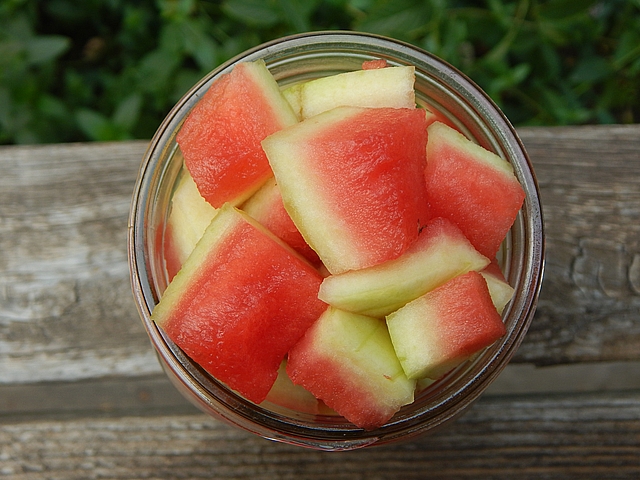
Watermelon

The nose-to-tail approach to cooking meats could be called tip to top for vegetables and fruits. Get whole watermelon recipes at TwiceasTasty.com.
Amid summer’s bounty, as I haul bags and boxes of produce from garden to kitchen, I always want more. I clean and trim and slice and wonder whether each root tip and leafy top that lands in my compost bucket could find its way into a dish or jar instead. The nose-to-tail approach to cooking meats could be called tip to top for vegetables and fruits, and that remains my goal throughout the growing season. It’s a goal that aligns nicely with this week’s challenge for the Montana Local Food Challenge.

Some of your harvest lends itself easily to the idea: people eat beet greens as readily as beet roots. Others seem obvious when you think about it. Like peas? The shoots carry a similar flavor and can be turned into pesto or simply mixed into salads. Grow storage onions? The green tops can be used like scallions and even lightly trimmed while the bulbs are still growing. And the classic processed watermelon rind pickle can be ready to eat alongside the juicy pink melon.
Learn to make Quick-Pickled Watermelon Rind and Watermelon–Feta Salad

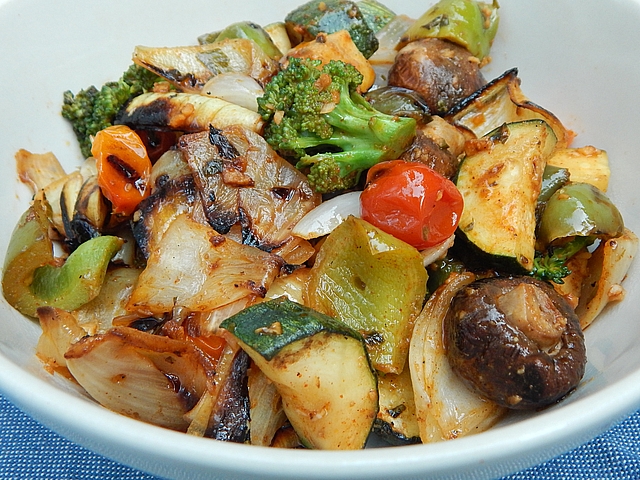
Stir-Fry

 Stir-fries are quick, go-to meals that show off well-cooked tofu. Get stir-fry and tofu recipes at TwiceasTasty.com.
When the garden is in full swing and sailing season is on, one of my go-to meals is a stir-fry. In the time it takes to cook a pot of rice, the rest of the meal can be chopped, cooked, and ready to serve from one pan as a single-dish meal. In spring, asparagus, early onions, young garlic, snap peas, spinach, and herbs dominate the stir-fry; at the height of summer, freshly harvested onions, peppers, carrots, zucchini, and cherry tomatoes take over. By late summer, corn, eggplant, and fall broccoli and peas are ready to mix in.

When you’re rich in a particular vegetable, you can let it solo in a stir-fry, backed by aromatics such as garlic, ginger, and chilies. But my favorite stir-fries are created with dibs and dabs of many vegetables and a protein such as tofu. To guarantee success, fry quickly, at high heat, in an order that lets the ingredients brown evenly, with plenty of movement. It’s in the name: stir and fry.
Learn to make Fresh Improv Stir-Fry and Pan-Fried Tofu

Eating Local

My local food sources start with the ground I garden in and continue down the road to the closest source. Learn more at TwiceasTasty.com.
I’ve been thinking a lot about local food lately. With last week’s official launch of Twice as Tasty Live, I’ve been making the rounds of local purveyors of flour, milk, coffee, tea, fish, and more to find ingredients for the first two Twice as Tasty house concerts coming up in the next week. I’ve also been inspecting progress in the garden, keeping tabs on what will be ready to harvest and take straight to the host’s table for each event.

But how to define “local food”? Some sources define the local food circle as within 100 miles of where it’s bought or eaten, but many federal assistance programs extend that range to 400 miles. Some define it as food grown and processed within a state, whereas others define local food systems by regions rather than borders. Giant chain stores sell local food; so do farmers from roadside stands and weekly markets.

My local food sources start with the ground I garden in, extend out to local producers and locally owned businesses, and continue down the road to the closest source for any item that isn’t grown in my backyard. I love the way Barbara Kingsolver put it in Animal, Vegetable, Miracle: A Year of Food Life: “Our highest shopping goal was to get our food from so close to home, we’d know the person who grew it.” It’s a lofty challenge, but this may be the month to work toward it.
Read more about eating local