Shrimp and Green Vegetable Risotto

Risotto often appears daunting but is actually just a 30-minute, one-pot meal. Learn more at TwiceasTasty.com.
Cool weather always puts me in the mood for risotto. The dish can be as warming as soup but is also hearty and filling. It’s a fabulous way to use up the last vegetables pulled from the garden before frost hits, but risotto can be made year-round: in winter with frozen and dry-stored ingredients, in spring with the first vegetables and herbs of the season, and throughout summer with the freshest treats from the garden.

As I explain this week in my Twice as Tasty column for the Flathead Beacon, risotto often appears daunting but is actually just a 30-minute, one-pot meal. Starting with the right rice and adjusting your cooking technique are key: Instead of covering a pot of short-grain rice and water with a lid, buy medium-grain Arborio rice and cook it in an open pot. Add a little hot liquid at a time, stirring often and letting the rice absorb it before pouring in more. I also create the best risotto when I use homemade stock.
Learn to make Shrimp and Green Vegetable Risotto
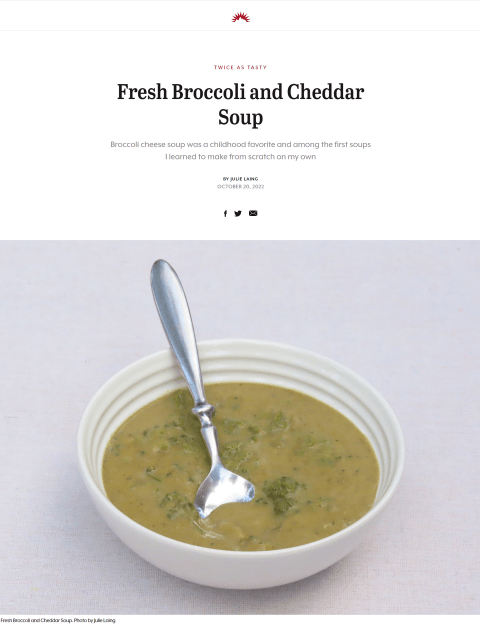
Fresh Broccoli and Cheddar Soup

Broccoli and cheese soup has long been a staple in my kitchen, but my recipe has evolved. Learn more at TwiceasTasty.com.
Broccoli and cheese soup has long been a staple on my fall and winter menu, but my recipe has evolved over the years. The first version I learned from my mom; besides fresh broccoli and sharp Cheddar cheese, it was simply seasoned with a bit of oregano. Once I began making it in my own kitchen, I jazzed it up (as Mom would say) with extra-sharp Cheddar and a little mustard and lemon juice, and when I began to successfully grow broccoli in my own garden, I created a freezer-based version of the jazzed-up recipe. Once I fell for grilled broccoli, I began grilling instead of steam-blanching it for even more flavor in the soup pot.

My latest rendition of a broccoli and cheese soup, which I share this week in my Twice as Tasty column for the Flathead Beacon, returns to fresh, lightly sautéed vegetables for just a touch of the roasted flavor. This is the way I make the soup with the last of the season’s broccoli, and it’s my preferred recipe for fresh store-bought broccoli. I’ve made one more ingredient addition, potato, for a thicker, chowder-like texture.
Learn to make Fresh Broccoli and Cheddar Soup

Kitchen Favorites: Ice Trays

I write about my favorite ice tray for freezing food in 1-ounce portions in my latest piece for The Spruce Eats. Learn more at TwiceasTasty.com.
I’ve been writing a lot recently about some of my favorite tools for freezer storage: ice trays. As I mentioned last week in my Flathead Beacon column, ice trays that make 1-cup cubes have become my new favorite tools for freezing stocks. Earlier this year, I had the chance to test and review a collection of ice trays that produce cubes in a range of sizes. While most of my testing involved making ice for cocktails, I also used some of the trays to freeze pesto, sauces, and more for quick and easy storage.

One of these trays ended up being my favorite for 1-ounce portions, as I share in my latest piece for The Spruce Eats. The Everyday Ice Tray is part of W&P’s Peak collection, along with the Cup Cubes Freezer Tray that I’ve been using for stocks. I’m not a W&P affiliate and don’t earn a commission on sales; I just really like these trays for freezing food.
Learn about choosing and using ice trays

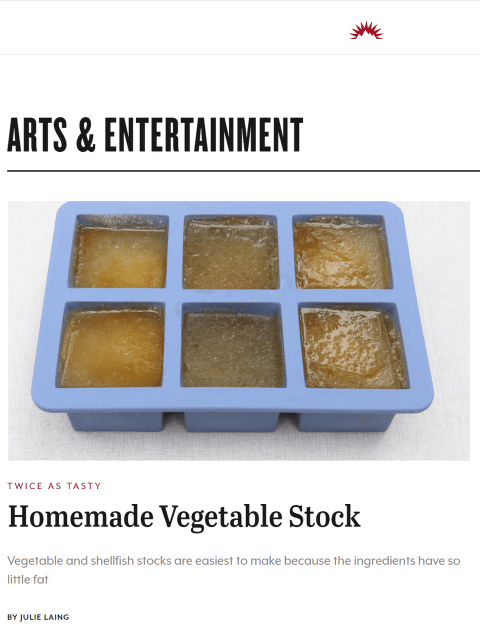
Homemade Vegetable Stock

When I make stock, it feels cost-free and effortless: I use whatever’s at hand, and it happens in the background of my day. Learn more at TwiceasTasty.com.
Any chef will point to stock as an easy way to add flavor. I use stocks the most from fall to spring, as the base for soups, to flavor rice or beans, and to round out sauces. Although you can simply use water in many of these dishes for the same effect, swapping in a stock gives a jump-start to a tasty meal.

Although many recipes include a stock in the ingredient list, they don’t mention how easy it is to make, either on the spot or in a large batch to freeze so that you always have a bit on hand. Store-bought stocks and broths may seem easier, but they add to your grocery bill, tend to be loaded with salt and preservatives, and can be thick enough that instead of giving light undertones of flavor they overpower a dish. When I make stock, it feels cost-free and effortless: I use whatever’s at hand, rather than buying ingredients specifically for it, and it happens in the background of my day, simmering on the stove while I prepare a meal or check other tasks off my to-do list.

This week, in my Twice as Tasty column for the Flathead Beacon, I share a stock recipe that uses whole vegetables so that you can learn the technique for making stock. Once you get a sense of the balance, you can swap in other vegetables and scraps so that you don’t spend time or money buying ingredients.
Learn to make Homemade Vegetable Stock

Fried Green Tomatoes

To successfully make fried green tomatoes, choose the right tomatoes and prepare them properly for the pan. Learn more at TwiceasTasty.com.
If you grow a garden, especially in a climate with a short growing season, you know that one of your last harvest decisions is what to do with green tomatoes. If you harvest them before they are damaged by frost, many green tomatoes will ripened indoors. You can also preserve tomatoes while they are still green. Some can be eaten fresh too.

I share one of my favorite ways to eat fresh tomatoes this week in my Twice as Tasty column for the Flathead Beacon: dredged in cornmeal and fried in a pan. Successfully making fried green tomatoes, with a just-soft, sweet interior and crisp outer shell that stays attached to each tomato slice, depends on the tomatoes you choose and the way you prepare them before you add them to the pan.
Learn to make Fried Green Tomatoes

Kitchen Favorites: Grill Mats

People are drawn not just to what I’m grilling on a copper mat but to the thin, flexible mat itself. Learn more at TwiceasTasty.com.
Over the last couple of summers, I’ve been questioned often about one of my favorite cooking tools—one that I use not in my kitchen but on the grill. When I pull out a Yoshi copper grill mat, people are drawn not just to what I’m preparing on it but to the thin, flexible mat itself. So I was excited to share how I use grill mats in my latest piece for The Spruce Eats.

As I explain in my post, which joins my recent story about my favorite immersion blender in the website’s new “This Is Fire” series, my grill mats come in handy on a range of grills. At home, we use them on an old charcoal Weber kettle grill, which we restore to functionality every time a handle or wheel comes off. We also use Yoshi copper mats on public grills so that Grilled Fish Skewers don’t pick up the flavor of the prior griller’s burgers. We even use them aboard the Blue Mule on a small portable gas grill, setting it up in the sailboat’s cockpit to cook locally caught fish and—in a pinch—scrambled eggs.
Learn about choosing and using grill mats

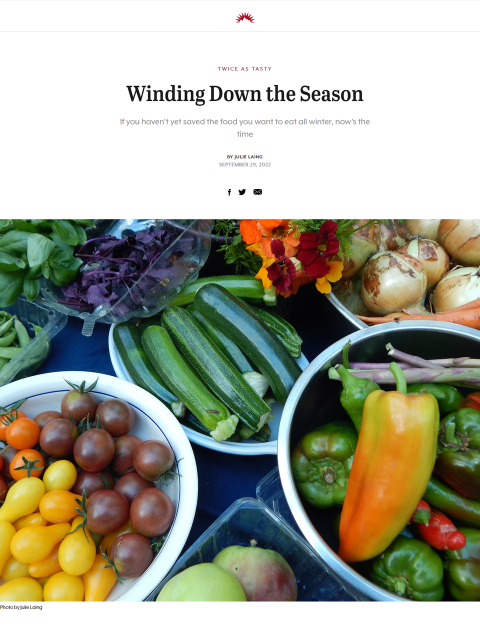
Winding Down the Season

Techniques that rely on freezing, dry storing, and dehydrating let you quickly save the garden’s last fruit and vegetables. Learn more at TwiceasTasty.com.
This September, we’ve been lucky to have fairly warm days and nights in Montana, with just a couple of hints at a killing frost that we were able to protect against temporarily. But the garden is still winding down. In the main garden, I’m finding fewer cucumbers and snap beans, with vines starting to dry and lose leaves. In the greenhouse, tomatoes and tomatillos are putting all of their energy into ripening existing fruit. It’s time to grab the last of the garden’s treats and stash it all away for winter.

This week, in my Twice as Tasty column for the Flathead Beacon, I share some of my favorite storage techniques for a range of vegetables. The article focuses on easy ways to save individual vegetables without needing to can or ferment them or changing their base flavor into a pickle or sauce. The techniques rely on freezing, dry storing, and dehydrating and can be done quickly with minimal prep.
Learn about winding down the season

Choosing Soup Ladles

For a recent piece for The Spruce Eats, I tested 15 soup ladles. Learn more at TwiceasTasty.com.
I’ve put quite a bit of thought into recipes for a wide range of soups, but I didn’t think much about the tool I use to serve those soups until I tested 15 soup ladles for The Spruce Eats. It turns out that how comfortably and cleanly you scoop soup from a pot and pour it into a bowl depends mostly on the ladle shape, size, and material. The latter can be especially important if you have nonstick cookware. Size might be the key consideration if you make soup in a small saucepan or giant stockpot. And shape and other features can be crucial if you’re skimming fat, drizzling gravy, or pouring into an oversized mug or wide, flat bowl.

By testing so many ladles, I developed all sorts of opinions and ideal uses for various ladle shapes, sizes, and materials. I also made a lot of soups, many of which will be lunch and dinner staples now that cool weather is becoming the norm.
Learn about choosing and using soup ladles

Kitchen Favorites: Immersion Blender

Since 2014, my Breville immersion blender has played many roles in my kitchen. Learn more at TwiceasTasty.com.
The tools I use in my tiny kitchen have to be more than functional: they have to earn their storage space by being small, powerful, multipurpose—or better yet, all three. In my latest piece for The Spruce Eats, I explain my love of one of my well-used kitchen gadgets, a Breville Control Grip immersion blender.

Since I became hooked on this immersion blender, I’ve retired my upright blender and rehomed my KitchenAid, both of which took up too much space. For a while, I didn’t even own a food processor, instead pushing my immersion blender to—and frankly beyond—its limits. It’s the tool I reach for when making fruit butter for canning, sorbet for freezing, fruit leather for dehydrating, or just simply soup for dinner.
Learn about choosing and using an immersion blender

Best DIY Salad Dressing

Using a basic ratio, you can make so many dressings in under 60 seconds. Learn more at TwiceasTasty.com.
After the heat of summer sent lettuces bolting, recent cool fall temperatures and rain mean salads are back. If you don’t grow your own salad fixings, you may not have noticed the shift from sweet, tender greens to bitter, coarse leaves. But home gardeners will be well aware of the change and have transitioned from lettuce-based salads to ones featuring heat-tolerant or late-season vegetables.

In a piece for Clean Pates earlier this summer, I shared my technique and ratio for making a collection of salad dressings. Even if you don’t grow salad greens, I’m a firm believer that you should make your own dressings. Among disappearing food traditions, one of the most lamentable is scratch-made salad dressing. As Mark Kurlansky writes in The Food of a Younger Land, “What could better spell the beginning of the end than bottled salad dressing, the manufacture of a product that was so easy to make at home?”

Easy is right: Using a basic ratio, you can make so many dressings. A pinch of this and dab of that completely change a dressing’s flavor. My technique clocks in under 60 seconds, and I can now eyeball the proportions without even dirtying measuring spoons.
Learn to make the Best DIY Salad Dressing