Pickling Salt and Other Canning Supplies

My canning-related pieces for several websites provide valuable insight and suggest handy supplies. Learn more at TwiceasTasty.com.
Canning season is upon us, and I’ve been writing canning-related pieces for several websites. If you’re new to home canning or experienced but looking to learn more about key ingredients and tools, these articles and product reviews provide valuable insight and suggest supplies you may want to keep handy over the next few months.

You can also find plenty of info on the basics of home canning, how to get ready to can, and other canning topics here on the blog. Beyond the new pieces I share in this post, you’ll want to check out the roundup of my go-to canning cookbooks for The Spruce Eats.

Personally, I’ve started my canning season with tart cherry pie filling, which I canned up using recipes from Preserving With Pomona’s Pectin and The All New Ball Book of Canning and Preserving so that I can compare the two versions and decide which I prefer. I’ve also made a batch of Roasted Raspberry Syrup, a particular favorite in my sister’s house. Using other preserving techniques, I’ve been playing with rhubarb, currant, cherry, mixed berry, and other shrub variations and keeping my fermentation crock full with curtido, an El Salvadoran cabbage slaw preserved with pickling salt, based on recipes from my pickling cookbook.
Learn about choosing Pickling Salt and Other Canning Supplies
Kitchen Favorites: Canning Cookbooks

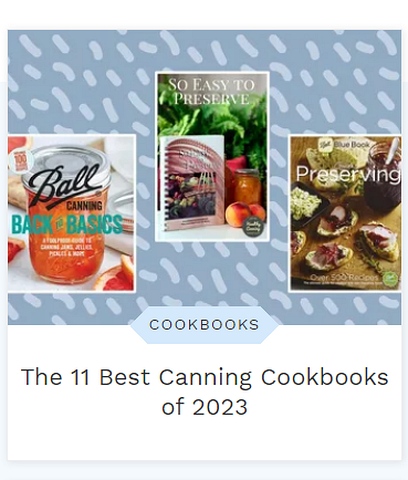
I’ve updated my list of favorite canning books with new editions plus newer releases worth adding to your canning bookshelf. Learn more at TwiceasTasty.com.
It might not feel like canning season with garden beds buried in snow. Still, seed catalogs keep arriving. To my mind, the smart way to grow and preserve your own food is to follow the progression from buying seeds to planting to harvesting to canning. That means that now, as I choose varieties from seed catalogs, I’m noting the recipes that I hope to can in summer or fall.

If you think the same way, you’ll want to be leafing through some of the canning cookbooks in my recent piece for The Spruce Eats. I originally wrote this roundup in 2021 and shared more about sourcing safe canning recipes in a related blog post. I’ve updated the list with new editions of some of my favorite canning books plus a couple of newer releases worth adding to your canning shelves.
Learn about choosing and using canning cookbooks

Shrimp and Summer Squash Enchiladas with Homemade Enchilada Sauce

A homemade sauce and soft yet intact tortillas makes these enchiladas household favorites. Learn more at TwiceasTasty.com.
The enchiladas I share this week in my Twice as Tasty column for the Flathead Beacon have become household favorites. And that all started with the sauce. Before I began making my own enchilada sauce, I occasionally attempted this rich, cheesy dish when we wanted comfort food, but I never quite nailed the technique of getting the tortillas in that just-right place, ending up with ones that were mushy or crunchy. Then I found a sauce recipe I love and started putting up jars of it, which led me to track down the technique that keeps the tortillas soft and intact, making them the perfect vehicle for the homemade sauce.

The recipe I share here lets you make this delicious sauce in a smaller batch without the effort of canning it. If you fall for this sauce like I did, you can make a larger amount to process in a boiling water bath using the instructions in Tips & Tricks. The enchiladas themselves can have all sorts of fillings: as we transition from summer to fall, my favorite pairs homegrown summer squash with sautéed shrimp.
Learn to make Shrimp and Summer Squash Enchiladas with Homemade Enchilada Sauce

Gearing Up to Preserve

 My top tip for stress-free preserving is to gear up before you dig in. Learn more at TwiceasTasty.com.
My fridge is currently full of macerating rhubarb and recently picked homegrown strawberries, ready to be turned today into jams and shrubs. I’m not the only one gearing up to preserve, as I share this week in my Twice as Tasty column for the Flathead Beacon. A local farmer told me last week that her crew has made 50 pounds of Rhubarb Kimchi, building on my recipe in The Complete Guide to Pickling. Tangy Radish Rounds and Spring Asparagus Pickles are also currently popular recipes from the book.

I’ll eventually be turning rhubarb into kimchi and fermented pickles, but today’s projects are on the sweeter side. Our strawberry crop has hit its peak, so I’ll be developing some jam recipes to share down the road, featuring the sweet fruit and pairing it with rhubarb. I’ll also be canning up one of my seasonal favorites: Rhubarb–Earl Grey Jam.
Learn how to gear up for preserving

Kitchen Favorites: Cookware and Canning Cookbooks

Tramontina’s pots perform so well that I couldn’t give them up. Learn more at TwiceasTasty.com.
I’m excited to share two pieces I worked on earlier this year that have made it live on The Spruce Eats: one on stackable cookware and one on canning books. The topics may seem to have little in common, but both articles feature favorites in my personal kitchen and will hopefully help you in choosing tools and resources.
Read more about cookware and canning books

A Year of Pickles

It’s hard to believe that this time last year I was gearing up for my cookbook’s release. Sample recipes from The Complete Guide to Pickling at TwiceasTasty.com.
Fermented Red Onions and Half-Sour Dill Pickles. Photograph by Andrew Purcell.

It’s hard to believe that this time last year I was gearing up for the launch of my first cookbook, The Complete Guide to Pickling. The timeline of writing and publishing a book means that I spent September 2020 sitting on my hands, resisting the urge to share my favorite recipes from the book ahead of the sales schedule and Brenda Ahearn’s stunning photos from my side project, The Pickled Picnic recipe collection, before the cookbook’s release.

As the cookbook’s official on-sale and launch party dates approached, I shared a handful of recipes from the book and offered details on some helpful tools I’d discovered while working on the project. This year, I’m able to get a jump on sharing new recipes from the book while many of us are still in the heart of harvest season.
Sample recipes from The Complete Guide to Pickling

Choosing Portable Burners

Of all the options when cooking outdoors, and portable induction burners are among the most efficient. Learn more at TwiceasTasty.com.
Our Montana heatwave rolls on, so I’m moving as may food projects as I can out of the hot kitchen to a shady, breezy space. Fortunately, there are plenty of options when cooking outdoors. As I blogged about all last month, a grill is my favorite summertime tool. It adds another layer of flavor whether I’m cooking a meal, preparing food for the freezer and midwinter use, or firing off rounds of vegetables to stockpile for canning.

But the grill is just one of my outdoor cooking tools. Aboard The Blue Mule, we carry a grill, a two-burner camp stove, and a Jetboil backpacking stove, covering every cooking need while on the water. At home, large canning sessions happen outdoors on a heavy-duty, two-burner cooker. The most recent addition to my cooking arsenal has been a portable electric burner. As long as I have access to a flat surface and an electrical outlet, I can set up this burner for Twice as Tasty live events, workshops, or anywhere else I want to go.

Off the blog, I’ve been researching the best portable burners for The Spruce Eats. My latest lineup has been focused on induction models.
Read more about induction cooking

Twice as Tasty Turns 5

Twice as Tasty hits the big 5 this month! Read more about what’s new with TwiceasTasty.com.
It’s been 5 years since I began the Twice as Tasty blog, and what a journey it has been. What started as a fun hobby creating a series of recipes read by a handful of friends has led to a shift in my writing and editing business—and it’s growing every day.

Thanks for being part of the adventure. The more you read, the more I research ideas, share new recipes and techniques, and write on the blog and for other publications.
Read more about what’s new with Twice as Tasty

Best Pressure Canners

I’ve been testing the best pressure canners for The Spruce Eats. Learn more at TwiceasTasty.com.
Gardening season is here, and I have exciting news to share, so I’m interrupting this month of cheese posts to put canning on your radar. One of my goals for this year has been to start writing about food for places other than this blog, and I’ve become a regular contributor to The Spruce Eats. If you’re not familiar with the website, I suggest checking it out: It’s loaded with everything from recipes to videos to cooking tips to buying guides. I’m working with a great editor there and having a lot of fun writing for the site.

My first project was a roundup of the year’s best pressure canners, and I spent last month testing some of my favorites. The first reviews went live this week. My writing for The Spruce Eats focuses on products, so I’ll be sharing a little about what I canned and cooked here.
Read more about what I’ve been pressure canning

Storing Pickles

Several tricks and tools will help you store pickled foods so that they stay fresh and crisp. Learn more at TwiceasTasty.com.
Now that you’re eager to or have successfully made pickles from the recipes in my new cookbook, The Complete Guide to Pickling, where and how should you store them? I talk briefly about pickle storage in the book, but several more tricks and tools will help you keep your pickled foods fresh and crisp.

As I mentioned in my post about pickling hacks earlier this month, you need two basic tools to make and store pickles: a container and a way to cover it. To ensure your pickles and their container stay clean and fresh, inside and out, choose nonreactive containers and lids—in other words, ones made of glass, stainless steel, food-grade plastic, or silicone.

Sure, you can cap your pickles with old metal mayonnaise lids or reuse tin-plated canning lids and rings; I did this, and recommended this repurposing, for years. But both will rust and break down over time as the acid in the pickle brine eats away at them, leaving an unattractive sticky mess around the jar threads, on your refrigerator shelves, and even potentially on the underside of the lid, where it can flake down into the food. Instead, I now save those old lids for dry storage and have switched to nonreactive options for high-acid foods.
Read more about storing pickles