Choosing Chip and Dip Sets

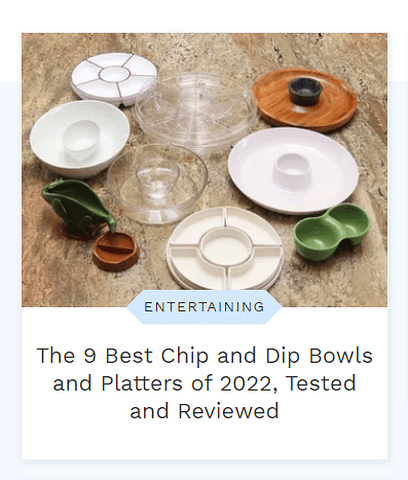
With the chance to test nine chip and dip sets, I spread out homemade dippers, fresh dips, and home-canned salsas. Learn more at TwiceasTasty.com.
I recently had the chance to test and photograph nine chip and dip bowls and platters for The Spruce Eats—much to the pleasure of munchie-loving friends who got to dig into the photo-shoot spread. I was surprised not just by the variety of sets and styles but also by the ways I could fill them. I’m not sure what my editor expected when she asked me to test whether the sets could hold “other finger food,” but I took the opportunity to spread out homemade pita wedges and crackers, home-smoked cheese, fermented pickles, and every type of salsa in my home-canned stash.

Each set had ideal uses, even if you just want to dump in a bag of chips and jar of queso. Some would be ideal for a fancy holiday spread, others can be taken to a bonfire party, and still others are made for curling up solo by a fire.
Learn about choosing and using chip and dip sets

Kitchen Favorites: Kitchen Knives

Between canning and teaching, cooking and testing, I’ve learned the value of a sharp knife. Learn more at TwiceasTasty.com.
One thing I’ve learned from teaching workshops in other people’s kitchens is the value of a sharp knife. At home, it can be easy to ignore the dullness of a blade because we’re used to the feel of it in our hand. We think, “Oh, I just want to finish cutting this tomato and eat; I’ll sharpen after I clean up” (and then rarely do). When I’m in someone else’s kitchen, and especially if I’m trying to show off neat, clean slices, dullness becomes obvious—and embarrassing if I brought my own knives.

So I started paying more attention to the knives I own and how I treat them. I offer one of my favorites in my recent piece for The Spruce Eats: a Misen Chef’s Knife. I’ve relied on it heavily through canning and teaching, cooking and testing, for the last 18 months, and I still can’t believe how sharp it was out of the box and how easy it is to keep sharp. I’m such a fan of this knife that I gifted it (and its smaller sibling, the paring knife) to family last Christmas, along with ceramic honing rods for continual sharpness.
Learn about choosing and using kitchen knives

Kitchen Favorites: Garlic Rocker

When I kept the Joseph Joseph Garlic Rocker, I was determined to justify its position in my tiny kitchen. And I’ve done just that. Learn more at TwiceasTasty.com.
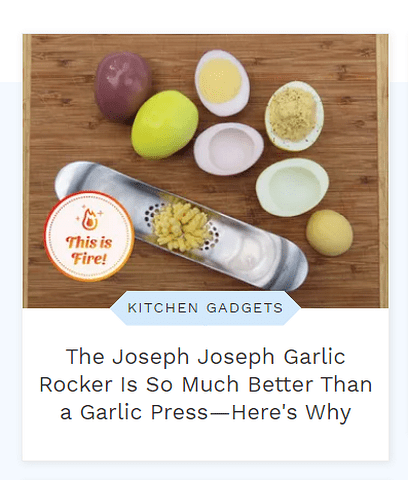
When I was asked to test an array of garlic presses last year, I hadn’t expected to keep any for my own kitchen. I grow and use piles of garlic; I’m just comfortable rock-chopping it for Sourdough Garlic Knots, slicing it for Spanish Shrimp in Garlic Oil, and roasting and squeezing it onto everything. When I owned a garlic press, it just took up space in my utensil drawer, sitting unused far too long before I gave it away.

Then, when I’d finished testing garlic presses, the look, feel, and easy use of the Joseph Joseph Garlic Rocker made it hard to give up. So I tucked it into my utensil drawer, determined to make it useful enough to justify its position in my tiny kitchen. And I’ve done just that, as I share in my latest piece for The Spruce Eats.
Learn about choosing and using garlic rockers and presses

Choosing Wooden Spoons

I reach for wooden spoons all of the time; when baking, sturdiness and handle comfort matter most. Learn more at TwiceasTasty.com.
As the holiday baking and gifting season begins, you may want to check out my recent piece for The Spruce Eats. I tested a dozen wooden spoons for the website earlier this year, using each of them to stir multiple batches of cookie dough or quick bread batter, as well as sautés, soups, pasta, and more.

I reach for wooden spoons all of the time in my kitchen, but they probably get the most use when I’m baking. Overall, I found that sturdiness and handle comfort mattered most when mixing doughs, especially dense ones. Some spoons I tested had additional features, like an edge shape that easily scraped down a mixing bowl or a small rubber scraper on the top of the handle that could clear out a measuring cup. A few had a shape that worked best when gripped a certain way to mix dough.
Learn about choosing and using wooden spoons

Kitchen Favorites: Mortar and Pestle

 Testing mortars and pestles revealed not only the best ones for various tasks but also my favorite. Learn more at TwiceasTasty.com.
As I’ve taught spice workshops and ground spices into custom mixes at home, I’ve used a range of tools: coffee grinders, nutmeg grinders and graters, salt mills and pepper grinders, hand-cranked spice mills. But it wasn’t until earlier this year, when I tested seven mortar and pestle sets for The Spruce Eats, that I became enamored of this traditional grinding tool.

As I spent weeks using various mortars and pestles, I not only learned how to choose and use the best ones for various tasks but also found my favorite: the IKEA Adelsten Mortar and Pestle. In my latest piece for The Spruce Eats, I tell the tale of my prior poor choices in mortars and pestles that never made them my go-to grinding tool and why I’ve made room for IKEA’s set in my small kitchen.
Learn about choosing and using a mortar and pestle set

Kitchen Favorites: Ice Trays

I write about my favorite ice tray for freezing food in 1-ounce portions in my latest piece for The Spruce Eats. Learn more at TwiceasTasty.com.
I’ve been writing a lot recently about some of my favorite tools for freezer storage: ice trays. As I mentioned last week in my Flathead Beacon column, ice trays that make 1-cup cubes have become my new favorite tools for freezing stocks. Earlier this year, I had the chance to test and review a collection of ice trays that produce cubes in a range of sizes. While most of my testing involved making ice for cocktails, I also used some of the trays to freeze pesto, sauces, and more for quick and easy storage.

One of these trays ended up being my favorite for 1-ounce portions, as I share in my latest piece for The Spruce Eats. The Everyday Ice Tray is part of W&P’s Peak collection, along with the Cup Cubes Freezer Tray that I’ve been using for stocks. I’m not a W&P affiliate and don’t earn a commission on sales; I just really like these trays for freezing food.
Learn about choosing and using ice trays

Kitchen Favorites: Grill Mats

People are drawn not just to what I’m grilling on a copper mat but to the thin, flexible mat itself. Learn more at TwiceasTasty.com.
Over the last couple of summers, I’ve been questioned often about one of my favorite cooking tools—one that I use not in my kitchen but on the grill. When I pull out a Yoshi copper grill mat, people are drawn not just to what I’m preparing on it but to the thin, flexible mat itself. So I was excited to share how I use grill mats in my latest piece for The Spruce Eats.

As I explain in my post, which joins my recent story about my favorite immersion blender in the website’s new “This Is Fire” series, my grill mats come in handy on a range of grills. At home, we use them on an old charcoal Weber kettle grill, which we restore to functionality every time a handle or wheel comes off. We also use Yoshi copper mats on public grills so that Grilled Fish Skewers don’t pick up the flavor of the prior griller’s burgers. We even use them aboard the Blue Mule on a small portable gas grill, setting it up in the sailboat’s cockpit to cook locally caught fish and—in a pinch—scrambled eggs.
Learn about choosing and using grill mats

Choosing Soup Ladles

For a recent piece for The Spruce Eats, I tested 15 soup ladles. Learn more at TwiceasTasty.com.
I’ve put quite a bit of thought into recipes for a wide range of soups, but I didn’t think much about the tool I use to serve those soups until I tested 15 soup ladles for The Spruce Eats. It turns out that how comfortably and cleanly you scoop soup from a pot and pour it into a bowl depends mostly on the ladle shape, size, and material. The latter can be especially important if you have nonstick cookware. Size might be the key consideration if you make soup in a small saucepan or giant stockpot. And shape and other features can be crucial if you’re skimming fat, drizzling gravy, or pouring into an oversized mug or wide, flat bowl.

By testing so many ladles, I developed all sorts of opinions and ideal uses for various ladle shapes, sizes, and materials. I also made a lot of soups, many of which will be lunch and dinner staples now that cool weather is becoming the norm.
Learn about choosing and using soup ladles

Kitchen Favorites: Immersion Blender

Since 2014, my Breville immersion blender has played many roles in my kitchen. Learn more at TwiceasTasty.com.
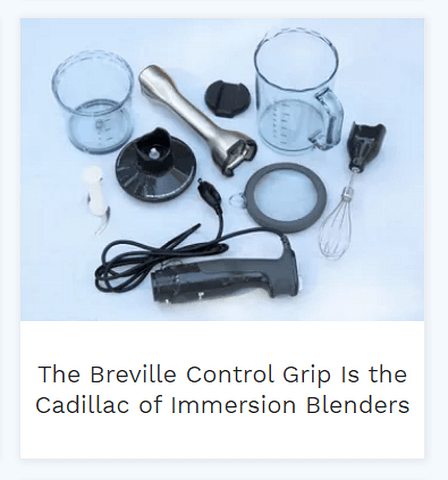
The tools I use in my tiny kitchen have to be more than functional: they have to earn their storage space by being small, powerful, multipurpose—or better yet, all three. In my latest piece for The Spruce Eats, I explain my love of one of my well-used kitchen gadgets, a Breville Control Grip immersion blender.

Since I became hooked on this immersion blender, I’ve retired my upright blender and rehomed my KitchenAid, both of which took up too much space. For a while, I didn’t even own a food processor, instead pushing my immersion blender to—and frankly beyond—its limits. It’s the tool I reach for when making fruit butter for canning, sorbet for freezing, fruit leather for dehydrating, or just simply soup for dinner.
Learn about choosing and using an immersion blender

Choosing Ice Cube Trays

I recently tested six ice cube trays for The Spruce Eats, but I use them homemade sauces, syrups, pesto, and more. Learn more at TwiceasTasty.com.
When The Spruce Eats asked me to test some top-selling ice cube trays, I had no hesitation saying “yes.” Besides using trays to freeze water into cubes, I rely on them for freezing a range of homemade sauces, syrups, pesto, and other recipes I make from homegrown produce and use in small servings throughout the year.

The website recently published my testing results and photos. I froze and used a lot of ice cubes for this project and even took several of the trays to a Twice as Tasty cocktail workshop for a wider range of feedback. Some of these trays have been in regular use all summer for far more than ice.
Learn choosing and using ice cube trays