
Kitchen Favorites: Mortar and Pestle

 Testing mortars and pestles revealed not only the best ones for various tasks but also my favorite. Learn more at TwiceasTasty.com.
As I’ve taught spice workshops and ground spices into custom mixes at home, I’ve used a range of tools: coffee grinders, nutmeg grinders and graters, salt mills and pepper grinders, hand-cranked spice mills. But it wasn’t until earlier this year, when I tested seven mortar and pestle sets for The Spruce Eats, that I became enamored of this traditional grinding tool.

As I spent weeks using various mortars and pestles, I not only learned how to choose and use the best ones for various tasks but also found my favorite: the IKEA Adelsten Mortar and Pestle. In my latest piece for The Spruce Eats, I tell the tale of my prior poor choices in mortars and pestles that never made them my go-to grinding tool and why I’ve made room for IKEA’s set in my small kitchen.
Learn about choosing and using a mortar and pestle set

Spiced and Roasted Pumpkin Seeds

You can spice pumpkin seeds with so many seasonings and can even roast the seeds of other winter squash in the same way. Learn more at TwiceasTasty.com.
Roasted pumpkin seeds feature among my favorite homegrown, homemade snacks, not just because they’re delicious but also because they’re easy. You can spice them with so many seasonings and can even roast the seeds of other winter squash in the same way, as I explain this week in my Twice as Tasty column for the Flathead Beacon.

The hardest part of roasting pumpkin and other winter squash seeds is getting the stringy mess out of the squash—which you need to do anyway when you want to use the flesh. As you scrape out the seeds and soft center of the squash, pull off any large pieces of membrane, dump everything else in a bowl of warm water, and let it sit for a couple of minutes. I’ve found it easiest to clean the seeds by plunging my hands into the bowl, rubbing the seeds free of the warmed stringy bits, and then plopping the seeds into a large-holed colander to drain.
Learn to make Spiced and Roasted Pumpkin Seeds

Kitchen Favorites: Cereal Bowls

The humble cereal bowl can hold many meals in many settings. Learn more at TwiceasTasty.com.
In the introduction of Consider the Fork, which examines the history of everyday kitchen tools, Bee Wilson starts by considering the wooden spoon, “a quiet ensemble player in so many meals that we take it for granted.” She could have just as easily opened her book with the humble “cereal” bowl, so named for one of its primary uses that immediately gives a sense of size, even though capacity still varies widely. Rather than being a dedicated vessel for one food, the cereal bowl can hold many meals in many settings, as I describe in my latest piece for The Spruce Eats.

Although I have numerous bowls in my kitchen, and even several types that fit the cereal-appropriate category, I found a perfect fit in Duoluv Unbreakable Bowls. The size, shape, texture, and price all fit my needs even before I realized I really did need them. They mainly consist of wheat straw fiber, so they’re more environmentally friendly than 100% plastic bowls.
Learn about choosing and using bowls

Shrimp and Green Vegetable Risotto

Risotto often appears daunting but is actually just a 30-minute, one-pot meal. Learn more at TwiceasTasty.com.
Cool weather always puts me in the mood for risotto. The dish can be as warming as soup but is also hearty and filling. It’s a fabulous way to use up the last vegetables pulled from the garden before frost hits, but risotto can be made year-round: in winter with frozen and dry-stored ingredients, in spring with the first vegetables and herbs of the season, and throughout summer with the freshest treats from the garden.

As I explain this week in my Twice as Tasty column for the Flathead Beacon, risotto often appears daunting but is actually just a 30-minute, one-pot meal. Starting with the right rice and adjusting your cooking technique are key: Instead of covering a pot of short-grain rice and water with a lid, buy medium-grain Arborio rice and cook it in an open pot. Add a little hot liquid at a time, stirring often and letting the rice absorb it before pouring in more. I also create the best risotto when I use homemade stock.
Learn to make Shrimp and Green Vegetable Risotto

Fresh Broccoli and Cheddar Soup

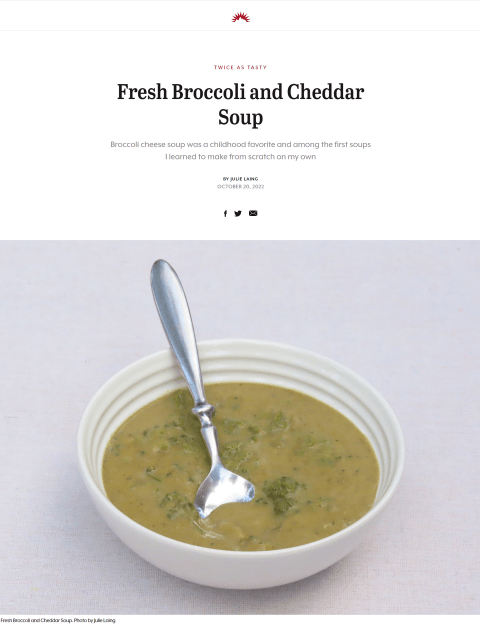
Broccoli and cheese soup has long been a staple in my kitchen, but my recipe has evolved. Learn more at TwiceasTasty.com.
Broccoli and cheese soup has long been a staple on my fall and winter menu, but my recipe has evolved over the years. The first version I learned from my mom; besides fresh broccoli and sharp Cheddar cheese, it was simply seasoned with a bit of oregano. Once I began making it in my own kitchen, I jazzed it up (as Mom would say) with extra-sharp Cheddar and a little mustard and lemon juice, and when I began to successfully grow broccoli in my own garden, I created a freezer-based version of the jazzed-up recipe. Once I fell for grilled broccoli, I began grilling instead of steam-blanching it for even more flavor in the soup pot.

My latest rendition of a broccoli and cheese soup, which I share this week in my Twice as Tasty column for the Flathead Beacon, returns to fresh, lightly sautéed vegetables for just a touch of the roasted flavor. This is the way I make the soup with the last of the season’s broccoli, and it’s my preferred recipe for fresh store-bought broccoli. I’ve made one more ingredient addition, potato, for a thicker, chowder-like texture.
Learn to make Fresh Broccoli and Cheddar Soup

Kitchen Favorites: Ice Trays

I write about my favorite ice tray for freezing food in 1-ounce portions in my latest piece for The Spruce Eats. Learn more at TwiceasTasty.com.
I’ve been writing a lot recently about some of my favorite tools for freezer storage: ice trays. As I mentioned last week in my Flathead Beacon column, ice trays that make 1-cup cubes have become my new favorite tools for freezing stocks. Earlier this year, I had the chance to test and review a collection of ice trays that produce cubes in a range of sizes. While most of my testing involved making ice for cocktails, I also used some of the trays to freeze pesto, sauces, and more for quick and easy storage.

One of these trays ended up being my favorite for 1-ounce portions, as I share in my latest piece for The Spruce Eats. The Everyday Ice Tray is part of W&P’s Peak collection, along with the Cup Cubes Freezer Tray that I’ve been using for stocks. I’m not a W&P affiliate and don’t earn a commission on sales; I just really like these trays for freezing food.
Learn about choosing and using ice trays

Homemade Vegetable Stock

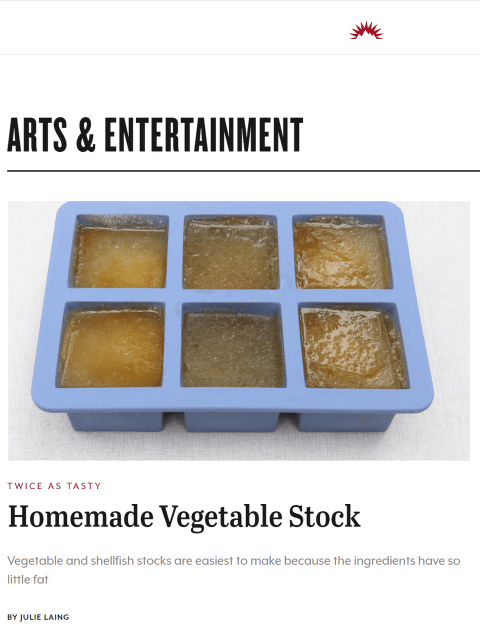
When I make stock, it feels cost-free and effortless: I use whatever’s at hand, and it happens in the background of my day. Learn more at TwiceasTasty.com.
Any chef will point to stock as an easy way to add flavor. I use stocks the most from fall to spring, as the base for soups, to flavor rice or beans, and to round out sauces. Although you can simply use water in many of these dishes for the same effect, swapping in a stock gives a jump-start to a tasty meal.

Although many recipes include a stock in the ingredient list, they don’t mention how easy it is to make, either on the spot or in a large batch to freeze so that you always have a bit on hand. Store-bought stocks and broths may seem easier, but they add to your grocery bill, tend to be loaded with salt and preservatives, and can be thick enough that instead of giving light undertones of flavor they overpower a dish. When I make stock, it feels cost-free and effortless: I use whatever’s at hand, rather than buying ingredients specifically for it, and it happens in the background of my day, simmering on the stove while I prepare a meal or check other tasks off my to-do list.

This week, in my Twice as Tasty column for the Flathead Beacon, I share a stock recipe that uses whole vegetables so that you can learn the technique for making stock. Once you get a sense of the balance, you can swap in other vegetables and scraps so that you don’t spend time or money buying ingredients.
Learn to make Homemade Vegetable Stock

Fried Green Tomatoes

To successfully make fried green tomatoes, choose the right tomatoes and prepare them properly for the pan. Learn more at TwiceasTasty.com.
If you grow a garden, especially in a climate with a short growing season, you know that one of your last harvest decisions is what to do with green tomatoes. If you harvest them before they are damaged by frost, many green tomatoes will ripened indoors. You can also preserve tomatoes while they are still green. Some can be eaten fresh too.

I share one of my favorite ways to eat fresh tomatoes this week in my Twice as Tasty column for the Flathead Beacon: dredged in cornmeal and fried in a pan. Successfully making fried green tomatoes, with a just-soft, sweet interior and crisp outer shell that stays attached to each tomato slice, depends on the tomatoes you choose and the way you prepare them before you add them to the pan.
Learn to make Fried Green Tomatoes

Kitchen Favorites: Grill Mats

People are drawn not just to what I’m grilling on a copper mat but to the thin, flexible mat itself. Learn more at TwiceasTasty.com.
Over the last couple of summers, I’ve been questioned often about one of my favorite cooking tools—one that I use not in my kitchen but on the grill. When I pull out a Yoshi copper grill mat, people are drawn not just to what I’m preparing on it but to the thin, flexible mat itself. So I was excited to share how I use grill mats in my latest piece for The Spruce Eats.

As I explain in my post, which joins my recent story about my favorite immersion blender in the website’s new “This Is Fire” series, my grill mats come in handy on a range of grills. At home, we use them on an old charcoal Weber kettle grill, which we restore to functionality every time a handle or wheel comes off. We also use Yoshi copper mats on public grills so that Grilled Fish Skewers don’t pick up the flavor of the prior griller’s burgers. We even use them aboard the Blue Mule on a small portable gas grill, setting it up in the sailboat’s cockpit to cook locally caught fish and—in a pinch—scrambled eggs.
Learn about choosing and using grill mats

Winding Down the Season

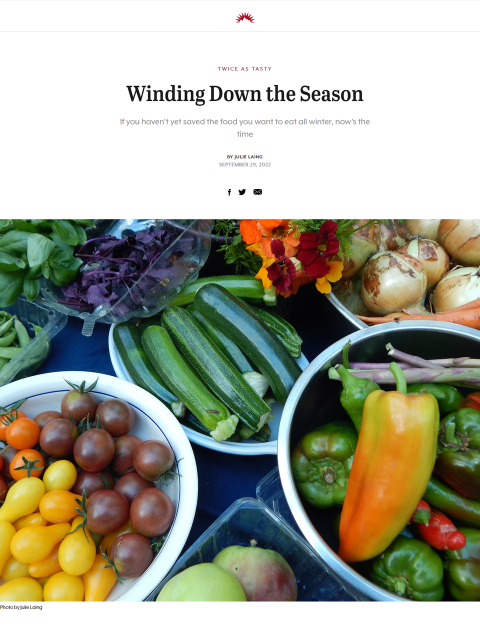
Techniques that rely on freezing, dry storing, and dehydrating let you quickly save the garden’s last fruit and vegetables. Learn more at TwiceasTasty.com.
This September, we’ve been lucky to have fairly warm days and nights in Montana, with just a couple of hints at a killing frost that we were able to protect against temporarily. But the garden is still winding down. In the main garden, I’m finding fewer cucumbers and snap beans, with vines starting to dry and lose leaves. In the greenhouse, tomatoes and tomatillos are putting all of their energy into ripening existing fruit. It’s time to grab the last of the garden’s treats and stash it all away for winter.

This week, in my Twice as Tasty column for the Flathead Beacon, I share some of my favorite storage techniques for a range of vegetables. The article focuses on easy ways to save individual vegetables without needing to can or ferment them or changing their base flavor into a pickle or sauce. The techniques rely on freezing, dry storing, and dehydrating and can be done quickly with minimal prep.
Learn about winding down the season