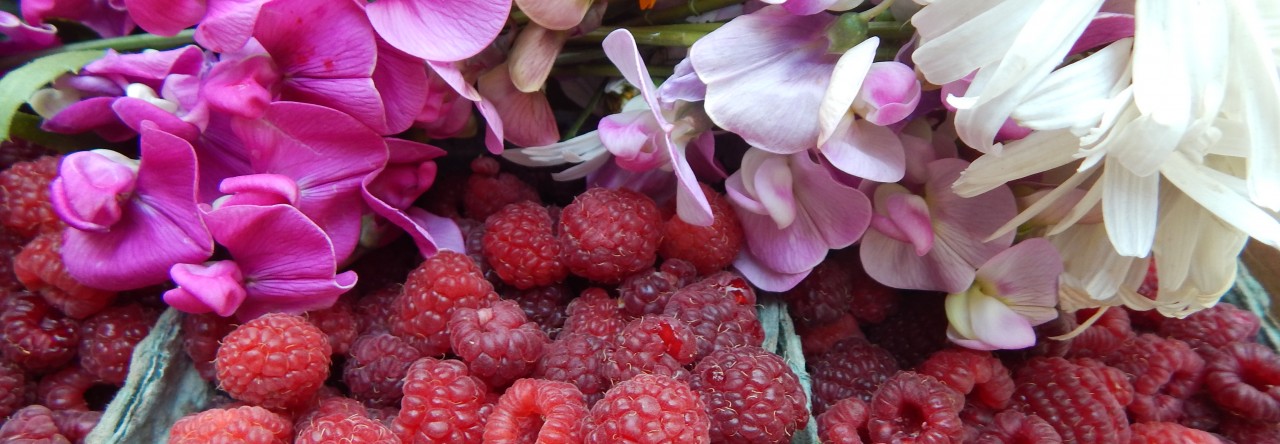
Smoked Beets

One of my favorite kitchen tools sits outside and doubles as grill and low-tech smoker. Get smoked beet recipes at TwiceasTasty.com.
One of my favorite kitchen tools doesn’t live in my kitchen: It sits outside the front door, looking weathered and well used. It’s both, whether the summer heat has made me abandon the oven or we’re digging it out of a snowbank for a winter meal. I’m talking about an old charcoal Weber kettle grill, handed down and repaired so many times it’s probably had nine lives.

For years it was just a grill, regularly loaded with fish, shellfish, and many kinds of vegetables and fruits. Then we discovered it made an easy, low-tech cold smoker for cheese. Add a few more briquettes, and we’re smoking chilies, beets, nuts, and more.

I got excited about smoking beets after falling for a vegetarian Rueben sandwich created by a local deli. But when I started harvesting my first beets a week ago, we’d already gobbled up the winter’s stash of sauerkraut. Fortunately, smoked beets are delicious with fresh greens and sourdough bread.
Learn to make Roasted and Smoked Beets and Smoked-Beet Sandwiches

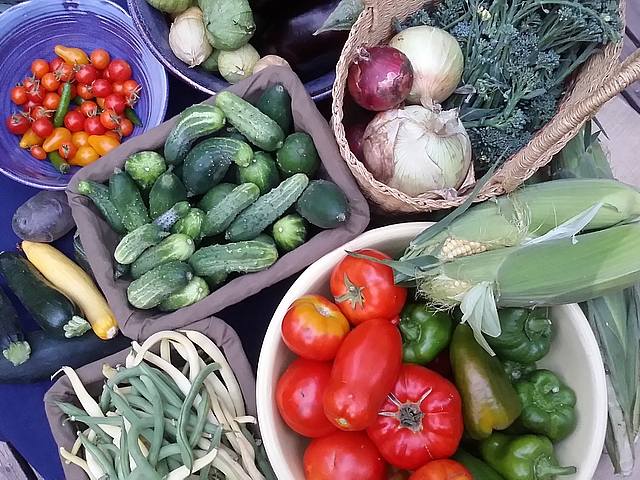
Summer Vegetables

Summer means filling bellies not just with the freshest produce possible but also with preserved vegetables the rest of the year. Learn more at TwiceasTasty.com.
If your garden isn’t in full swing yet, it’s about to be. Even here in Montana, with our long winters and short growing season, spring produce is beginning to wind down: Lettuces and spinach will soon be bolting, the asparagus crop has tapered off, and the strawberry bed has been picked nearly clean. In their place, summer produce is ready to burst forth, launching itself into the annual race to grow faster than I can harvest and process.

If you’ve been following along on Instagram, you’ve seen how I deal with spring’s vegetable bounty: #dailysalad. But with a large garden, summer vegetables need a different approach. The next few weeks are not just about filling bellies with the freshest produce possible but also about preserving those vegetables so that they can fill bellies the rest of the year. Here’s how I’ll be spending the next few weeks.
Read more about enjoying summer vegetables year-round

Winding Down Year 2

As 2017 winds down, it’s time to look back at a second year of Twice as Tasty and share a few things to come. Read more about what to expect in 2018.
Like any toddler, it’s hard to believe how Twice as Tasty has grown in a year. As 2017 winds down, indulge me in looking back at a second year of Twice as Tasty—or skip down the page to read about the year to come.

Twice as Tasty grew with 55 posts this year. The blog now offers 135 recipes and 25 pages related to techniques for preparing, storing, and eating well year-round. The number of email subscribers and WordPress and Facebook followers more than tripled in the last year, and membership in the companion Facebook group almost doubled. All I can say is “wow and thank you” for being so supportive.

Offline, I taught the first Twice as Tasty workshop in March and have followed it with a steady flow of classes. One of the most popular topics was beautifully featured in the local newspaper. The current roster boasts 16 workshops, including several seasonal ones, and I’m preparing to launch more options next month. With your participation, I hope to teach even more workshops in 2018.
Read more about what to expect in 2018

Beets

Root vegetables are ideal for roasting. Beets, potatoes, carrots, onions, garlic—all take on a range of flavors missing from a raw or boiled preparation. The hidden sugars rise to the surface and caramelize, and the oven’s enclosed, indirect heat intensifies flavors. High-temperature roasting seals the surface, leaving the interior soft and moist, while low heat deters mushiness. Either way, the result is delicious.

Most root vegetables can be roasted in the same way: Cut them into pieces, coat them with some oil so that they cook rapidly and don’t stick to the pan, and spread them evenly and turn them occasionally for consistent cooking. Even beets and garlic can be roasted in this way. But I like to wrap these vegetables whole in foil, let this bonus layer and their natural skins seal in their juices and flavor, and then remove the skins and cut them down to size at the end.
Learn to roast beets and make Roasted Beet and Cheese Salad

Grill It, Roast It, Smoke It

And just like that, September is here. Long before I’m ready for summer to be over, the month that signals the start of fall rolls in. But even though a few of August’s garden-fresh favorites are finished for the season, September’s list of harvestable fruits and vegetables is the longest of year, with the last of the summer beans, berries, and corn bumping up against the first of the fall greens, plums, and winter squash.

If August is the month for enjoying fresh fruit and veg, September is the month for adding a bit of charred, caramelized, and smoky flavor to the produce on the table. We’ll be grilling, roasting, and smoking all month at Twice as Tasty—mostly thanks to some incredible response from recent Twice as Tasty workshops.

Although my September schedule is quickly filling up, it’s not too late to get in on the current lineup or featured workshops locally. And Twice as Tasty will be on the road again in late October! For more details, click here.
Read more about grilling, roasting, and smoking

Any-Fruit Jam

Sweetness defines jams—and sometimes overpowers them. To my mind, a jam that leaves a lingering coat of sugar on your tongue misses the point: savor the fruits of summer. Making fruit-forward jam is simple once you understand a bit of the science behind it.

Fruit needs three things to set, or thicken, a spreadable consistency: acid, sugar, and pectin. Think of the molecular interactions in fruit like a high-school romance: Pectin molecules are attracted to water, but water is attracted to sugar. If water and sugar “hook up,” the pectin molecules will bond—with a little encouragement from their best friend, acid—and the jam will thicken.

The traditional method of encouraging this interaction is to throw enough sugar into the batch to distract all the water molecules. But more sugar is not the only option. An acidic pectin, like one based on citrus fruits, is an effective matchmaker for pectin molecules. Another method to encourage pectin couplings is to reduce the pool of available water molecules.
Learn to make Any-Fruit Jam without Added Pectin and Any-Fruit Jam with Added Pectin

Fruit Syrups

Syrup. For most of us, the word brings to mind pancakes or waffles drizzled with—OK, drowning in—liquid maple sugar or its cheaper, corn syrup–based counterpart. But as you start harvesting from your garden, the word expands to endless options based on the fruits of summer and enhanced with herbs.

My love of fruit syrups grew when I learned how to extract bonus jars of the flavor-packed liquid from fruit solids intended for jam—and make jam more easily in the process. Syrups are less finicky than jelly but can still be processed for long-term storage or simply stashed in the fridge. Traditionally made from boiled fruit that’s been strained to separate its juice, I’ve found a cold method separates the juice even more effectively from almost any fruit and a roasted method gives an extra boost of flavor.
Learn to roast and freeze fruit for syrup

Yogurt Dips

Homemade cheese and yogurt are delicious not just on their own but also when featured or even a footnote in other recipes. Bring a tray of homemade dips, cheese, and sourdough bread to a potluck or party (or house concert), and guests immediately compliment your tasty contribution. Then when someone asks what’s in the dip, say, “homemade yogurt”; eyes brighten, jaws drop, and people dig back into the bowl. At least, that’s my experience.

I’ve long been a fan of tzatziki, and it’s among my favorite ways to showcase homemade yogurt. A tangy fresh batch makes the dip pop—so much so that I cut back on the lemon juice. Although traditionally made with sheep’s or goat’s milk, draining a cow’s milk yogurt until it’s thick works beautifully. Just a tablespoon or two of the same thickened yogurt gives a surprising creaminess to other dips, especially ones featuring beans.
Learn to make Tzatziki and Asian White Bean Dip

Hummus

Hummus, to my mind, is like applesauce: store-bought versions are no substitute for the real deal. Fortunately, the two have many other similarities. Both are incredibly easy to make. Both only require a few, easily obtainable ingredients. And particularly when made at home, both are not just good eating but good to eat.

Although few people get excited about applesauce these days, hummus remains hugely popular. Anecdotally, I know this because I get more requests for made-from-scratch hummus than any other creation at Twice as Tasty catered events. Neil Irwin of the New York Times supports this view by ranking hummus among “foods that have generally had staying power.” When you combine it with homegrown veg or Sourdough Pita Chips and flavor it with roasted garlic, hummus is guaranteed to fly off the table.
Learn to roast garlic and make Roasted-Garlic Hummus

Pumpkin

It’s been a week of firsts here at Twice as Tasty. It saw the official launch of workshops on just about any technique, recipe, or topic that is or will be covered by the blog. If you’re intrigued by these recipes but timid about trying them solo, workshops are for you—and your friends; the workshops are designed to be hosted in private kitchens for small groups. The first phase will be in my local corner of Montana. But I love to travel, so contact me if you’re interested in hosting anywhere: Next stop will be Bellingham, WA, and the Puget Sound area at the end of December.

Twice as Tasty also catered its first event, a house concert at the EVK Lounge. From a food standpoint, this was an opportunity to add smell and taste to an already sensual evening, with the scent of baking pumpkin and chocolate wafting through the room midway through the show. Learn to make Roasted Pumpkin Puree and Seeds and Pumpkin–Chocolate Cookies